

Explore the region
About Mount Heng
Mount Heng (衡山), also called Nanyue (南岳, "Southern Peak"), is one of China's Five Great Mountains (五岳), and its main scenic area lies in Nanyue District (南岳区) of Hengyang (衡阳) in Hunan.
The range lies in central Hunan, toward the southeast of the province, and runs about 80 kilometres from Bailu'ao (白露坳) in Hengyang north to the west side of Changsha (长沙). Tradition counts 72 peaks, with Huiyan Peak (回雁峰) in Hengyang city as the head and Yuelu Mountain (岳麓山) in Changsha as the foot. The mountain is a fault block of Yanshanian granite, and its highest point, Zhurong Peak (祝融峰), stands at 1,300.2 metres. Forest covers 67 percent of the range. The scenic area became a Hunan provincial nature reserve in 1979 and was among the first National Key Scenic Areas announced on 8 November 1982; the nature reserve was raised to national level in 2005.
The monk Huihai (惠海) brought Buddhism to the mountain in 503 and founded Guangfang Temple (广方寺); in 568 the monk Huisi (慧思) and his disciples founded the Banruo temples, today's Fuyan Temple (福严寺) and Sutra Repository Hall (藏经殿). The Nanyue and Qingyuan lineages of Chan, and the Tiantai and Caodong schools, trace their origins to the mountain, and for Daoists it holds Zhuling Grotto-Heaven (朱陵洞天), third of the 36 grotto-heavens. In 725 the shrine that became the Nanyue Temple (南岳大庙) was built. In the Southern Song dynasty Hu Anguo (胡安国), his son and scholars including Zhu Xi (朱熹) and Zhang Shi (张栻) lectured at the Chunqiu Tower (春秋楼) they built here, the start of the Huxiang school (湖湘学派).
The Nanyue Temple faces south across a compound 416 metres long and 191 metres wide, laid out along a central axis in nine successive sections and four courtyards; its clay sculpture, woodcarving and stone carving are known as the "three wonders of Jiangnan" (江南三绝). Below Xianglu Peak (香炉峰) stands the Nanyue Martyrs' Shrine (南岳忠烈祠), a cemetery for Nationalist soldiers killed in the war against Japan, modelled on the Sun Yat-sen Mausoleum in Nanjing, completed in 1943 and listed in 1996 among the Major Historical and Cultural Sites Protected at the National Level. Zhurong Peak, named after the fire god Zhurong, carries a hall built in the Ming dynasty; from its Wangri Terrace (望日台) visitors watch the sunrise and seas of cloud, and in winter the high slopes are known for rime ice.
What to look for
- Nanyue Temple (南岳大庙), a south-facing compound of nine sections on one axis, begun as a shrine in 725
- Zhurong Peak (祝融峰), the 1,300.2-metre summit, with a Ming-dynasty hall to the fire god Zhurong
- Wangri Terrace (望日台) on Zhurong Peak, for sunrise and seas of cloud
- Nanyue Martyrs' Shrine (南岳忠烈祠), a memorial cemetery below Xianglu Peak completed in 1943
- Fuyan Temple (福严寺) and the Sutra Repository Hall (藏经殿), on the sites of temples founded by the monk Huisi in 568
- Rime ice on the upper slopes in winter
Location & getting there
Getting to Mount Heng
- Search for 衡山 with 衡阳市 and 南岳区.
Find Mount Heng
衡山 · 南岳区
No reliable map pin yet: search by the Chinese name.
Sources & visit information
Written from the linked sources and fact-checked against them on 2026-09-23. Opening hours, admission and access arrangements are not covered; confirm current visitor information with the site.
Some facts checked against Wikipedia contributors, "衡山" · CC BY-SA 4.0.
Image credits & notes (1)
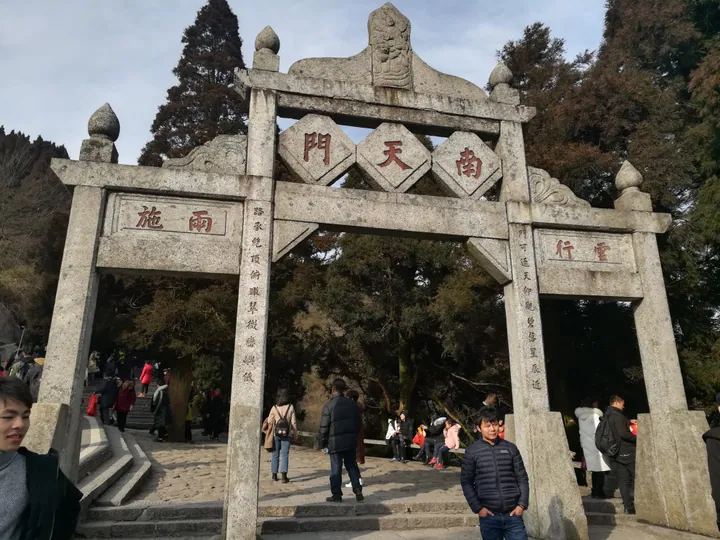
- The Heavenly Southern Gate (南天门) archway near the summit of Mount Heng, Nanyue District, Hengyang · 衡阳市南岳区衡山南天门Photo: Huangdan2060 · CC0 · taken 2018-02-23Resized for the web; the photo itself has not been edited. Thumbnails may show a cropped view.
