


Explore the region
About Jiuyi Mountain Mausoleum of Emperor Shun
Jiuyi Mountain Mausoleum of Emperor Shun (九嶷山舜帝陵) is the tomb and temple of Shun (舜), a ruler of Chinese legend, on Jiuyi Mountain (九嶷山) in Ningyuan County (宁远县), Yongzhou (永州), Hunan, 30 kilometres south of the county seat.
The mountain is named for nine peaks that look alike. The Records of the Grand Historian (史记) say that Shun died while touring the south, in the wilds of Cangwu (苍梧), and was buried at Jiuyi, the place called Lingling (零陵). His first tomb temple stood beside the Taiyang Stream (太阳溪); a Tang rebuilding of 738 was lost in the fighting at the end of the Yuan. In 1371 the temple moved to the foot of Shunyuan Peak (舜源峰), the first of the Jiuyi peaks, which was taken as the tomb mountain, so that tomb and temple became one site. It is one of the two Shun mausoleums in China.
Local people rebuilt the temple in 1506. An earthquake damaged it in 1555, Wu Yu (吴愈), magistrate of Anyi (安邑), rebuilt it in 1603, and a major earthquake in 1815 left only the main hall before another rebuilding in 1816. Fire destroyed the main hall in 1935 and the rear and worship halls in 1962. Hunan made it a provincial protected site in 1956, and from 1985 to the end of 1998 government funds and public donations paid for a full restoration that largely returned it to its early-Qing appearance. In 2019 the mausoleum was merged into the nationally protected Shun Temple Site (舜帝庙遗址).
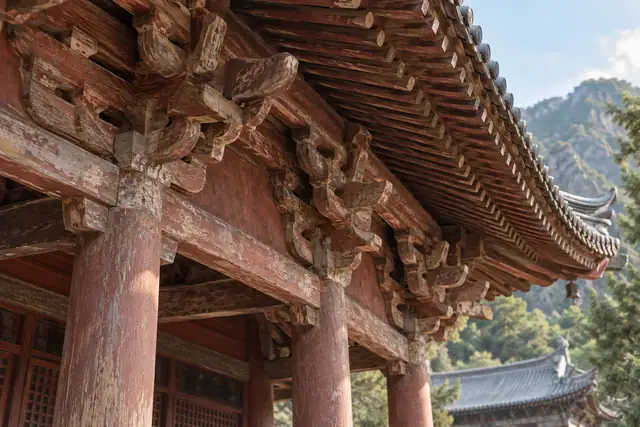
The restored complex spreads over more than 500 mu (亩), with over 40,000 square metres of buildings: a mountain gate, the Meridian Gate (午门), worship, main and rear halls, side halls, a stele house, and a spirit way with stone statues. Behind the temple a pavilion holds a stele carved in clerical script with "Tomb of Shun of the Youyu clan" (帝舜有虞氏之陵). Sacrifices here have a long record: the Tang emperor Xuanzong sent his official Zhang Jiuling (张九龄), imperial sacrifices were held 15 times under the Ming and 45 times under the Qing, and 30 Qing and four Republican-era sacrifice stelae survive at the tomb. The Shun sacrificial rite (舜帝祭典) entered the national intangible heritage list in 2011; it moves through welcome, procession, sacrifice, homage and tomb-visit ceremonies and ends with the unveiling of a stele bearing the prayer text.
What to look for
- Shunyuan Peak (舜源峰), first of the Jiuyi peaks and the tomb mountain since 1371
- Stele pavilion with the clerical-script inscription "Tomb of Shun of the Youyu clan" (帝舜有虞氏之陵)
- Meridian Gate (午门), worship hall and main hall, restored in 1985-1998 largely to their early-Qing appearance
- Spirit way lined with stone statues
- Thirty Qing and four Republican-era stelae recording sacrifices to Shun
- Shun sacrificial rite (舜帝祭典), national intangible heritage since 2011
Location & getting there
Getting to Jiuyi Mountain Mausoleum of Emperor Shun
- Search for 九嶷山舜帝陵 with 永州市 and 宁远县.
Find Jiuyi Mountain Mausoleum of Emperor Shun
九嶷山舜帝陵 · 宁远县
No reliable map pin yet: search by the Chinese name.
Sources & visit information
Written from the linked sources and fact-checked against them on 2026-09-23. Opening hours, admission and access arrangements are not covered; confirm current visitor information with the site.
Some facts checked against Wikipedia contributors, "九嶷山舜帝陵" · CC BY-SA 4.0.