

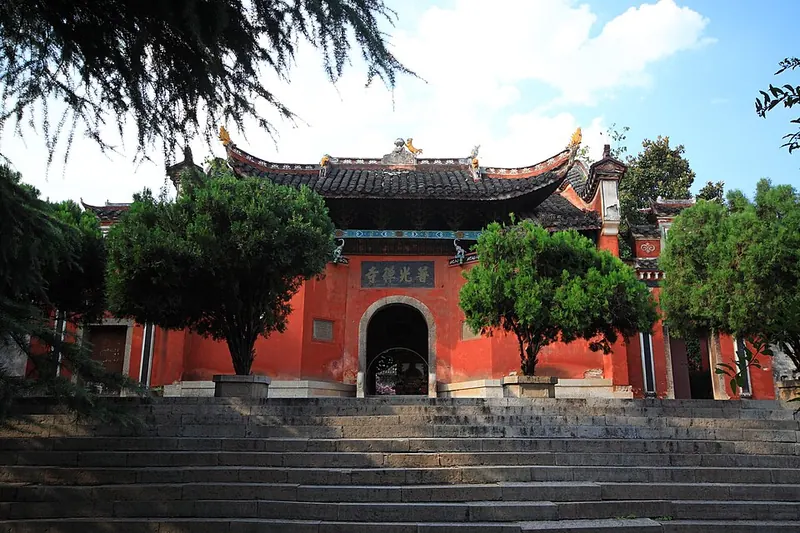
Photo adjustments
Full frame retained; proportionally resized and converted to WebP. No retouching or changes to the photographed subject. Card displays may crop the view.
Explore the region
About Zhangjiajie
Yongding is the city around the railway and airport connections and the urban Tianmen Mountain cableway station; Wulingyuan is the separate gateway to the sandstone-pillar landscape. A museum or temple stop in the city can fit around transfers, while the forest-park sectors deserve their own mountain days. Decide where to sleep from the entrance you will use next morning, rather than assuming every attraction bearing the Zhangjiajie name is close together.
The city is named after the Han-dynasty minister Zhang Liang (张良), who is said to have retreated into seclusion in the area. It was formerly called Dayong (大庸); in May 1985 the State Council approved converting Dayong County into a county-level city, and in May 1988 it was upgraded to a prefecture-level city. In April 1994 it was renamed Zhangjiajie because the name Dayong was far less well known than the Zhangjiajie National Forest Park within its territory, China's first national forest park.
Zhangjiajie lies in the heart of the Wuling Mountains in northwestern Hunan, bordering Changde and Huaihua prefectures, the Xiangxi autonomous prefecture, and Hubei's Enshi prefecture. The terrain is predominantly mountainous, with widespread limestone producing karst landforms, peak forests and caves; the Li River (澧水) crosses the area, joined by tributaries including the Rushui (溇水). Elevation ranges from 1,890.4 meters at the highest point to 75 meters at the lowest. The city covers 9,534 square kilometers, with a resident population of about 1.524 million, of whom over sixty percent are Tujia.
The sandstone peak-forest landscape of the Wulingyuan Scenic Area, within the city's territory, is considered rare worldwide and was inscribed by UNESCO as a World Natural Heritage Site in December 1992. Zhangjiajie is popularly known through the saying 'three thousand peculiar peaks, eight hundred clear waters' (奇峰三千,秀水八百).
What to look for
- The distinction between Tianmen Mountain’s city-side access and the Wulingyuan pillar landscape.
- Urban cultural stops that explain the region beyond its famous mountain photographs.
Location & getting there
Getting to Zhangjiajie
Check whether your train uses Zhangjiajie West or the older Zhangjiajie station, then arrange the transfer to Yongding or Wulingyuan. Choose the specific hotel and scenic entrance before booking the onward ride.
Combine your visit
A suggested order for exploring this place and its immediate setting.
-
City museum张家界市博物馆
Use an arrival-day visit for regional context.
-
Tianmen Mountain天门山
Plan a separate booked outing from its route-specific entrance.
-
Wulingyuan mountain days武陵源
Move to the appropriate gateway for the pillar-and-valley landscape.
Check access to the individual stops. A suggested sequence does not imply a combined ticket or guaranteed transfer.
Find Zhangjiajie overview
张家界 · 张家界市
The pin marks the area, not the entrance.
More places nearby
Approximate straight-line distances between map pins, not travel distances.
Puguang Chan Temple 普光禅寺
1 km awayPuguang Chan Temple is an older cultural stop within Zhangjiajie’s Yongding city centre. The surviving complex reflects more than a single Buddhist tradition, with the temple, martial shrine and Wenchang-related buildings…
View guide →Zhangjiajie Museum 张家界市博物馆
3 km awayZhangjiajie Museum links the region’s famous geology with its human and urban history. The ground-floor geological display provides a useful introduction to the landscape, while the upper historical galleries move through local…
View guide →Tianmen Mountain 天门山
7 km awayTianmen Mountain is defined by its enormous natural arch and cliff-edge paths above Zhangjiajie city. The mountain-top circuit, temple area and Tianmen Cave give it a different character from Wulingyuan’s sandstone pillars…
View guide →Sources & visit information
The sources below support the place-specific description and arrival information. Suggested combinations are editorial planning ideas; confirm current opening, entry arrangements and transport services for your date.
- Zhangjiajie ↗
- City museum — location and regional interpretation ↗
- Chinese Wikipedia: 张家界市 (revision 94240922, 2026-09-08) ↗
Visitor information adapted and edited from Wikipedia contributors: Zhangjiajie · CC BY-SA 4.0. Source revision 1337248890.
Background paragraphs translated and condensed from Wikipedia contributors, "张家界市", Chinese Wikipedia · CC BY-SA 4.0. Source revision 94240922.