

Explore the region
Tap any red Chinese text to hear it in Mandarin.
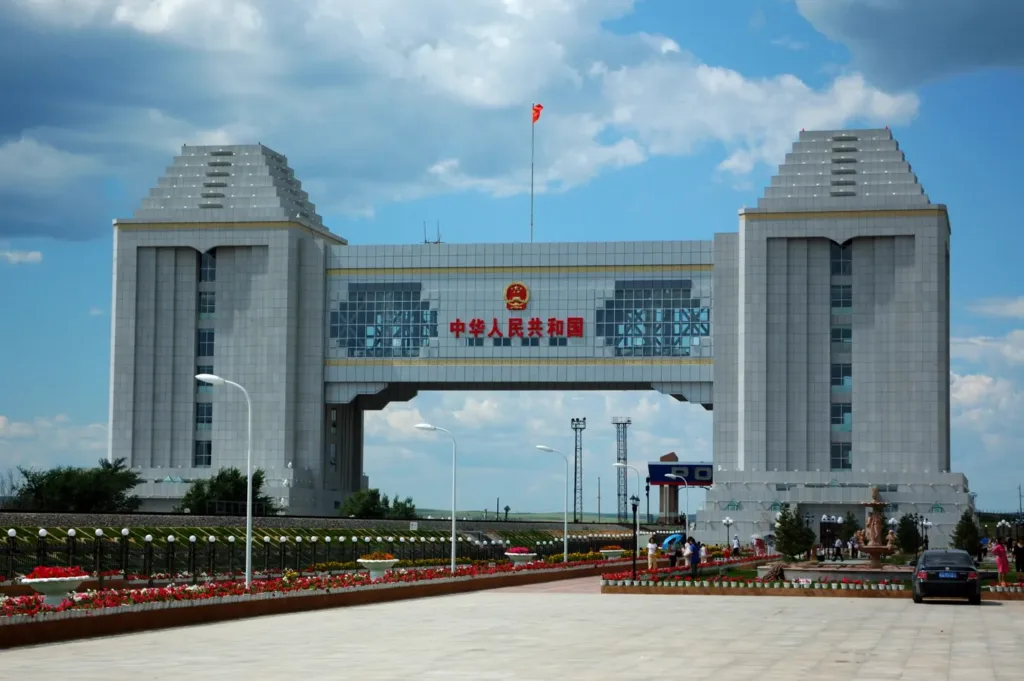
Manzhouli’s National Gate is a border-viewing attraction rather than a generic city monument. On the Chinese side of the frontier, the fifth-generation gate stands beside the railway corridor linking toward Russia, so the gate, tracks and border landscape read as one scene. At the administrative level, it belongs to the 5A China–Russia Border Tourist Area, but that larger area also includes the Matryoshka Tourist Area and the Beijiang Pearl Viewing Tower; do not treat the whole parent area as one compact attraction.
What to look for
Start with the gate and the railway setting, then find No. 41 Boundary Marker (41号界碑). The marker is the most literal point of the visit: it identifies the frontier within a managed public sightseeing route. The Ministry of Culture and Tourism also lists a replica of the fourth-generation National Gate, which gives the site a useful time-layered detail instead of leaving the visit as a single photo stop.
The surrounding displays make the place as much about twentieth-century movement as about the border structure itself. The city government lists the former red secret-transportation-line site, Peace Gate Square, Aircraft Square, Locomotive Square, the CPC Sixth National Congress Exhibition Hall and the Manzhouli Red Exhibition Hall among the scenic area’s attractions. A local educational route links the red-history displays with No. 41 Boundary Marker, the fifth-generation gate and the Sixth Congress exhibition hall.
The railway references matter here. The red secret line used the China Eastern Railway corridor through Manzhouli as an international route between China and the Soviet Union in the early twentieth century; the exhibition route uses that history to explain why this border town appears in the story of the Chinese Communist movement. Read the displays for that specific connection rather than expecting a general museum about all of Russia or all of border history.
A practical order is to begin with the red-history exhibition, continue to No. 41 Boundary Marker and the fifth-generation gate, and finish at the Sixth Congress exhibition hall if it is open. This follows the published educational route, not a promise that every indoor gallery or display will operate on every date.
Entry and border awareness
The public booking listing currently shows a winter schedule of 09:00–17:30 from 8 October to 30 April, with entry stopping at 17:00. It says online ticket sales stop at 16:00 and the on-site window at 17:00, while also warning that the day’s scenic-area notice takes priority. Treat these as a date-specific check, not a year-round timetable.
The same listing describes the scenic area as a military-management area and says visitors must carry an identity document for ticketing and identity verification. It does not explain how a foreign passport is handled. International visitors should contact the scenic area at 0470-6666666 before paying or setting out, and ask specifically whether a passport can be used for the public sightseeing route.
This is a sightseeing visit on the Chinese side, not a substitute for current border-crossing or immigration information. Stay on the signed public route around the marker and gate, follow staff instructions, and do not approach restricted operational areas or attempt to cross the boundary.
Getting there and back
From central Manzhouli, the current public listing gives city bus 6 from Beifang Market (北方市场) toward Guomen Scenic Area; get off at Guomen Scenic Area (国门景区). The listing marks this as reference information, so confirm the day’s service and the final walk at the stop rather than relying on an old timetable.
For a taxi or ride-hailing car, use the Chinese destination 满洲里国门景区 Mǎnzhōulǐ Guómén Jǐngqū and ask for the public scenic-area visitor and ticketing entrance. The sources consulted here do not establish a reliable street-number address, so check that the map result is the scenic area rather than a border-control facility. There is no metro route to add for this out-of-centre attraction.
The public listing gives the outbound bus direction but no dependable return timetable. Before entering, check whether the reverse-direction service is running that day; otherwise arrange a pickup from the scenic-area entrance using the same Chinese destination. Do not assume that a ticket, a map pin or a border crossing implies a guaranteed return connection.
Combine your visit
Suggested order within this visit:
-
National Gate viewing area
Begin with the gate and railway setting.
-
Boundary Monument No. 41
Read the frontier's physical marker from the public route.
-
Locomotive Square
Finish with the railway history represented by the displayed engine.
This sequence is an editorial suggestion based on the features described in the sources. Access to individual buildings or areas should be checked locally; no travel time or shared admission is implied.
Find Manzhouli National Gate Scenic Area
满洲里国门景区游客中心 · 呼伦贝尔
The pin marks the area, not the entrance.
More places nearby
Approximate straight-line distances between map pins, not travel distances.
Manzhouli Matryoshka Square 满洲里套娃广场
4 km awayManzhouli's Matryoshka complex turns the Russian nesting doll into architecture, scenery and entertainment. The giant doll-shaped hotel anchors a theme park whose buildings borrow Russian decorative forms. Inside, the Matryoshka…
View guide →Manzhouli Beihu Park 满洲里北湖公园
9 km awayBeihu Park is a small urban-lake retreat in northwestern Manzhouli. Its appeal comes from the water, planted edges and views back toward the surrounding city, rather than a long sightseeing checklist. A circuit along the…
View guide →Hulun Lake 呼伦湖
73 km awayHulun Lake spreads across a shallow basin in the western Hulunbuir grassland. Reeds and wetlands around its margins form important habitat, while the managed Xiaohekou visitor shore provides the familiar open-water view. The…
View guide →Sources & visit information
Sources checked on 1 November 2026. Hours, tickets, reservations and transport can change; confirm with the operator before you go.
Image credits & notes (1)
- The Manzhouli National Gate seen from the Chinese side, with the landscaped forecourt and the railway-border setting visible beyond. Photo: leon liPhoto: CC BY-SA 2.0