

Explore the region
Tap any red Chinese text to hear it in Mandarin.
Why visit
Yucheng Post Station makes the Grand Canal legible as working infrastructure rather than only a waterside view. Founded in 1375, it served as a government courier station in Gaoyou, the Yangzhou-administered city whose old name “Yucheng” comes from the poet Qin Guan’s image of his home town as an upturned bowl. The site sits in the old South Gate area, with Guanyi Lane and the canal forming the setting for the surviving buildings.
This was a water-and-land post. Its work included carrying official messages, receiving travelling officials, moving military clothing and other supplies, and escorting prisoners. At its busiest, records describe a large staff, courier boats and horses; the point of the visit is not the numbers but the way the compound connects administration, transport and everyday animal work. The Grand Canal itself was the empire’s inland communications and supply network and remains a UNESCO World Heritage property.
The station was founded under the Hongwu reign, burned in 1557 and rebuilt in 1568, with later repairs. China’s post stations were abolished in 1913; the site was identified in a 1985 cultural-relics survey and later repaired for public interpretation. It is now part of the Grand Canal World Heritage property and is listed by the venue as a national 4A tourist attraction and a national key protected cultural relic.
What to look for
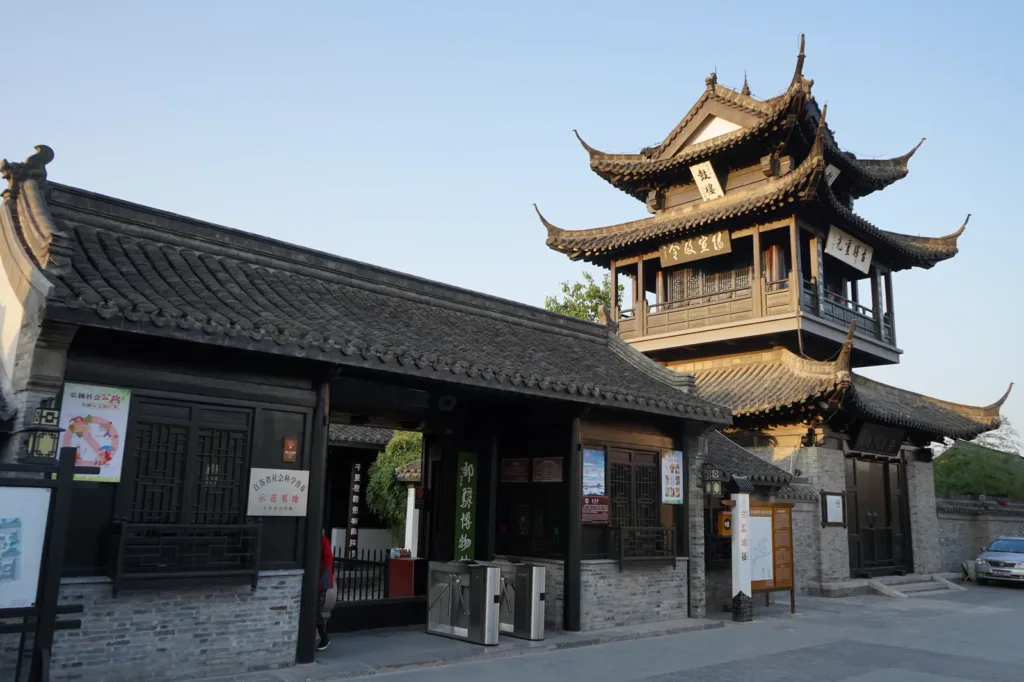
Start with the drum tower, the compound’s tallest landmark. Its elevated position once supported night watch, lookout and drum signals; the lower walls contain commemorative steles. The view is a useful reminder that the station was designed around movement and supervision, not just ceremony. Access to upper levels can change, so do not assume that the top floor is open on every visit.
Huanghua Hall, also known as the main or reception hall, is a five-bay Ming building associated with orders and official receptions. Zhujie Hall at the rear was used to receive officials and is described in the local account as the best-preserved building, with surviving Ming columns and beams. Read the two halls together: one expresses the post’s administrative role, the other its hospitality and lodging function.
Look also for the Horse God Temple and the life-size red-granite stone horse, then continue through the remaining post-station spaces rather than stopping at the gate. The official site identifies the core area, Guanyi Lane, Huanghua Archway, Liuyin Zen Grove, Mayintang and South Gate Street as the wider visitor setting. The canal lies immediately beyond the historic urban fabric, but the current site page does not publish a seasonal boat boarding point, so this is a walking visit rather than a promised boat excursion.
Location and getting there
The venue’s official site places Yucheng Post Station on South Gate Street in Guanyi Lane, Gaoyou, and publishes the consultation number 0514-84611979. A separate Chinese visitor-information page prints the street number as 13, so show the full Chinese destination to a driver: 盂城驿,江苏省扬州市高邮市南门外馆驿巷13号. Ask for the current visitor entrance at drop-off; the precise gate arrangement is not separately published on the official homepage.
Gaoyou has no applicable metro route for this visit. If you arrive by high-speed rail, check the ticket carefully: 高邮站 Gāoyóu Zhàn and 高邮北站 Gāoyóu Běi Zhàn are separate stations. The local railway station is integrated with the 高铁客运枢纽 Gāotiě Kèyùn Shūniǔ; from that hub, the operator lists 游15路 to the terminal stop 盂城驿 Yúchéng Yì. The same published route runs back towards the high-speed hub. The operator currently lists 07:00–17:00 service at 30-minute intervals, but check the day’s departure board before relying on those times.
For a city-bus alternative, 10路 runs between 高铁客运枢纽 and 高邮中学 and includes the stop 盂城驿 Yúchéng Yì. 游5路 includes 南门大街·盂城驿 Nánmén Dàjiē · Yúchéng Yì and 盂城驿·琵琶社区 Yúchéng Yì · Pípá Shèqū, which are useful when combining the post station with the old South Gate area. For the return journey, use the signed stop in the opposite direction rather than crossing to an unmarked roadside position. For an intercity coach arrival, confirm the terminal and onward connection separately; no direct current coach connection is published on the local operator page.
Tickets and timing
The official venue homepage links to a reservation service but does not publish a current ticket price, opening schedule or passport-specific booking rule on the page read for this guide. A separate visitor-information page lists CNY 30 and 08:30–17:30; because that page has no visible publication date or clear operator attribution, treat those figures as a lead rather than a current guarantee. Contact the venue or use its booking link before setting out, especially if you need a passport-based reservation or want to visit near closing time.
Find Yucheng Post Station
盂城驿 · 高邮市
The pin marks the area, not the entrance.
Sources & visit information
Sources checked on 24 October 2026. Hours, tickets, reservations and transport can change; confirm with the operator before you go.
- Yucheng Post Station official site ↗
- Gaoyou Passenger Transport bus information ↗
- Gaoyou Yucheng Postal Stop ↗
- Yucheng Post Station in Gaoyou ↗
- Gaoyou Yucheng Post Station and the Grand Canal ↗
- Yucheng Post Station in retrospect ↗
- The Grand Canal ↗
- Yucheng Post Station visitor information ↗
- Gaoyou Railway Station ↗
Image credits & notes (1)
- The street-facing entrance of Yucheng Post Station in Gaoyou, with the drum tower rising above the tiled gate. Photo: HuanokinhejoPhoto: CC BY-SA 4.0