

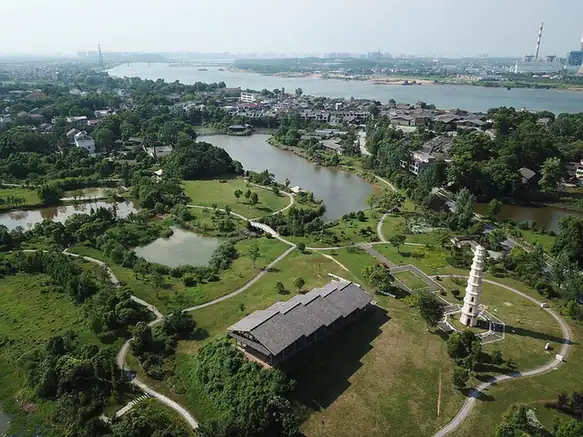
Explore the region
About Jizhou Kiln Site
Jizhou Kiln Site (吉州窑遗址) is the ancient pottery-making ground at Yonghe Town (永和镇) in Ji'an County (吉安县), Jiangxi, about 8 km south of the city of Ji'an (吉安). The kilns take their name from Jizhou (吉州), the name Ji'an carried from the Sui to the Song.
Yonghe is listed as a Chinese Historic and Cultural Town (中国历史文化名镇). The national intangible-heritage register describes the site as one of the well-preserved famous ancient kiln sites in China, with 24 complete kiln mounds (窑包) still standing. The State Council placed the Jizhou Kiln Site, dated to the Song and Yuan, on the fifth list of Major Historical and Cultural Sites Protected at the National Level on 25 June 2001.
The same register dates the craft from the late Tang, growing in the Five Dynasties, peaking in the Southern Song and declining after the Yuan. Chinese Wikipedia names five kiln families, Shu, Chen, Guo, Zhou and Xie, and says the pieces of Shu Weng (舒瓮) were the most famous, while his daughter Shu Jiao (舒娇) worked with even more skill. In 1974 the Jiangxi Provincial Cultural Relics Commission made a trial dig at Yonghe that turned up Southern Song pieces fired upside-down and, in deeper layers, Northern Song qingbai (青白瓷) porcelain. A local saying, "先有永和镇,后有景德镇" ("first came Yonghe, then Jingdezhen"), is quoted in the register, which adds that Jizhou wares were traded abroad in the Song and Yuan.
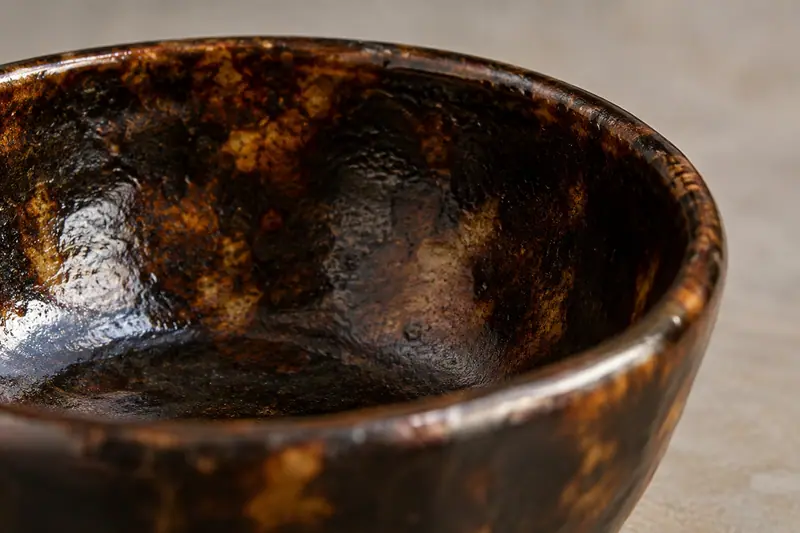
Jizhou is best known for simple stoneware shapes under dark glazes, which in the Song enjoyed high standing among Buddhist monks and tea drinkers. Their papercut decoration began in the Southern Song: a paper pattern was stuck either on the bare body or on an iron-rich first glaze, a glaze was laid over it, and the paper was then peeled off so the design showed in a contrasting colour. For leaf bowls, a real leaf appears to have been soaked in glaze and set in the vessel, then burnt away in the kiln, often leaving only its skeleton. Named glaze effects include partridge-feather (鹧鸪斑), hare's-fur (兔毫纹), tiger-skin (虎皮斑) and tortoiseshell (玳瑁斑). The register credits Jizhou's underglaze painted wares with some influence on the rise of blue-and-white porcelain. The Jizhou firing technique entered the fourth national intangible-heritage list in 2014 as item VIII-215.
What to look for
- The 24 surviving kiln mounds (窑包) at Yonghe, a site on the national protection list since 2001
- Yonghe Town (永和镇), a Chinese Historic and Cultural Town
- Papercut-resist bowls, with patterns reserved in a contrasting glaze
- Leaf bowls, where a burnt-away leaf leaves its skeleton in the glaze
- Partridge-feather, hare's-fur, tiger-skin and tortoiseshell glaze effects
Location & getting there
Getting to Jizhou Kiln Site
- Search for 吉州窑遗址 with 吉安市 and 吉安县.
Find Jizhou Kiln Site
吉州窑遗址 · 吉安县
No reliable map pin yet: search by the Chinese name.
Sources & visit information
Written from the linked sources and fact-checked against them on 2026-09-23. Opening hours, admission and access arrangements are not covered; confirm current visitor information with the site.
- 吉州窑陶瓷烧制技艺 - 中国非物质文化遗产网·中国非物质文化遗产数字博物馆 - 中国非物质文化遗产网非遗 ↗
- 第五批全国重点文物保护单位 - 维基百科,自由的百科全书 ↗
- 吉州窑 - 维基百科,自由的百科全书 ↗
- Jizhou ware - Wikipedia ↗
- 永和镇 (吉安县) - 维基百科,自由的百科全书 ↗
Some facts checked against Wikipedia contributors, "第五批全国重点文物保护单位" · CC BY-SA 4.0.
Some facts checked against Wikipedia contributors, "吉州窑" · CC BY-SA 4.0.
Some facts checked against Wikipedia contributors, "Jizhou ware" · CC BY-SA 4.0.
Some facts checked against Wikipedia contributors, "永和镇 (吉安县)" · CC BY-SA 4.0.
Image credits & notes (1)
- Jizhou Kiln Site · 吉州窑遗址Photo: Zhangzhugang · CC BY-SA 4.0Resized for the web; the photo itself has not been edited.
