

Photo adjustments
Wikimedia thumbnail; fitted to the ranking-card frame.
Explore the region
About Lushan
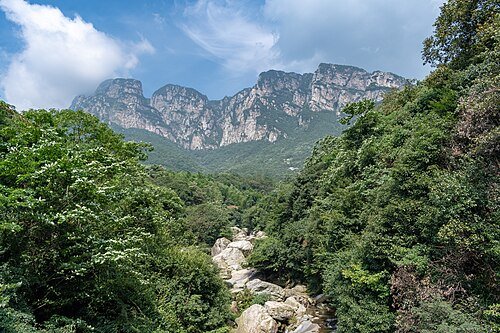
Around Guling, historic villas recall its development as a summer retreat, while the Flower Path and Jinxiu Valley introduce a more intimate landscape of wooded paths and steep rock scenery. The mountain’s attractions are spread across several routes; choose a coherent section instead of assuming that every named sight belongs to one walk.
The name Lushan is first attested in the Records of the Grand Historian (史记); no earlier written record survives. According to local tradition, the name honours a recluse named Kuang Su (匡俗), whose secluded dwelling on the mountain gave it the name Lushan. In 126 BC the Han historian Sima Qian visited and recorded climbing the mountain in that same text, the earliest confirmed written use of the name.
After the Qing defeat in the Second Opium War led to Jiujiang's opening as a treaty port in 1860, Western merchants began arriving in the area, and in 1884 Russian merchants took over Lushan's Jiufeng Temple (九峰寺) as a summer retreat. The British missionary Li Bode (李德立) leased land at Guniuling (牯牛岭) in 1885 and, after the Qing defeat in the First Sino-Japanese War in 1895, secured an official 999-year lease with British government backing, laying the ground for the later resort town.
Lushan National Park has been a UNESCO World Heritage Site since 1996 and is also a UNESCO Global Geopark; it is designated a national 5A tourist attraction (国家5A级旅游景区). Formed during the Quaternary glaciation as a horst-type fault-block range, its highest peak, Hanyang Peak (汉阳峰), reaches 1,474 metres.
What to look for
- The Flower Path’s literary landscape near the highland resort area.
- Jinxiu Valley’s rocky slopes and changing mountain views.
Location & getting there
Getting to Lushan
For the highland core, use the north or south visitor-transfer centre and continue on the scenic transport system, or use the Lushan transport cableway from its lower station. Jiujiang and Lushan railway stations connect with different approaches; choose the gateway before booking the final transfer.
Combine your visit
A suggested sequence linking the specific features of this visit.
-
Flower Path
Begin with the landscaped setting associated with Bai Juyi.
-
Jinxiu Valley
Continue to the rock scenery on the same western sightseeing side of the mountain.
This order is editorial. Confirm access and any transfers between stops; it does not establish a walking route, same-day connection or common admission ticket.

Find Lushan
庐山 · 九江市
The pin marks the area, not the entrance.
More places nearby
Approximate straight-line distances between map pins, not travel distances.
Sandie Spring Waterfall 庐山三叠泉瀑布
4 km awaySandiequan drops down three rock steps below Lushan’s Wulao Peaks. The water first falls sharply, spreads across the intermediate ledges and gathers again before reaching the lower pool. Different rock layers and erosion created…
View guide →White Deer Grotto Academy 白鹿洞书院
6 km awayWhite Deer Grotto Academy occupies a wooded hollow below Lushan’s Wulao peaks. Its courtyards bring together spaces for Confucian ritual and study: Lisheng Hall honours Confucius, while Minglun Hall recalls the teaching…
View guide →Donglin Temple (Jiangxi) 东林寺
6 km awayDonglin Temple lies at Lushan’s northwestern foot and is closely associated with Huiyuan and the Pure Land Buddhist tradition. The present complex includes a main Buddha hall and smaller commemorative spaces set among wooded…
View guide →Sources & visit information
The sources below support the place-specific description and arrival information. Suggested combinations are editorial planning ideas; confirm current opening, entry arrangements and transport services for your date.
- Mount Lu ↗
- www.lushan.gov.cn ↗
- Jiujiang ↗
- Chinese Wikipedia: 庐山 (revision 93487028, 2026-07-15) ↗
- English Wikipedia: Mount Lu (revision 1373320715, 2026-09-05) ↗
Visitor information adapted and edited from Wikipedia contributors, “Mount Lu” · CC BY-SA 4.0. Source revision 1373320715.
Visitor information adapted and edited from Wikivoyage contributors, listing “Lushan” · CC BY-SA 4.0.
Background paragraphs translated and condensed from Wikipedia contributors, "庐山", Chinese Wikipedia · CC BY-SA 4.0. Source revision 93487028.
Background paragraphs condensed from Wikipedia contributors, "Mount Lu", English Wikipedia · CC BY-SA 4.0. Source revision 1373320715.