

Explore the region
About Qingyuan Mountain Jingju Temple
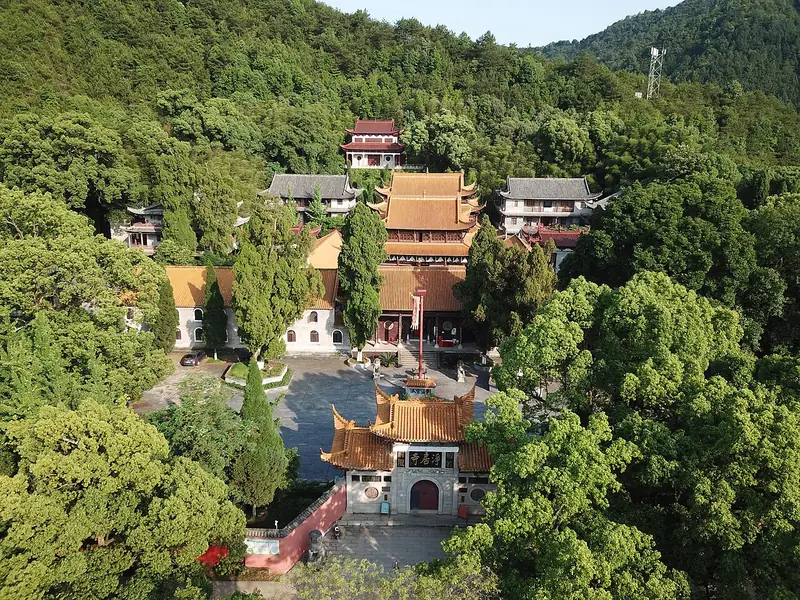
Xingsi received the teaching of the Sixth Patriarch Huineng at Nanhua Temple in Caoxi and afterwards returned to Qingyuan Mountain, where he opened the mountain and founded the monastery more than 1,300 years ago, in the early Tang. Monks gathered around him and the Qingyuan line of Chan took shape; he is honoured as the Seventh Patriarch, and the temple is known as the house of the Seventh Patriarch in Jiangxi. The Caodong, Yunmen and Fayan schools all branched from this line and are together called the Caoxi school, and a stele in the temple courtyard carries those two words, 'Caoxi zongpai', in an inscription attributed to the Ming philosopher Wang Yangming about five hundred years ago. During the Land Revolution period the abbot Gaoguang supported Mao Zetan and others in setting up a rear hospital of the First Front Army in the temple, where more than 1,300 wounded were treated and which Mao Zedong visited.
The monastery has been repaired and rebuilt since 1984. The bell and drum towers, guest hall, patriarch hall, meditation hall and mountain gate were rebuilt, the Vairocana Pavilion was reconstructed, the Mahavira Hall and the Hall of the Heavenly Kings were overhauled, old stone inscriptions were conserved and the Qingyuan stupa court was built, with the whole-body relic stupa of the monk Tiguang at its highest point. Vegetable plots worked by monks and lay residents still lie inside and outside the walls and supply the temple kitchen, continuing the Chan tradition of combining farming with practice. The temple sits inside the Qingyuan Mountain scenic area, which is planned over 19.4 square kilometres with 87 per cent forest cover and a main peak of 316 metres; the Jingju Temple zone is its core, covering 3.3 square kilometres, and the Song poet Yang Wanli is quoted for the phrase that calls this the finest landscape in Jiangxi.
What to look for
- The stele in the courtyard inscribed 'Caoxi zongpai', attributed to Wang Yangming
- The Mahavira Hall and the Hall of the Heavenly Kings, overhauled in the restoration work
- The Vairocana Pavilion, rebuilt during the same programme of works
- The Qingyuan stupa court, with the whole-body relic stupa of the monk Tiguang at its highest point
- The monastery's vegetable plots, worked by monks and lay residents for the temple kitchen
Location & getting there
Getting to Qingyuan Mountain Jingju Temple
Check which interiors and courtyards are accessible. Active places of worship and protected monuments may have different visitor rules.
- Search for 青原山净居寺 with 吉安市 and 青原区.
Find Qingyuan Mountain Jingju Temple
青原山净居寺 · 青原区
No reliable map pin yet: search by the Chinese name.
Sources & visit information
The linked sources support the identity and background described in this introduction. Opening hours, admission, activity availability and exact arrival arrangements have not been comprehensively checked. Confirm current visitor information with the venue; the original catalogue locality and editorial review flag are retained.
Image credits & notes (1)
- Qingyuan Mountain Jingju Temple (青原山净居寺), Qingyuan District. Photograph: "Ji".Photo: Zhangzhugang · CC BY-SA 4.0Resized for the web; the photo itself has not been edited. Thumbnails may show a cropped view.
