

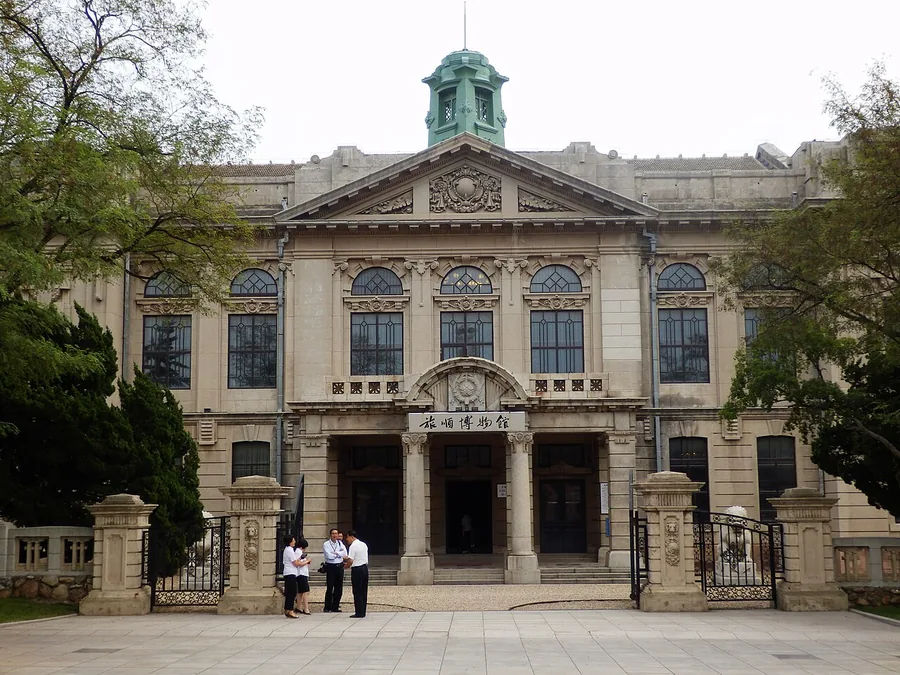
Photo adjustments
Proportionally resized and converted to WebP without cropping, retouching or changing the photographed subject.
Explore the region
About Lüshun Museum
Xinjiang material and the museum's ceramics, enamels and snuff bottles give the collections a wider reach than the immediate port district. The architecture itself is part of the visit, reflecting the institution's early twentieth-century origins and later changes. Choose a few currently open collection rooms rather than expecting every historic gallery description to match the day's display.
The museum was established in 1915 during the Japanese occupation of Dalian, initially as the Manchu-Mongol Products Exhibition Hall (满蒙物产陈列所) in the former Lüshun branch of the Russo-Chinese Bank (俄清银行旅顺分行). Work on its present building began in 1917 on the foundations of a planned Russian officers' assembly hall. The museum moved into the completed building in 1918 and took its current name, Lüshun Museum (旅顺博物馆), in 1934.
The museum reopened in 1972 and was rated a national first-grade museum (国家一级博物馆) in 2008. The museum holds more than 60,000 objects, chiefly relics from Dalian and Xinjiang together with historical art, arranged across twenty galleries, including collections of ceramics and mummies, the last including specimens collected by Kozui Otani during expeditions to Central Asia between 1901 and 1910.
The building, constructed in a Renaissance-eclectic style, is a Major Historical and Cultural Site Protected at the National Level (国家重点文物保护单位); a China-Soviet Friendship Tower (中苏友谊纪念塔) stands in the square in front of it, surrounded by cherry trees. The museum has organised research publications since 1988 and has collaborated with Japan's Ryukoku University (龙谷大学), and in June 2006 the Dalian Institute of Historical Relics (大连市历史文物研究所) was formally established, sharing its premises and taking part in the national Qing history compilation project.
What to look for
- The historic main building and its European architectural composition.
- The museum's Xinjiang and decorative-art collections, including ceramics, enamels or snuff bottles where displayed.
The surrounding area
Southern coastal city base with a specific waterfront focus around Xinghai Bay, Xinghai Square and selected Binhai Road walking sections. The Changshan Islands require an additional island travel plan.
Location & getting there
Getting to Lüshun Museum
Use 42 Liening Street in Lüshunkou District for the main museum. Confirm which building houses your chosen exhibition before visiting, as the museum has several associated sites.
Combine your visit
Suggested order within this visit:
-
Main-building exterior
Read the institution's architectural setting.
-
Xinjiang collection displays
Explore one of its distinctive collecting areas.
-
Decorative-art galleries
Compare ceramics, enamels or snuff bottles from the current display.
This sequence is an editorial suggestion based on the features described in the sources. Access to individual buildings or areas should be checked locally; no travel time or shared admission is implied.

Find Lüshun Museum
旅顺博物馆 · 大连市
The pin marks the area, not the entrance.
More places nearby
Approximate straight-line distances between map pins, not travel distances.
Baiyu Mountain Scenic Area 旅顺白玉山
1 km awayBaiyu Mountain rises above central Lüshun and gives a clear view of the port's confined setting. Its summit tower was erected by Japan after the Russo-Japanese War and is now interpreted in the context of the occupation. That…
View guide →Lüshun Russo-Japanese Prison 旅顺日俄监狱旧址
3 km awayFormer prison museum documenting Russian and Japanese occupation. Closed for heritage conservation from 17 October 2025; no verified reopening date was found. Confirm reopening before travelling for an interior visit.
View guide →Lüshun Submarine Museum 旅顺潜艇博物馆
3 km awayLüshun Submarine Museum is organised around a retired Type 033 submarine on the Huangjinshan shore. The boat is the principal object, supported by retired land, sea and air equipment and simulated submarine experiences. These…
View guide →Sources & visit information
The sources below support the place-specific description and arrival information. Suggested combinations are editorial planning ideas; confirm current opening, entry arrangements and transport services for your date.
- Wikipedia: 旅顺博物馆 ↗
- Wikivoyage: Dalian/Lüshunkou ↗
- English Wikipedia: Lüshun Museum (revision 1363328570, 2026-07-09) ↗
Visitor information adapted and edited from Wikipedia contributors · CC BY-SA 4.0. Source revision 94052228.
Visitor information adapted and edited from Wikivoyage contributors · CC BY-SA 4.0.
Background paragraphs translated and condensed from Wikipedia contributors, "旅顺博物馆", Chinese Wikipedia · CC BY-SA 4.0. Source revision 94052228.
Background paragraphs condensed from Wikipedia contributors, "Lüshun Museum", English Wikipedia · CC BY-SA 4.0. Source revision 1363328570.