

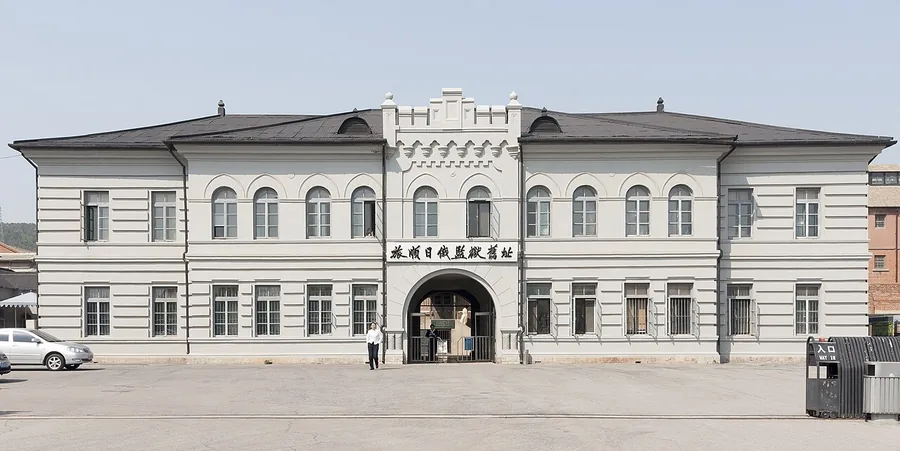
Photo adjustments
Proportionally resized and converted to WebP without cropping, retouching or changing the photographed subject.
Explore the region
About Lüshun Russo-Japanese Prison
Its interpretation includes Chinese and Korean prisoners and opponents of Japanese rule, with An Jung-geun among the people associated with the site. These are historical spaces with a difficult human context rather than a conventional architectural attraction. A conservation closure began on 17 October 2025; a reopening announcement had not been verified when this guide was checked.
The prison was built by the Russian Empire in 1902, with an office building and 85 brick cells, and briefly served as a field hospital during the Russo-Japanese War of 1904-05. Japan expanded it from November 1907 to 253 cells, adding wards and workshops, before its dissolution in August 1945. Reportedly close to 20,000 people were held there between 1906 and 1936, and about 700 were executed between 1942 and August 1945.
The compound is enclosed by a red-brick wall 4 metres high and 725 metres long, with 275 cells that could hold more than 2,000 prisoners, plus body-search, interrogation and execution rooms and workshops using prisoner labour. Grey-brick cells at the centre date from the Russian period, with red-brick sections added by Japan in 1907; the grounds, covering 226,000 square metres in total, also held a kiln, forestry plots, orchards and vegetable fields.
It reopened as a public exhibition hall in July 1971 and was designated a Major Historical and Cultural Site Protected at the National Level (全国重点文物保护单位) in 1988, in the third such listing. In October 2009 an exhibition on the Korean independence activist An Jung-geun (安重根), held there for five months before his execution, opened within the museum.
What to look for
- The preserved cell blocks and workshops, which show imprisonment and forced labour within the same complex.
- The historical interpretation associated with An Jung-geun and other prisoners, when the museum reopens.
The surrounding area
Southern coastal city base with a specific waterfront focus around Xinghai Bay, Xinghai Square and selected Binhai Road walking sections. The Changshan Islands require an additional island travel plan.
Location & getting there
Getting to Lüshun Russo-Japanese Prison
The site is at 139 Xiangyang Street in Lüshunkou District. Confirm an official reopening announcement before travelling specifically to enter; the published conservation closure remains unresolved in this research.
Combine your visit
Conditional sequence for a future confirmed reopening:
-
Cell-block interpretation
Understand the prison's layout and prisoner experience.
-
Workshop and historical-person displays
Connect the spaces with forced labour and individual lives.
This sequence is an editorial suggestion based on the features described in the sources. Access to individual buildings or areas should be checked locally; no travel time or shared admission is implied.
Find Lüshun Russo-Japanese Prison
旅顺日俄监狱旧址 · 大连市
The pin marks the area, not the entrance.
More places nearby
Approximate straight-line distances between map pins, not travel distances.
Baiyu Mountain Scenic Area 旅顺白玉山
2 km awayBaiyu Mountain rises above central Lüshun and gives a clear view of the port's confined setting. Its summit tower was erected by Japan after the Russo-Japanese War and is now interpreted in the context of the occupation. That…
View guide →Lüshun Museum 旅顺博物馆
3 km awayLüshun Museum brings together archaeological and decorative-art collections in a historic European-style museum building. Xinjiang material and the museum's ceramics, enamels and snuff bottles give the collections a wider reach…
View guide →Lüshun Submarine Museum 旅顺潜艇博物馆
3 km awayLüshun Submarine Museum is organised around a retired Type 033 submarine on the Huangjinshan shore. The boat is the principal object, supported by retired land, sea and air equipment and simulated submarine experiences. These…
View guide →Sources & visit information
The sources below support the place-specific description and arrival information. Suggested combinations are editorial planning ideas; confirm current opening, entry arrangements and transport services for your date.
- Wikipedia: 旅顺监狱旧址 ↗
- Liaoning cultural tourism department: prison site and address ↗
- Peninsula Morning News: prison museum conservation closure from 17 October 2025 ↗
- English Wikipedia: Lüshun Russo-Japanese Prison (revision 1300318875, 2025-07-13) ↗
Visitor information adapted and edited from Wikipedia contributors · CC BY-SA 4.0. Source revision 93354626.
Background paragraphs translated and condensed from Wikipedia contributors, "旅顺监狱旧址", Chinese Wikipedia · CC BY-SA 4.0. Source revision 93354626.
Background paragraphs condensed from Wikipedia contributors, "Lüshun Russo-Japanese Prison", English Wikipedia · CC BY-SA 4.0. Source revision 1300318875.