

Photo adjustments
Proportionally resized and converted to WebP without cropping, retouching or changing the photographed subject.
Explore the region
About Hushan Great Wall
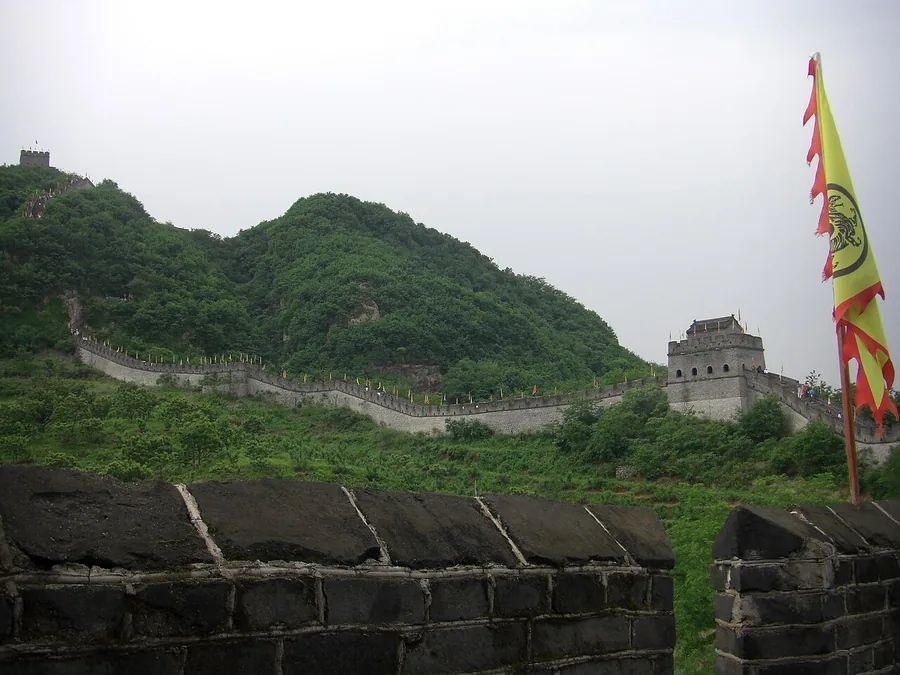
The height above the surrounding plain provides a clear sense of why this border position mattered. Much of the visible wall is modern restoration, so distinguish it from the archaeological remains that informed the reconstruction. The upper watchtower and river views are the main objectives; a complete circuit should not be assumed, because the lower return walkway has had closures.
Hushan was originally called Ma'er Mountain, and the wall here, recorded as the 'old border wall' (老边墙), was first built in the fifth year of the Ming Chenghua era (1469) at the foot of the hill, part of the Ming dynasty's border defenses running from the Yalu River east to Jiayuguan in the west, built to guard against the rising Jurchen people and raiders from the sea. By the late Ming the area had come under the actual control of the Later Jin; after the Battle of Sarhu the wall was destroyed as a military stronghold blocking the Later Jin, and once the Qing had entered the pass it lost its military purpose and was abandoned.
The hill lies at the confluence of the Yalu River and its tributary, the Ai River (叆河), about 20 kilometers from central Dandong, and faces North Korea across the water. It covers an area of about 4 square kilometers, with the main peak rising to 146.3 meters amid otherwise flat surrounding terrain. In 2013 the wall was listed as a Major Historical and Cultural Site Protected at the National Level (全国重点文物保护单位), grouped with other Great Wall sites in the fifth such batch.
What to look for
- The restored wall's steep ascent and watchtower sequence.
- Views over the Yalu–Ai river landscape from the permitted upper lookout.
The surrounding area
Eastern border-city base for Yalu riverfront history and a different coastal-border food repertoire.
Location & getting there
Getting to Hushan Great Wall
Go to Hushan Village in Hushan Town, Kuandian Manchu Autonomous County, northeast of Dandong.
- Confirm the return route before climbing; the lower walkway was reported closed in 2025 and should not be treated as a guaranteed loop.
Combine your visit
Suggested order within this visit:
-
Lower restored wall
Start by distinguishing restoration from surviving archaeological context.
-
Upper watchtower viewpoint
Read the river plain and hilltop position, then return by the route confirmed open.
This sequence is an editorial suggestion based on the features described in the sources. Access to individual buildings or areas should be checked locally; no travel time or shared admission is implied.

Find Hushan Great Wall
虎山长城 · 丹东市
The pin marks the area, not the entrance.
More places nearby
Approximate straight-line distances between map pins, not travel distances.
Jinjiangshan Park 丹东锦江山公园
15 km awayJinjiangshan Park rises above central Dandong, combining wooded paths with pavilions overlooking the city and Yalu River. The main gate provides a formal approach, while Jinjiang Pavilion and the higher Shuguang Pavilion give…
View guide →Yalu River Broken Bridge 鸭绿江断桥
16 km awayThe Yalu River Broken Bridge preserves the Chinese-side spans of an early twentieth-century crossing damaged during the Korean War. Its steel structure and surviving piers make the interruption in the bridge physically clear…
View guide →Memorial of the War to Resist US Aggression and Aid Korea 抗美援朝纪念馆
17 km awayDandong's Korean War memorial presents China's participation through historical galleries, a commemorative tower and an outdoor equipment collection. The museum's official Chinese perspective is part of its interpretation and…
View guide →Sources & visit information
The sources below support the place-specific description and arrival information. Suggested combinations are editorial planning ideas; confirm current opening, entry arrangements and transport services for your date.
Visitor information adapted and edited from Wikipedia contributors · CC BY-SA 4.0. Source revision 89744400.
Visitor information adapted and edited from Wikivoyage contributors · CC BY-SA 4.0.
Background paragraphs translated and condensed from Wikipedia contributors, "虎山长城", Chinese Wikipedia · CC BY-SA 4.0. Source revision 89744400.