

Photo adjustments
Proportionally resized and converted to WebP without cropping, retouching or changing the photographed subject.
Explore the region
About Chengtian Temple Pagoda
The original monument belonged to the Western Xia period, while the standing tower was rebuilt in 1820 after an earthquake destroyed its predecessor. Its layered eaves and raised base provide a compact architectural visit within the old city. The former provincial museum grounds here should not be confused with today’s Ningxia Museum in Jinfeng.
The pagoda was built in 1050, during the infancy of Emperor Yizong, commissioned by the empress dowager (没藏皇后) to protect his reign and to house pieces of the Buddha's skull bone in an underground chamber; a commemorative stele records the exact date. The temple was completed five years later, and in 1055 received a set of the Tripitaka from the Song emperor Renzong. By the Ming Hongwu era the temple had already been destroyed, leaving only the pagoda; the Ming prince Zhu Zhan (朱栴) undertook its renovation, completed by his grandson Zhu Suikan (朱邃坎) in 1469.
A major earthquake struck near Yinchuan in 1738 and destroyed the pagoda; the present tower, rebuilt in 1820, kept the same scale and largely preserved the Western Xia style. In 1939, Japanese bombing killed 42 people sheltering in an air-raid shelter on the temple grounds, though the pagoda itself was undamaged. The pagoda was listed as a Major Historical and Cultural Site Protected at the National Level (全国重点文物保护单位) in 2006.
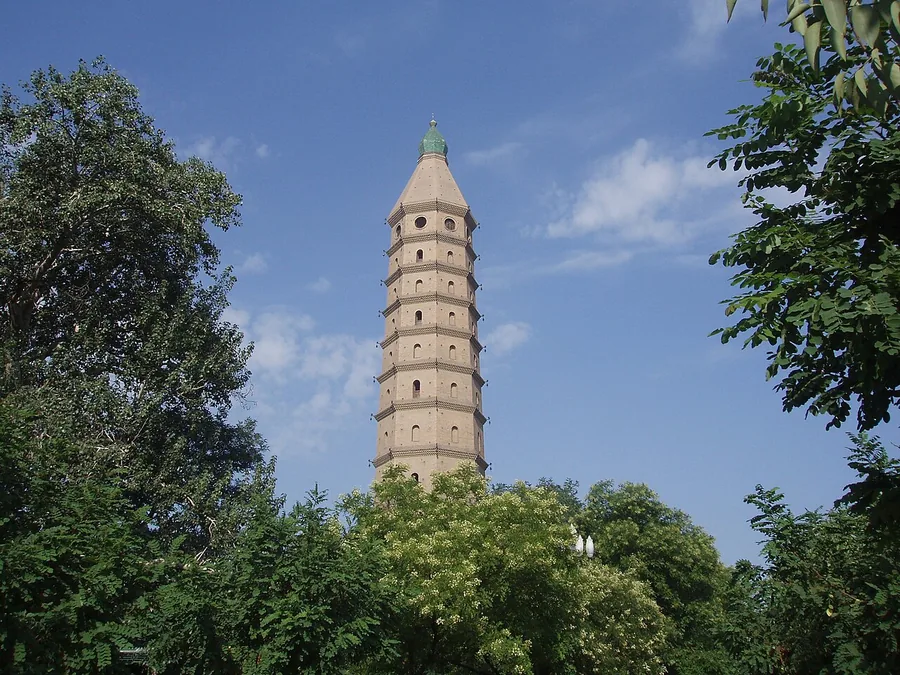
Although the pagoda appears to have thirteen storeys from outside, it actually contains eleven. Each storey's eaves carry an iron bell at its corners, the roof is built of green glazed brick, and the pagoda is topped not by a canopy but by a large octagonal, peach-shaped green finial.
What to look for
- An octagonal brick body rises through eleven storeys.
- The raised base and layered eaves preserve the form of the rebuilt pagoda.
Background & history
The Pagoda of Chengtian Temple (Chinese: 承天寺塔; pinyin: Chéngtiānsì Tǎ), meaning 'Bearing Heaven Pagoda', is an eleven-storeyed brick pagoda located on the site of a previous Buddhist temple in Yinchuan city, Ningxia, China. The pagoda was originally built during the Western Xia, but the current structure dates to the Qing dynasty. At 64.5 metres (212 ft) in height it is the tallest pagoda in Ningxia. In contrast to the Haibao Pagoda in Yinchuan, which is known as the Northern Pagoda, Chengtian Temple Pagoda is also informally referred to as the Western Pagoda (Chinese: 西塔; pinyin: Xī Tǎ).
Excerpt from Wikipedia: Pagoda of Chengtian Temple · Wikipedia contributors · CC BY-SA 4.0. Selected introductory sentences; formatting simplified. Background information, not current visitor-service advice.
Location & getting there
Getting to Chengtian Temple Pagoda
Navigate to Chengtian Temple/Western Pagoda in Yinchuan’s Xingqing old-city area. Check whether the courtyard and tower interior are open separately; the presence of historic internal stairs does not guarantee climbing access.
Combine your visit
Choose from these complementary stops when planning your visit.
-
Temple courtyard承天寺塔院
See the tower within its historic grounds.
-
Pagoda exterior承天寺塔外观
Look at the brickwork and eaves.
-
Ningxia Museum宁夏博物馆
For the provincial collection, make a separate journey to Jinfeng.
This is a suggested combination, not a timed route; confirm the opening and transport arrangements for your date.
Find Chengtian Temple Pagoda
承天寺塔 · 银川
The pin marks the area, not the entrance.
More places nearby
Approximate straight-line distances between map pins, not travel distances.
Yinchuan Drum Tower 银川鼓楼
1 km awayYinchuan’s Drum Tower stands at a crossroads in the historic city centre. Its masonry base has passages on four sides, with a timber tower and multiple rooflines above. The present monument reflects successive rebuilding and…
View guide →Yinchuan Jade Emperor Pavilion 银川玉皇阁
1 km awayYinchuan’s Yuhuang Pavilion rises above a tall masonry platform in the old city. A passage through the base connects the streets, while the timber buildings above create a compact sequence of layered roofs. Bell and drum…
View guide →Yinchuan Zhongshan Park 银川中山公园
1 km awayZhongshan Park is a long-established public park in northwestern Xingqing, with shaded paths, water and several historic features. Wenchang Pavilion and the bell pavilion around Yinhu give the landscape more character than a…
View guide →Sources & visit information
The linked encyclopedia sources support background and place descriptions. Current opening hours, ticket prices, booking rules and transport schedules have not been independently verified for this guide. Confirm them with the venue or operator before travelling.
- Pagoda of Chengtian Temple — Wikipedia geographic and historical reference ↗
- Chinese Wikipedia: 承天寺塔 (revision 86856425, 2025-04-16) ↗
- English Wikipedia: Pagoda of Chengtian Temple (revision 1368260319, 2026-08-08) ↗
Geographic and historical facts selectively adapted from Wikipedia contributors, Pagoda of Chengtian Temple · CC BY-SA 4.0. Source revision 1368260319.
Background paragraphs translated and condensed from Wikipedia contributors, "承天寺塔", Chinese Wikipedia · CC BY-SA 4.0. Source revision 86856425.
Background paragraphs condensed from Wikipedia contributors, "Pagoda of Chengtian Temple", English Wikipedia · CC BY-SA 4.0. Source revision 1368260319.