

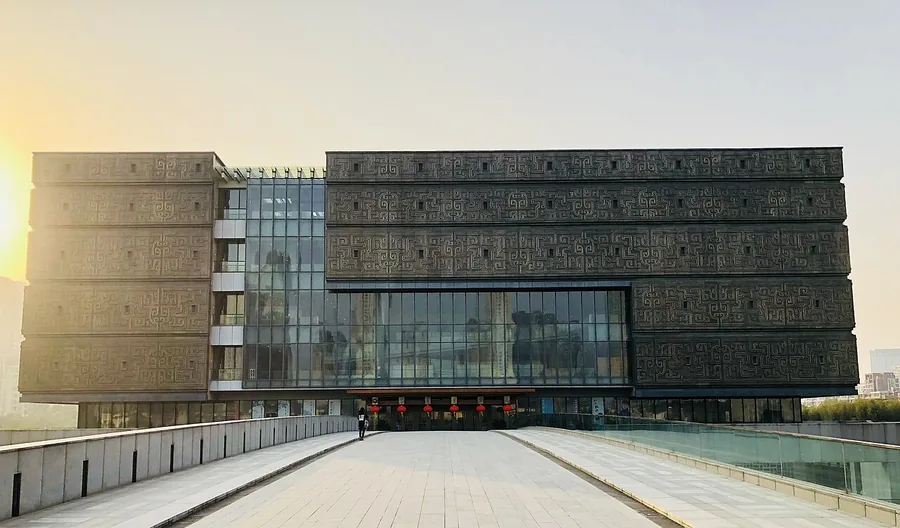
Photo adjustments
Proportionally resized and converted to WebP without cropping, retouching or changing the photographed subject.
Explore the region
About Anhui Museum
The large Zhuke ding, often called the Chu Great Ding, is a defining object in the collection; bronze bells and other ritual vessels broaden the story. Galleries also explore Huizhou culture and the province’s later history. The older Luyang branch remains a separate museum building, so choose the exhibitions and branch together before setting out.
The museum's predecessors were the Hefei Science Museum and the Wanbei Cultural Relics Management Committee, both established in Hefei soon after the People's Republic was founded, together with the Wuhu Science Museum and the Wannan Cultural Relics Museum in Wuhu. These institutions merged on 23 April 1953 to form the preparatory office of the Anhui Provincial Museum. An 11,580-square-meter exhibition building begun in August 1954 was completed in February 1956, and the Anhui Provincial Museum formally opened that November. It was renamed Anhui Museum (安徽博物院) on 28 December 2010, and the new Shushan branch opened on 29 September 2011.
The Luyang branch (庐阳馆), the original museum built in 1956, stands at 268 Anqing Road in Luyang District and covers about 70 mu (亩); its exhibition building is designated a Major Historical and Cultural Site Protected at the National Level (全国重点文物保护单位) under the name 'Anhui Provincial Museum Exhibition Building'. The Shushan branch (蜀山馆), the newer building, is located at 87 Huaining Road in Shushan District and has a floor area of 41,000 square meters. The museum holds close to 220,000 cultural relics.
What to look for
- The Chu Great Ding and the collection of ritual bronzes.
- The Shushan galleries on Anhui’s ancient civilisation and Huizhou culture.
Location & getting there
Getting to Anhui Museum
The Shushan branch is at No 87 Huaining Road, approached from Shengbowuyuan metro station. The separate Luyang branch is at No 268 Anqing Road. Use the branch name and current exhibition listing to avoid the incorrect Huaining Road number repeated in some references.
Combine your visit
A suggested sequence linking the specific features of this visit.
-
Ancient Anhui civilisation galleries
Establish the archaeological sequence behind the collections.
-
Jianghuai bronze displays
Study ritual vessels and musical objects from the region.
-
Huizhou culture galleries
Continue into the province’s later artistic and social traditions.
This order is editorial. Confirm access and any transfers between stops; it does not establish a walking route, same-day connection or common admission ticket.
Find Anhui Museum
安徽博物院 · 合肥市
The pin marks the area, not the entrance.
More places nearby
Approximate straight-line distances between map pins, not travel distances.
Dashu mountain 大蜀山
6 km awayDashu is an isolated wooded hill on Hefei’s western side, standing apart from the much flatter city around it. The summit television tower is a useful landmark, and clear weather opens views across the expanding urban landscape…
View guide →Lord Bao Park 包公园
9 km awayLord Bao Park commemorates Bao Zheng through buildings set around a central lake. In the shrine, the main hall’s statues and inscribed plaques present the official’s later reputation for upright judgment. The tomb complex gives…
View guide →Xiaoyaojin Park 逍遥津公园
10 km awayXiaoyaojin occupies the remembered setting of an old river crossing in central Hefei. Its association with the Three Kingdoms battle is marked by an equestrian statue of Zhang Liao, but the everyday scene is a lake park with…
View guide →Sources & visit information
The sources below support the place-specific description and arrival information. Suggested combinations are editorial planning ideas; confirm current opening, entry arrangements and transport services for your date.
Visitor information adapted and edited from Wikipedia contributors, “安徽博物院” · CC BY-SA 4.0. Source revision 94169549.
Background paragraphs translated and condensed from Wikipedia contributors, "安徽博物院", Chinese Wikipedia · CC BY-SA 4.0. Source revision 94169549.