

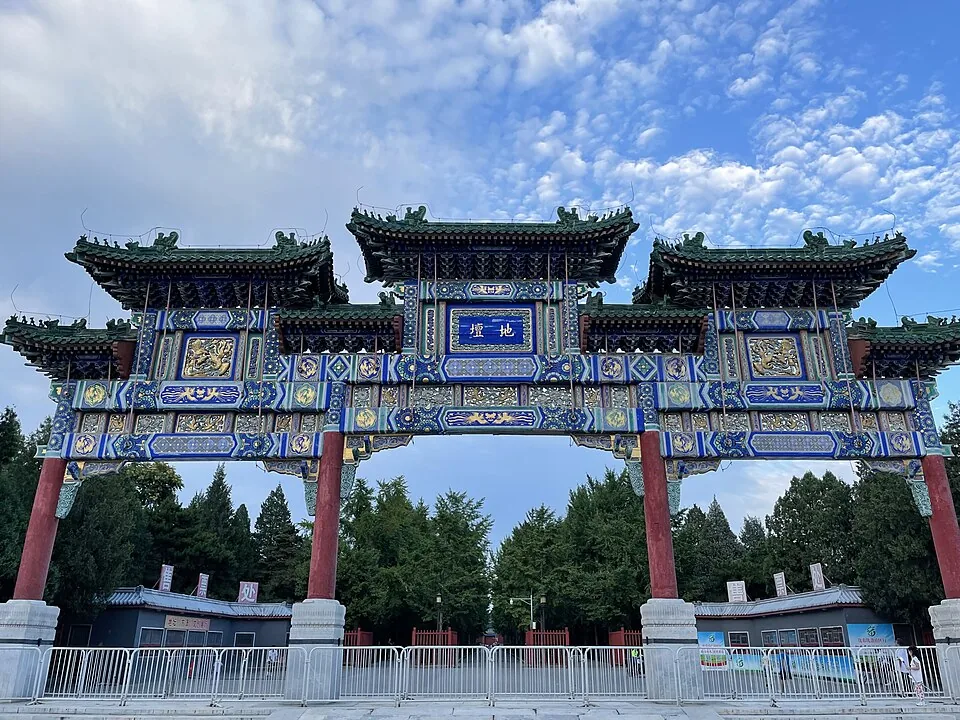
Photo adjustments
Converted to WebP and resized without changing the subject or cropping the source frame.
Explore the region
About Temple of Earth
Its central Fangze Altar uses a square plan to express the traditional association between the earth and that shape, contrasting with the circular forms of the Temple of Heaven. Built for imperial sacrifices, the ritual complex sits within a larger park of trees and paths. Give the altar and its surrounding ceremonial buildings their own attention before continuing into the landscaped grounds; the park and the historic ritual enclosure offer different experiences.
The temple was built in 1530, during the Jiajing era of the Ming dynasty, and covered 37.4 hectares; it is also called the Fangze Altar (方泽坛). It stands east of Andingmen, facing the Temple of Heaven, with the Yonghe Temple (雍和宫), the Confucius Temple (孔庙) and the Imperial Academy (国子监) across the river. The emperor personally performed sacrifices to the earth god each year on the summer solstice; the last was carried out by proxy in 1911. After the 1923 Tokyo earthquake, the deposed emperor Puyi opened the grounds to raise relief funds for Japan, and the site became a public park in 1925, was later renamed, fell derelict, and was restored as Ditan Park in 1957.
The Fangze Altar, the temple's main structure, is a two-tiered square platform of brick and stone facing north, surrounded by a moat that gives it its name; its lower tier once held the spirit tablets of mountains, ranges, seas and rivers during the ceremony. A bell tower built in 1530 was dismantled in 1965 and rebuilt to its original form in 2000. Restoration of the historic buildings began in 1981, and the site was designated a Major Historical and Cultural Site Protected at the National Level on 25 May 2006.
What to look for
- Fangze Altar: examine the square platform and enclosing geometry associated with sacrifices to the Earth.
- Ceremonial buildings: look for the Imperial Respecting House and the supporting sacrificial structures along the complex’s axis.
Location & getting there
Getting to Temple of Earth
Use Ditan Park in the Andingmen area as the arrival destination. It lies beyond the Second Ring Road, north of Yonghe Temple.
- If combining it with Yonghe Temple, check the street crossing around the ring road rather than treating the two compounds as adjoining courtyards.
Combine your visit
Suggested order within this visit:
-
Fangze Altar
Begin with the square ritual platform that explains the site’s purpose.
-
Ceremonial buildings
Read the supporting architecture in relation to the altar.
-
Ditan park paths
Finish in the tree-lined grounds outside the concentrated ritual area.
This sequence is an editorial suggestion based on the features described in the sources. Access to individual buildings or areas should be checked locally; no travel time or shared admission is implied.
Find Temple of Earth
地坛 · 东城区
The pin marks the area, not the entrance.
More places nearby
Approximate straight-line distances between map pins, not travel distances.
Yonghe Temple 雍和宫
Less than 1 km awayYonghe Temple, also called the Lama Temple, began as a Qing prince’s residence and later became a Tibetan Buddhist monastery. That history is visible in the procession of courtyards and major halls along a north–south axis…
View guide →Guozijian 国子监
Less than 1 km awayBeijing Guozijian was the imperial academy and education-administration center of the Yuan, Ming, and Qing periods. It stands immediately west of the Temple of Confucius, joining formal learning with the ritual honoring of the…
View guide →Temple of Confucius, Beijing 北京孔庙
Less than 1 km awayBeijing’s Temple of Confucius occupies a sequence of enclosed courtyards beside the imperial academy on Guozijian Street. Xianshi Gate, Dacheng Gate, Dacheng Hall, and Chongsheng Temple organize the main axis, while the…
View guide →Sources & visit information
The linked encyclopedia sources support background and place descriptions. Current opening hours, ticket prices, booking rules and transport schedules have not been independently verified for this guide. Confirm them with the venue or operator before travelling.
Visitor information adapted and edited from Wikipedia contributors · CC BY-SA 4.0. Source revision 1373270234.
Background paragraphs translated and condensed from Wikipedia contributors, "地坛", Chinese Wikipedia · CC BY-SA 4.0. Source revision 92021261.