

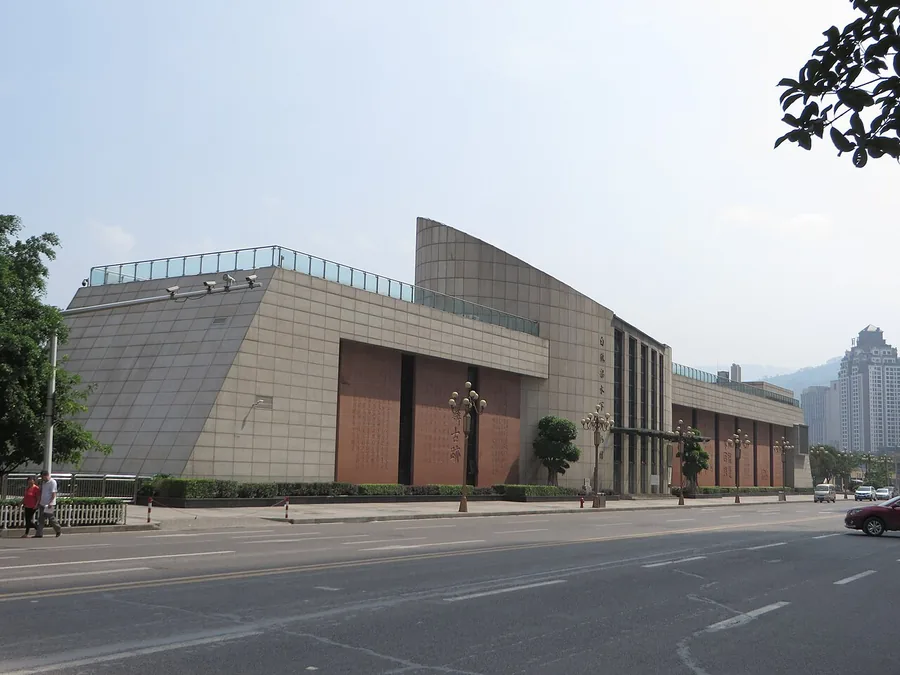
Photo adjustments
Proportionally resized and converted to WebP without cropping, retouching or changing the photographed subject.
Explore the region
About Baiheliang Underwater Museum
Many record historic low-water conditions, turning the riverbed into a long environmental archive. The museum combines above-water interpretation with an underwater corridor, where viewing windows face the protected original rock. Begin with the records and rubbings upstairs before descending, so the inscriptions seen through the water have a clearer meaning. Underwater access depends on the museum’s operating arrangements.
The inscriptions at Baiheliang date back to the Guangde era of the Tang dynasty (764); the surviving carvings span from the fourth year of the Northern Song Kaibao era (971) to 1963, recording 72 low-water levels over 1,200 years. In 1994, as the Three Gorges Dam threatened to submerge the ridge permanently, academician Ge Xiurun (葛修润) proposed protecting it as an underwater museum built as a 'pressureless vessel' (无压容器); the plan was endorsed in 2002 by a Chongqing expert panel and the National Cultural Heritage Administration, and construction began on 13 February 2003, taking six years.
The technique seals the carvings in a chamber filled with filtered river water to balance internal and external pressure, an approach more stable and cheaper than an earlier 'crystal palace' design. Visitors descend by a 91-metre escalator to the viewing area, about 40 metres below the river surface, pass a 150-metre corridor on the Yangtze's fish and boat culture, and reach a 60-metre circular corridor with 23 windows overlooking the submerged ridge.
The museum is administered by the Chongqing China Three Gorges Museum (重庆中国三峡博物馆). It is designated a national 4A tourist attraction, a National Water-Regime Education Base (全国水情教育基地) and a National Science Popularization Education Base (全国科普教育基地). UNESCO has recognised it as the world's first underwater heritage-site museum reachable without diving.
What to look for
- Rubbings and interpretation explain the ridge’s historic water-level records.
- Underwater viewing windows reveal the protected original stone inscriptions.
Background & history
The Baiheliang Underwater Museum or White Crane Ridge Underwater Museum (simplified Chinese: 白鹤梁水下博物馆; traditional Chinese: 白鶴梁水下博物館) is an underwater museum built around the White Crane Ridge of Fuling District, Chongqing. It is China's first underwater museum. The museum is located on the Yangtze River in the Three Gorges area, near the Three Gorges Dam; it opened on May 18, 2009. The construction of the museum began in 2002 and has cost around US$28 million. The main architect was Ge Xiurun of the Institute of Rock and Soil Mechanics and the Chinese Academy of Sciences. Baiheliang (literally meaning the "White Crane Ridge") is an archeological site in northern Fuling District that has since been submerged underwater due to the building of the Three Gorges Dam. The museum displays centuries-old inscriptions recording changes in the water level of the Yangtze River for around 1,200 years. The site consists of a stone ridge that is 1,600 meters by 15 meters in size. It is now submerged under 43 meters of water.
Excerpt from Wikipedia: Baiheliang Underwater Museum · Wikipedia contributors · CC BY-SA 4.0. Selected introductory sentences; formatting simplified. Background information, not current visitor-service advice.
Location & getting there
Getting to Baiheliang Underwater Museum
The museum is at 185 Binjiang Avenue, Section 2, in Fuling district. Arrange a local road arrival at the riverfront museum entrance and confirm access to the underwater route before booking the visit.
Combine your visit
Suggested order for the visit:
-
Above-water interpretation
Understand the water-level records.
-
Rubbings and inscription displays
Look at the forms of the writing and carved marks.
-
Underwater corridor
View the original ridge where access is operating.
This is an editorial sequence of named spaces or places. It does not imply a verified walking connection or promise opening, ticket availability or a journey time.
Find Baiheliang Underwater Museum
白鹤梁水下博物馆 · 涪陵
The pin marks the area, not the entrance.
More places nearby
Approximate straight-line distances between map pins, not travel distances.
816 Nuclear Plant 816地下核工程
21 km awayThe 816 site at Baitao is an unfinished underground nuclear-industrial project now interpreted through a managed visitor route. Long passages open into very large chambers, including the reactor hall and former control room…
View guide →Changshou Lake 长寿湖
26 km awayChangshou Lake is a reservoir landscape dotted with islands and bordered by planted visitor areas. The west-bank attractions combine lake views with local longevity themes, including Baishou Garden and the memorial garden…
View guide →Fengdu Ghost City 丰都鬼城
38 km awayFengdu Ghost City climbs Ming Mountain through temples and sculptural scenes inspired by Chinese ideas of the afterlife. The three-arched Bridge of Helplessness, demon figures at Ghost-Torturing Pass and Tianzi Palace form a…
View guide →Sources & visit information
The sources below support the place-specific description and arrival information. Suggested combinations are editorial planning ideas; confirm current opening, entry arrangements and transport services for your date.
- Baiheliang Underwater Museum ↗
- Wikivoyage: Fuling ↗
- Chongqing Civil Affairs: Baiheliang museum visit ↗
- Three Gorges Museum: Baiheliang venue address ↗
- Chinese Wikipedia: 白鹤梁水下博物馆 (revision 93758972, 2026-08-03) ↗
Visitor information adapted and edited from Wikipedia contributors, “Baiheliang Underwater Museum” · CC BY-SA 4.0. Source revision 1286052783.
Visitor information adapted and edited from Wikivoyage contributors, Fuling · CC BY-SA 4.0. Source revision 5256992.
Background paragraphs translated and condensed from Wikipedia contributors, "白鹤梁水下博物馆", Chinese Wikipedia · CC BY-SA 4.0. Source revision 93758972.