

Photo adjustments
Proportionally resized and converted to WebP without cropping, retouching or changing the photographed subject.
Explore the region
About Fengdu Ghost City
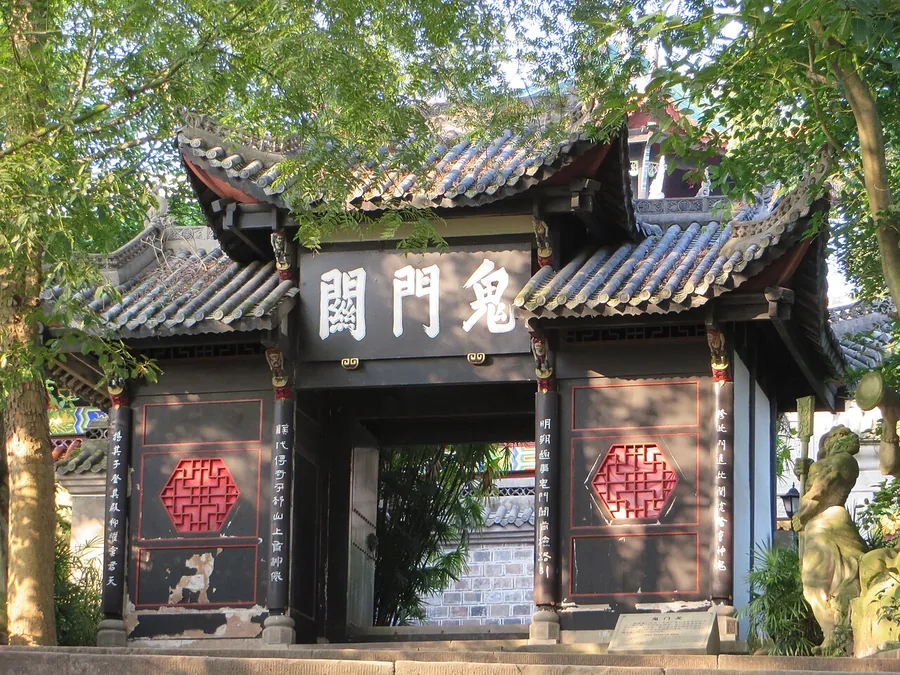
The three-arched Bridge of Helplessness, demon figures at Ghost-Torturing Pass and Tianzi Palace form a sequence of symbolic judgement. Treat these as religious and cultural imagery, with legends explained by the site interpretation. The mountain setting involves changes of level; choose the operating access route before beginning the ascent.
Fengdu Ghost City is also known as Youdu (幽都) and as 'China's home of the Divine Comedy'. Its afterlife theme combines Confucian, Taoist and Buddhist beliefs and is referenced in classic Chinese literature, including Journey to the West, Investiture of the Gods and Strange Tales from a Chinese Studio. According to local tradition, the site is where the Emperor Fengdu (酆都大帝) and the Ten Kings of the underworld govern the dead.
The site's temples and structures also include the Heng-Ha Shrine (哼哈祠), the City of Unjust Death (枉死城), the Yellow Springs Road (黄泉路), the Terrace for Gazing at One's Homeland (望乡台) and the Hall of the Medicine King (药王殿), each representing a different part of the underworld theme running through the complex.
After the Three Gorges Dam raised the level of the Yangtze, the site became separated from the Fengdu county seat, which was subsequently rebuilt on higher ground on the river's south bank. Fengdu Ghost City remains a stop for river cruise boats bringing visitors up the mountain.
What to look for
- The Bridge of Helplessness has three stone arches and an associated afterlife legend.
- Ghost-Torturing Pass and Tianzi Palace contain the complex’s judgement imagery and major temple spaces.
Background & history
Fengdu Ghost City (simplified Chinese: 丰都鬼城; traditional Chinese: 豐都鬼城; pinyin: Fēngdū Guǐ Chéng, originally 酆都鬼城) is a large complex of shrines, temples and monasteries dedicated to the afterlife located on the Ming mountain, in Fengdu County, Chongqing municipality, China. It is situated about 170 kilometres (110 mi) downstream of Chongqing on the north bank of the Yangtze River.
Excerpt from Wikipedia: Fengdu Ghost City · Wikipedia contributors · CC BY-SA 4.0. Selected introductory sentences; formatting simplified. Background information, not current visitor-service advice.
Location & getting there
Getting to Fengdu Ghost City
Use the Ming Mountain scenic-area entrance on the north bank of the Yangtze in Fengdu. Visitors arriving with a river cruise should follow that operator’s dock-to-site transfer; independent visitors need a road arrival at the mountain entrance.
Combine your visit
Suggested order for the visit:
-
Bridge of Helplessness
Begin with the symbolic river crossing.
-
Ghost-Torturing Pass
Observe the sculptural judgement scenes.
-
Tianzi Palace
Finish at the principal temple space.
This is an editorial sequence of named spaces or places. It does not imply a verified walking connection or promise opening, ticket availability or a journey time.
Find Fengdu Ghost City
丰都鬼城 · 丰都
The pin marks the area, not the entrance.
More places nearby
Approximate straight-line distances between map pins, not travel distances.
Baiheliang Underwater Museum 白鹤梁水下博物馆
38 km awayBaiheliang preserves inscriptions carved into a natural stone ridge in the Yangtze at Fuling. Many record historic low-water conditions, turning the riverbed into a long environmental archive. The museum combines above-water…
View guide →816 Nuclear Plant 816地下核工程
42 km awayThe 816 site at Baitao is an unfinished underground nuclear-industrial project now interpreted through a managed visitor route. Long passages open into very large chambers, including the reactor hall and former control room…
View guide →Fairy Mountain 仙女山
43 km awayFairy Mountain combines broad upland meadow with dense woodland above Wulong. The Great Grassland is the signature scene: low rolling ground and open pasture framed by forest, very different from the deep karst pits elsewhere in…
View guide →Sources & visit information
The sources below support the place-specific description and arrival information. Suggested combinations are editorial planning ideas; confirm current opening, entry arrangements and transport services for your date.
- Fengdu Ghost City ↗
- Wikivoyage: Fengdu ↗
- Chinese Wikipedia: 丰都鬼城 (revision 92542037, 2026-05-05) ↗
- English Wikipedia: Fengdu Ghost City (revision 1361227761, 2026-06-26) ↗
Visitor information adapted and edited from Wikipedia contributors, “Fengdu Ghost City” · CC BY-SA 4.0. Source revision 1361227761.
Visitor information adapted and edited from Wikivoyage contributors, Fengdu · CC BY-SA 4.0. Source revision 5257083.
Background paragraphs translated and condensed from Wikipedia contributors, "丰都鬼城", Chinese Wikipedia · CC BY-SA 4.0. Source revision 92542037.
Background paragraphs condensed from Wikipedia contributors, "Fengdu Ghost City", English Wikipedia · CC BY-SA 4.0. Source revision 1361227761.