

Photo adjustments
Proportionally resized and converted to WebP without cropping, retouching or changing the photographed subject.
Explore the region
About Dazu Rock Carvings
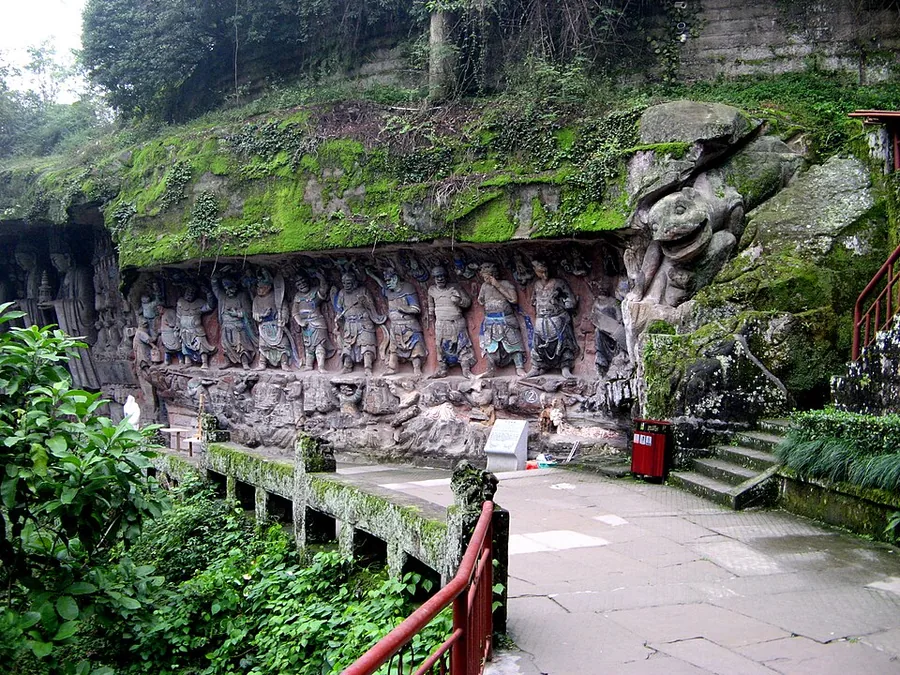
At Baodingshan, a long sequence of reliefs follows a curved valley; Beishan provides another major concentration of carved niches and figures. The appeal lies in the changing subjects and the way the sculpture uses the rock face. Choose one main site first, adding a second only with a planned road transfer.
Carving began in the Tang dynasty in 650 AD, continued through the late Tang and Five Dynasties period, and reached its height in the Song dynasty, with further additions in the Ming and Qing dynasties. The Baodingshan (宝顶山) carvings, northeast of Dazu, were begun in 1179, in the Southern Song Chunxi era (淳熙), by the monk Zhao Zhifeng (赵智凤), and took more than 70 years to complete. The Beishan (北山) carvings, north of Dazu, were begun in the late Tang Jingfu era (景福), in 892 and were not finished until 1146, a process spanning more than 250 years.
At Beishan, the southern section consists mostly of late Tang and Five Dynasties work, while the northern section is largely from the Song dynasty. More than 4,600 carved images survive, and the site contains 264 niches and caves. At Baodingshan, the carvings are centred on Dafowan (大佛湾), one of thirteen sites in the group. Baodingshan and Beishan were each listed as a Major Historical and Cultural Site Protected at the National Level (全国重点文物保护单位) in 1961. The wider Dazu carvings were closed to visitors for many years, opening to Chinese travellers in 1961 and foreign visitors in 1980.
What to look for
- Baodingshan’s valley walls carry large narrative reliefs and religious figures.
- Beishan offers a separate concentration of sculpted niches for comparison.
Background & history
The Dazu Rock Carvings (Chinese: 大足石刻; pinyin: Dàzú Shíkè) are a series of Chinese religious sculptures and carvings and UNESCO World Heritage Site located in Dazu District, Chongqing, China. The carvings date back as far as the 7th century AD, depicting and influenced by Buddhist, Confucian and Taoist beliefs. Some are in rock-cut cave shrines, in the usual Chinese Buddhist style, but many others are rock reliefs carved into the open rock faces. Listed as a World Heritage Site in 1999, the Dazu Rock Carvings are made up of 75 protected sites containing some 50,000 statues, with over 100,000 Chinese characters forming inscriptions and epigraphs. The sites are located in Chongqing Municipality within the steep hillsides throughout Dazu District, located about 165 kilometers west of the urban area of Chongqing. The highlights of the rock grotto are found on Mount Baoding and Mount Beishan.
Excerpt from Wikipedia: Dazu Rock Carvings · Wikipedia contributors · CC BY-SA 4.0. Selected introductory sentences; formatting simplified. Background information, not current visitor-service advice.
Location & getting there
Getting to Dazu Rock Carvings
For Baodingshan, arrive at the Dazu Rock Carvings Visitor Centre and use its managed uphill visitor transport. The institute’s route then leads through the museum towards Dafowan. Beishan is a separate site requiring its own arrival plan.
Combine your visit
Suggested order for the visit:
-
Dazu Rock Carvings Museum
Begin with the context for the sculpture.
-
Baodingshan’s Dafowan
Follow the main carved valley.
-
Beishan, if planned separately
Compare another group after a road transfer.
This is an editorial sequence of named spaces or places. It does not imply a verified walking connection or promise opening, ticket availability or a journey time.
Find Dazu Rock Carvings
大足石刻 · 大足
The pin marks the area, not the entrance.
More places nearby
Approximate straight-line distances between map pins, not travel distances.
Dazu Baodingshan carvings 大足宝顶山石刻
11 km awayBaodingshan’s Great Buddha Bend follows a curved rock face with connected reliefs that read like a long visual narrative. Large devotional images alternate with scenes about conduct, suffering and spiritual practice. The…
View guide →Wanling Ancient Town 万灵古镇
24 km awayWanling, formerly Lukong, steps down towards the Laixi River through a stone-paved trading street. Its immigrant associations are visible in Huguang Guild Hall, where a shrine, meeting rooms and a stage served newcomers from…
View guide →Tea Mountain Bamboo Sea · Niwu Viewpoint 茶山竹海·霓雾观景台
38 km awayNiwu is a named lookout in Yongchuan's Tea Mountain and Bamboo Sea, a forest landscape where tea cultivation and extensive bamboo groves share the slopes. The viewpoint belongs to a wider network of places including Tianbao…
View guide →Sources & visit information
The sources below support the place-specific description and arrival information. Suggested combinations are editorial planning ideas; confirm current opening, entry arrangements and transport services for your date.
- Dazu Rock Carvings ↗
- Dazu Rock Carvings Research Institute: visitor route ↗
- Chinese Wikipedia: 大足石刻 (revision 93422445, 2026-07-11) ↗
- English Wikipedia: Dazu Rock Carvings (revision 1365860000, 2026-07-24) ↗
Visitor information adapted and edited from Wikipedia contributors, “Dazu Rock Carvings” · CC BY-SA 4.0. Source revision 1365860000.
Background paragraphs translated and condensed from Wikipedia contributors, "大足石刻", Chinese Wikipedia · CC BY-SA 4.0. Source revision 93422445.
Background paragraphs condensed from Wikipedia contributors, "Dazu Rock Carvings", English Wikipedia · CC BY-SA 4.0. Source revision 1365860000.