

Explore the region
Explore the old town
Wanling is in Wanling Town, Rongchang District, within Chongqing Municipality but well outside the central urban districts. It is a living town as well as a named heritage and visitor area; do not mistake it for the urban Chongqing neighbourhoods or assume that every historic building is a separately operated museum. The settlement grew around the Laixi River as a riverside trading and transport hub, and is associated with the Ming–Qing-era migration known as “Huguang fills Sichuan.”
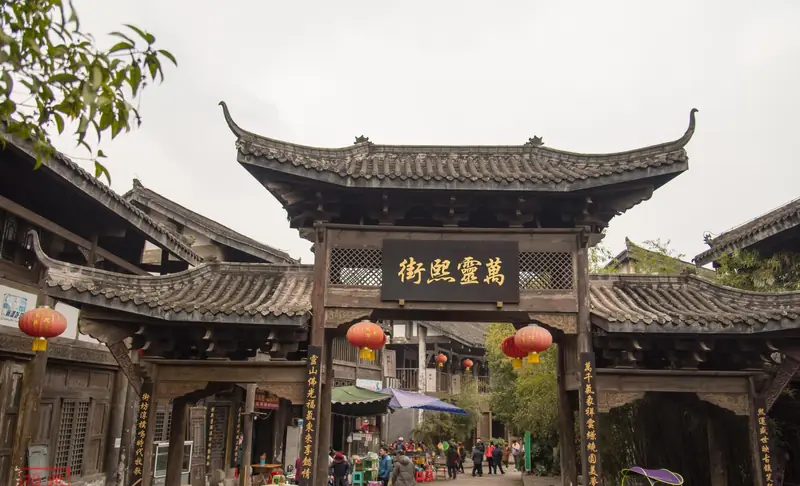
Begin on the sloping Ming–Qing street. Look at the close-set timber-and-masonry shopfronts, stone paving and gateways that mark the old fortified settlement. Then follow the steps down toward the river: the long stairway makes the town’s steep relationship to the water easy to read, but it is tiring underfoot and is not a step-free route. At the riverside, Darong Bridge offers a view back to the old town and the Laixi’s banks. The Huguang Guild Hall is another useful stop for understanding how migrants organised community life; treat it as a historic building whose interior access may differ from the public lanes, rather than assuming it is always open.
A simple visit is to walk from the upper old street down to the river, pause at the bridge and return by the same hillside route. The town also has lanes and heritage structures including the old street, guild hall, and Yerya Academy (尔雅书院); follow on-site signs and allow time for uneven stone paving and stairs. Recent local coverage describes the street, gates and water-side remains, while an earlier city-government account also records the riverside parks and nearby village landscape. These are part of the wider Wanling setting, not a promise that every outlying feature lies on one short pedestrian loop.
Getting there
There is no Chongqing urban metro station at the old town. For rail travel, take a train to Rongchang North Railway Station (荣昌北站), then arrange the final leg to the historic core. A 2024 Chongqing city travel guide lists the high-speed-rail connection to Rongchang North and onward travel to Wanling, but does not specify the transfer. Local reports document bus 602 serving the urban area–Wanling corridor; a 2026 notice describes additional service only for the 15–19 August festival dates, and does not establish the ordinary timetable or a current visitor-side stop. Confirm the day’s operating route and stop with the local operator before relying on the bus; the exact regular stop and return boarding point were not independently confirmed for this guide.
For a taxi or ride-hail, enter 重庆市荣昌区万灵镇大荣寨社区(万灵古镇核心景区) as the destination. This points to the historic core rather than a map pin for the whole town. Ask to be dropped at the signed public parking or visitor-access area serving the core, and follow current road signs; an exact named vehicle gate or legally designated drop-off bay could not be confirmed. Do not ask a driver to stop on a through-road. If using bus 602, confirm both the outward stop and the reverse-service stop before setting out.
Before you go
The public lanes and riverside setting are the most dependable way to experience the town’s spatial character. I could not verify current standard opening hours, a general admission arrangement, or routine access rules for the interiors of individual halls. Check local signs or the site operator for those details on the day; do not infer current prices or daily performances from old travel listings or dated festival notices. Wear shoes with grip for the stone paving and steep steps, and be considerate around homes and residents.
Combine your visit
A suggested sequence through the documented features.
-
Huguang Guild Hall
Start with the immigrant community’s gathering place.
-
Ming–Qing Old Street
Follow the stone steps down towards the river.
-
Darong Bridge
Finish with the stone crossing and river-trade setting.
This is an editorial sequence. Check local access and required road or boat transfers; it does not promise a walking route or common ticket.
Find Wanling Ancient Town
万灵古镇 · 荣昌
The pin marks the area, not the entrance.
More places nearby
Approximate straight-line distances between map pins, not travel distances.
Dazu Rock Carvings 大足石刻
24 km awayThe Dazu Rock Carvings are a group of separate hillside sites, where Buddhist, Daoist and Confucian imagery appears alongside scenes of ordinary life. At Baodingshan, a long sequence of reliefs follows a curved valley; Beishan…
View guide →Tea Mountain Bamboo Sea · Niwu Viewpoint 茶山竹海·霓雾观景台
30 km awayNiwu is a named lookout in Yongchuan's Tea Mountain and Bamboo Sea, a forest landscape where tea cultivation and extensive bamboo groves share the slopes. The viewpoint belongs to a wider network of places including Tianbao…
View guide →Dazu Baodingshan carvings 大足宝顶山石刻
33 km awayBaodingshan’s Great Buddha Bend follows a curved rock face with connected reliefs that read like a long visual narrative. Large devotional images alternate with scenes about conduct, suffering and spiritual practice. The…
View guide →Sources & visit information
Sources checked on 22 October 2026. Hours, tickets, reservations and transport can change; confirm with the operator before you go.
Image credits & notes (1)
- Wanling Ancient Town · 万灵古镇Photo: sohu.comResized for the web; the photo itself has not been edited.