

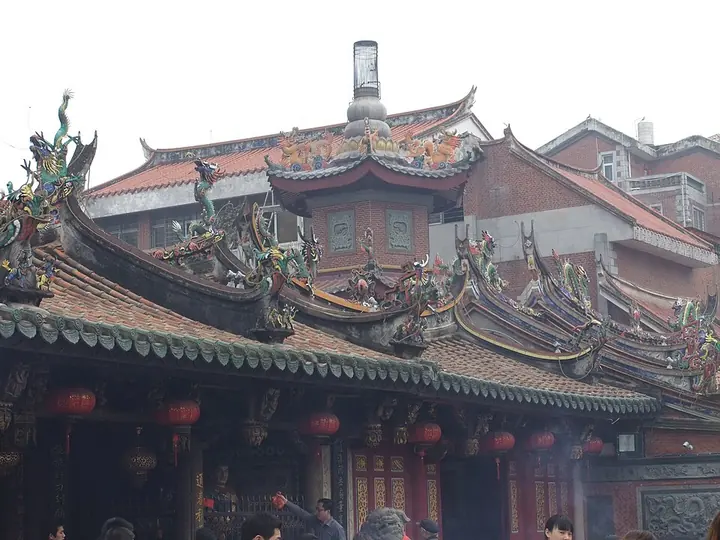
Photo adjustments
Full frame retained; proportionally resized and converted to WebP. No retouching or changes to the photographed subject. Card displays may crop the view.
City & district guides
About Guan-Yue Temple
Wucheng Hall, Chongxian Hall and Sanyi Temple form a dense timber-built complex dedicated to martial and ancestral traditions, with Guan Yu and Yue Fei central to its identity. The large ritual furnace and active offering spaces make worship especially visible here. Compare the halls from the visitor areas and leave room for devotees moving between them.
The temple's founding date is unknown; it began as a temple dedicated solely to Guan Yu (关帝庙), and in 1914 the worship of Yue Fei was added, after which it took its present name. The current buildings were rebuilt in 1867, during the Qing Tongzhi era, and again in the early Republican period, with a comprehensive renovation carried out between 1986 and 1990.
The temple faces south, and its three adjoining halls share hard-ridge roofs and chuan-dou timber frames three bays wide, together covering a floor area of 1,294 square meters. Worship here has spread to the Philippines, Singapore, Malaysia, Japan and Taiwan, and the temple has more than 70 branch shrines in Taiwan and Southeast Asia. It was listed as a Quanzhou municipal cultural relic protection unit in 1992 and a Fujian provincial cultural relic protection unit in 2005.
What to look for
- The three connected halls and their timber architectural framework.
- The large ritual furnace and the active offering spaces.
The surrounding area
A city base for maritime heritage, religious buildings, old lanes and a possible performance.
Location & getting there
Getting to Guan-Yue Temple
Use No 196 Tumen Street in Licheng District, east of Qingjing Mosque. This is a street-front temple, so approach on foot from the surrounding old-city streets and observe the worship routes inside.
Combine your visit
A suggested sequence linking the specific features of this visit.
-
Wucheng Hall
Begin with the principal martial-deity worship space.
-
Chongxian and Sanyi halls
Compare the adjoining halls and their linked arrangement.
This order is editorial. Confirm access and any transfers between stops; it does not establish a walking route, same-day connection or common admission ticket.
Find Guan-Yue Temple
通淮关岳庙 · 泉州市
The pin marks the area, not the entrance.
More places nearby
Approximate straight-line distances between map pins, not travel distances.
Qingjing Mosque清净寺
Less than 1 km awayQingjing Mosque preserves a monumental stone entrance on Quanzhou’s Tumen Street. Its sequence of vaulted arches leads towards the remains of the original prayer hall, where walls, niches and inscriptions give a sense of the…
View guide →Quanzhou Tianhou Temple泉州天后宫
Less than 1 km awayQuanzhou’s Tianhou Temple honours Mazu, whose protection was sought by sailors and trading communities. The main hall’s richly decorated double-eaved roof contrasts with the broader, simpler sleeping hall behind it. Courtyards…
View guide →Kaiyuan Temple (Quanzhou)泉州开元寺
2 km awayKaiyuan Temple’s two stone pagodas rise above a broad Buddhist precinct on Quanzhou’s West Street. Zhenguo and Renshou pagodas give the complex its unmistakable outline, while the main hall contains details that reward a slower…
View guide →Sources & visit information
The sources below support the place-specific description and arrival information. Suggested combinations are editorial planning ideas; confirm current opening, entry arrangements and transport services for your date.
Visitor information adapted and edited from Wikipedia contributors, “通淮关岳庙” · CC BY-SA 4.0. Source revision 92115138.
Visitor information adapted and edited from Wikivoyage contributors, listing “Guan-Yue Temple” · CC BY-SA 4.0.
Background paragraphs translated and condensed from Wikipedia contributors, "通淮关岳庙", Chinese Wikipedia · CC BY-SA 4.0. Source revision 92115138.