

Photo adjustments
Proportionally resized and converted to WebP without cropping, retouching or changing the photographed subject.
Explore the region
About Kaiyuan Temple (Quanzhou)
Zhenguo and Renshou pagodas give the complex its unmistakable outline, while the main hall contains details that reward a slower inspection. Reused carvings from a Hindu temple connect the site with merchants from southern India. The combination makes Kaiyuan a particularly clear place to see how Quanzhou’s religious life absorbed material from its international trading past.
According to local tradition, Kaiyuan Temple was founded in 686 when the wealthy Quanzhou landowner Huang Shougong (黄守恭), having dreamed a mulberry tree bore lotus flowers, donated his mulberry garden to build a temple, first called Lotus Temple. In 738 it took its present name when Emperor Xuanzong ordered every prefecture to build a temple named for the reign era. In 1982 it was listed as a Major National Historical and Cultural Site (全国重点文物保护单位) and a National Key Buddhist Temple.
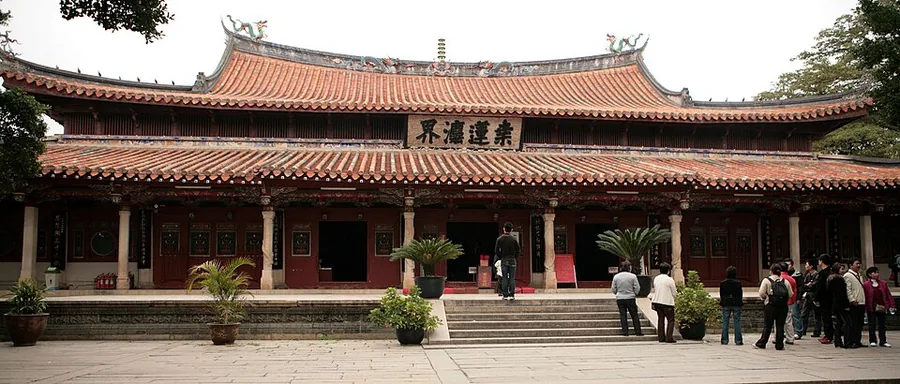
The Daxiongbao Hall, rebuilt in 1637, is nine bays wide and six bays deep, covering 1,338 square metres beneath a double-eave roof 20 metres high. Its 86 large stone columns support the beam frame without some interior columns, giving the hall its nickname, the Hundred-Pillar Hall. Among its 76 dougong bracket clusters are twenty-four carved flying-apsara musicians (飞天乐伎) combining the forms of Buddhist apsaras and Christian angels.
East and west of the hall stand a pair of stone pagodas built in imitation of timber towers. Zhenguo Pagoda (镇国塔), raised in 865 and rebuilt in stone between 1238 and 1250, stands 48.24 metres high; Renshou Pagoda (仁寿塔), raised in 916 and rebuilt in stone between 1228 and 1237, stands 44.06 metres high. The pair are described as China's tallest stone pagodas, and have withstood a magnitude-eight earthquake and typhoons for centuries.
What to look for
- Zhenguo and Renshou, the temple’s twin stone pagodas.
- The main-hall setting and reused Hindu stone carvings.
Background & history
Kaiyuan Temple (simplified Chinese: 开元寺; traditional Chinese: 開元寺; pinyin: Kāiyuán Sì; Pe̍h-ōe-jī: Khai-gôan-sī) is a Buddhist temple located in West Street, Quanzhou, China, and is considered as the largest Buddhist temple in Fujian province with an area of 78,000 square metres (840,000 ft2). The central figures of veneration in the temple are the Five Tathāgathas from Chinese Esoteric Buddhism who are enshrined in the temple's Daxiongbao Hall. In 2021, the temple was inscribed on the UNESCO World Heritage List along with other sites near Quanzhou because of its importance during the medieval global maritime trade based in Quanzhou and its testimony to the global exchange of ideas and cultures. The temple is also one of few in China to contain Hindu monuments, left there by traders from Southern India.
Excerpt from Wikipedia: Kaiyuan Temple (Quanzhou) · Wikipedia contributors · CC BY-SA 4.0. Selected introductory sentences; formatting simplified. Background information, not current visitor-service advice.
The surrounding area
A city base for maritime heritage, religious buildings, old lanes and a possible performance.
Location & getting there
Getting to Kaiyuan Temple (Quanzhou)
Approach from West Street in Quanzhou’s old city and use the signed Kaiyuan Temple entrance. If adding the ancient-ship exhibition, check its separate visitor arrangements within the wider temple grounds.
Combine your visit
A suggested sequence linking the specific features of this visit.
-
Twin pagoda courts
Compare the two stone towers and their exterior carving.
-
Main hall and reused stonework
Look for the meeting of Buddhist worship and overseas artistic material.
This order is editorial. Confirm access and any transfers between stops; it does not establish a walking route, same-day connection or common admission ticket.

Find Kaiyuan Temple (Quanzhou)
泉州开元寺 · 泉州市
The pin marks the area, not the entrance.
More places nearby
Approximate straight-line distances between map pins, not travel distances.
Guan-Yue Temple 通淮关岳庙
2 km awayTonghuai Guan-Yue Temple places three connected halls side by side on busy Tumen Street. Wucheng Hall, Chongxian Hall and Sanyi Temple form a dense timber-built complex dedicated to martial and ancestral traditions, with Guan Yu…
View guide →Qingjing Mosque 清净寺
2 km awayQingjing Mosque preserves a monumental stone entrance on Quanzhou’s Tumen Street. Its sequence of vaulted arches leads towards the remains of the original prayer hall, where walls, niches and inscriptions give a sense of the…
View guide →Quanzhou Tianhou Temple 泉州天后宫
2 km awayQuanzhou’s Tianhou Temple honours Mazu, whose protection was sought by sailors and trading communities. The main hall’s richly decorated double-eaved roof contrasts with the broader, simpler sleeping hall behind it. Courtyards…
View guide →Sources & visit information
The linked encyclopedia sources support background and place descriptions. Current opening hours, ticket prices, booking rules and transport schedules have not been independently verified for this guide. Confirm them with the venue or operator before travelling.
- Kaiyuan Temple (Quanzhou) ↗
- Chinese Wikipedia: 开元寺 (泉州) (revision 93583050, 2026-07-21) ↗
- English Wikipedia: Kaiyuan Temple (Quanzhou) (revision 1369203910, 2026-08-13) ↗
Visitor information adapted and edited from Wikipedia contributors, “Kaiyuan Temple (Quanzhou)” · CC BY-SA 4.0. Source revision 1369203910.
Background paragraphs translated and condensed from Wikipedia contributors, "开元寺 (泉州)", Chinese Wikipedia · CC BY-SA 4.0. Source revision 93583050.
Background paragraphs condensed from Wikipedia contributors, "Kaiyuan Temple (Quanzhou)", English Wikipedia · CC BY-SA 4.0. Source revision 1369203910.