


Photo adjustments
Full frame retained; proportionally resized and converted to WebP. No retouching or changes to the photographed subject. Card displays may crop the view.
Explore the region
About Bingling Temple Grottoes
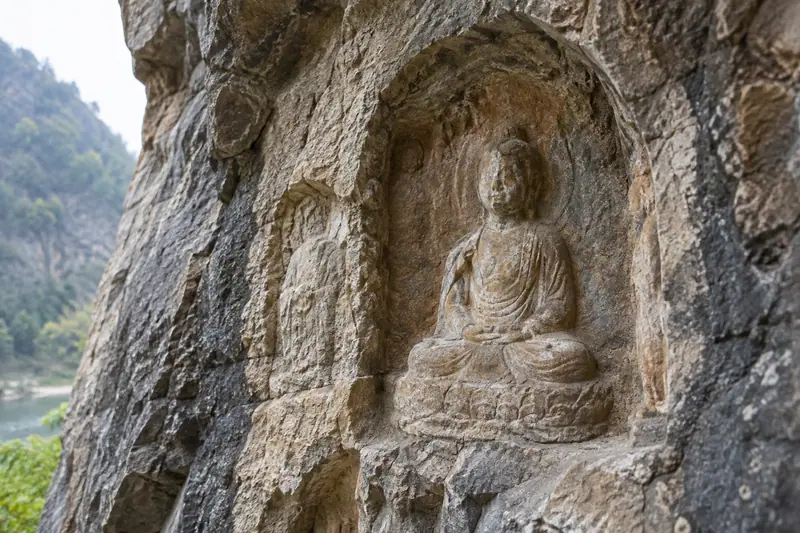
The Gansu Provincial Local Chronicles Office page records that the site preserves 196 niches and caves, distributed over the upper temple, the lower temple, Donggou and Foyetai, and that they fall into three groups, the upper temple, Donggou and the lower temple, of which the lower temple is the most imposing. The caves run along a cliff 200 m long and 60 m high. The important early cave is Cave 169, a large natural cavern holding Western Qin images and wall paintings; the page gives its dimensions as 15 m high, 8 m deep and 20 m wide, notes that it was once called Tangshu Cave and is now known as Tianqiao Cave, and calls it the earliest-cut and best-preserved cave known in China.
Niche 6 in that cave holds a Buddha with two bodhisattvas, and the ink inscription at its side reads, as the page gives it, 建弘元年岁在玄枵三月廿四日造, that is 420 CE, which the page calls the earliest dated inscription in a Chinese cave temple; below it are rows of donor figures including the monks Tanmopi and Daorong. The page also names the three standing Buddhas of Niche 9, a surviving standing Buddha in Niche 7, and in Niche 17 a bodhisattva with a half-cross-legged meditating bodhisattva below the niche, while the five seated meditation Buddhas of Niche 23 show western-regions influence. The Western Qin wall paintings in Cave 169 carry preaching scenes, a Vimalakirti transformation, Amitayus, Prabhutaratna and Shakyamuni, Maitreya and the Buddhas of the ten directions, thousand Buddhas, flying figures, musicians and donors, in a plain and vigorous style.
Across the site the page counts 694 stone statues, 82 clay figures and more than 900 sq m of wall painting, with the largest Tang Maitreya seated Buddha 27 m high and the smallest statue 10 cm. It records that two caves with one niche were cut under the Western Qin, eight with 25 niches under the Northern Wei, two under the Northern Zhou, two under the Sui and 20 with 113 niches under the Tang, that the Tang work is the finest, and that the monks there then numbered more than 3,000. Niche 171 on the cliff holds a Tang-dynasty clay-on-stone seated Maitreya Buddha cut against the rock and 27 m high, and the former Cave 16, now rehoused in the Sleeping Buddha Hall opposite the cave group, holds a clay reclining Buddha 8.6 m long which the page calls the only surviving Northern Wei reclining Buddha in China. A 25 cm Tang attendant figure is called by the page the most precious of the figures surviving in Chinese cave temples. At the entrance the steep Sister Peaks stand beside the cliff, with Yuanyang Cave and Yaoshui Spring nearby.
The Dunhuang Academy's visitor page records that the grottoes are open all year, with 08:30 to 18:00 hours in the high season from 1 April to 31 October and 09:00 to 17:00 in the low season from 1 November to 31 March. A full-price ticket costs 50 yuan per person per visit and a concession ticket 25 yuan; concessions cover children over 1.2 m, full-time undergraduates and below, men aged 60 to 69 and women aged 60 to 64, serving military personnel and religious personnel, and free admission covers disabled visitors, men aged 70 and over and women aged 65 and over, police officers, holders of the Gansu high-level talent card, and primary and secondary school pupils from the Linxia area. A guide costs 100 yuan for one to ten people, 150 yuan for 11 to 15 and 200 yuan for 16 to 20, with 20 yuan for each person above 20 up to a maximum group of 25.
The gazetteer office page gives no opening arrangements or ticket prices, and the Dunhuang Academy page describes no caves, images or wall paintings and carries no publication date, so its prices and hours are reported as those posted on the page rather than as a current guarantee. The gazetteer office page also attributes the 420 CE inscription to a named monk while elsewhere on the same page giving the donor figures as Tanmopi and Daorong; this record reports only the inscription's date and its donors and names no author. The page's claims that the site is one of China's four great cave temples and that its artistic value is second only to the Mogao Caves are the page's own and are not adopted here.
What to look for
- Cave 169, 15 m high, 8 m deep and 20 m wide, holding Western Qin images and wall paintings and an ink inscription dated to 420 CE
- Niche 171, with the Tang clay-on-stone seated Maitreya Buddha cut against the rock and 27 m high
- The clay reclining Buddha 8.6 m long, rehoused in the Sleeping Buddha Hall opposite the cave group
- The steep Sister Peaks beside the cliff at the entrance, with Yuanyang Cave and Yaoshui Spring nearby
Location & getting there
Getting to Bingling Temple Grottoes
Check which interiors and courtyards are accessible. Active places of worship and protected monuments may have different visitor rules.
- Search for 炳灵寺石窟 with 临夏回族自治州 and 永靖县.
Find Bingling Temple Grottoes
炳灵寺石窟 · 永靖县
No reliable map pin yet: search by the Chinese name.
Sources & visit information
The linked sources support the identity and background described in this introduction. Opening hours, admission, activity availability and exact arrival arrangements have not been comprehensively checked. Confirm current visitor information with the venue; the original catalogue locality and editorial review flag are retained.