


Photo adjustments
Full source framing retained; proportionally resized and converted to WebP. No retouching or subject alteration. Card displays may crop the view.
Explore the region
About Mati Temple Grottoes
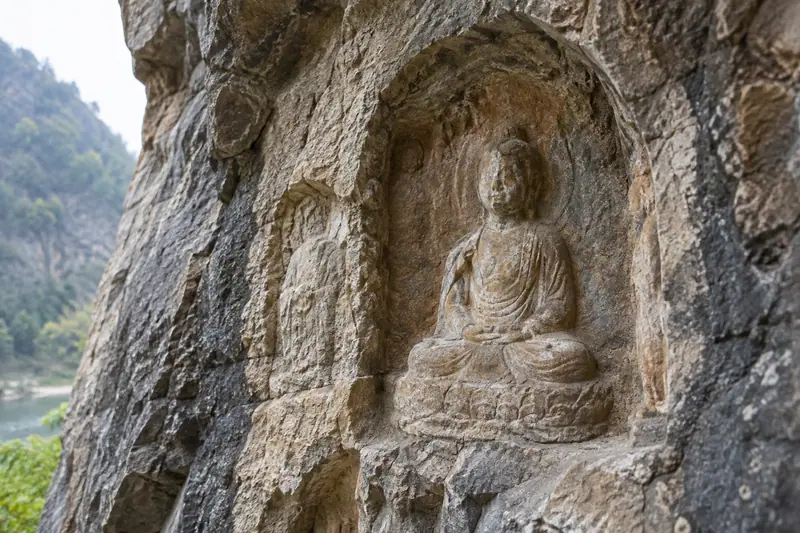
Mati Temple Grottoes (马蹄寺石窟) are a group of Buddhist cave temples in Linsong Mountain (临松山) on the northern flank of the Qilian Mountains (祁连山), in the Mati area of Sunan Yugur Autonomous County (肃南裕固族自治县), more than 60 km south of the city of Zhangye (张掖), Gansu.
The first caves are credited to Guo Yu (郭瑀), an Eastern Jin scholar from Dunhuang (敦煌) who lived and taught here in seclusion. The Northern Liang (北凉) ruler Juqu Mengxun (沮渠蒙逊), a devout patron of Buddhism, had parts of the Thousand Buddha Caves (千佛洞) and the Jintasi (金塔寺) caves cut. Caves were restored in the late Northern Wei and kept up under the Sui, Tang, Western Xia, Yuan, Ming and Qing, with the biggest repairs in 1524 and 1898. The name Mati, 'horse hoof', is linked to a Tibetan tribe of that name that settled in southern Zhangye after the An Lushan rebellion (安史之乱); another account ties it to a hoof print in the North Temple.
Seven groups make up the site: the South and North Mati temples, Jintasi, the Thousand Buddha Caves, and the Upper, Middle and Lower Guanyin Caves (观音洞), with 37 caves, more than 500 statues and 1,200 square metres of murals. The North Temple, Puguang Temple (普光寺), has more than 30 caves cut into red sandstone. Its Cave 3, the 'Thirty-Three Heavens' (三十三天), faces east and climbs 42 m in five tiers of 21 niches, linked by tunnels, like a pagoda. Cave 7, the Standing Buddha Hall (站佛殿), is the largest, 33.5 m deep and 15 m high; a 2004 Xinhua report lists 21 Tibetan Buddhist statues of the Yuan period in it, and Yuan and Ming murals of guardian figures survive in its side passages. Cave 8, the Horse Hoof Hall (马蹄殿), is named for a hoof print said to lie in front of it.
Jintasi, in Daduma Township (大都麻乡), consists of two central-pillar caves cut into a red cliff more than 60 m above the ground. In the eastern cave the pillar has niches in three tiers, with clay Buddhas and attendant bodhisattvas, and three or four flying apsaras on either side of each lower niche arch. The Thousand Buddha Caves, on the west bank of the Mati River (马蹄河), date from the Northern Liang; their northern section is mostly a forest of relief stupas.
The caves were listed as a Gansu provincial protected site in 1957 and entered the fourth national list of key protected heritage sites (全国重点文物保护单位) in November 1996. The 2004 Xinhua report also noted a crack about 20 m long running through the second and third tiers of the 'Thirty-Three Heavens'; rock reinforcement began in August 2004 and was completed in November 2006.
What to look for
- Cave 3 of the North Temple, the 'Thirty-Three Heavens' (三十三天): 21 niches in five tiers rising 42 m
- Cave 7, the Standing Buddha Hall (站佛殿), the largest cave, with Yuan Tibetan Buddhist statues
- Cave 8, the Horse Hoof Hall (马蹄殿), named for a legendary hoof print
- Jintasi (金塔寺), two central-pillar caves high on a red cliff, with clay Buddhas and flying apsaras
- The Thousand Buddha Caves (千佛洞) on the west bank of the Mati River, with a forest of relief stupas
- The Upper, Middle and Lower Guanyin Caves (观音洞), about 3 km from Jintasi
Location & getting there
Getting to Mati Temple Grottoes
- Search for 马蹄寺石窟 with 张掖市 and 肃南裕固族自治县.
Find Mati Temple Grottoes
马蹄寺石窟 · 肃南裕固族自治县
No reliable map pin yet: search by the Chinese name.
Sources & visit information
Written from the linked sources and checked sentence by sentence against quoted extracts by a separate reviewer on 2026-09-23. Opening hours, admission and access arrangements are not covered; confirm current visitor information with the site.
Some facts checked against Wikipedia contributors, "马蹄寺石窟群" · CC BY-SA 4.0.