

Photo adjustments
Wikimedia thumbnail; fitted to the ranking-card frame.
Explore the region
About Mingsha Mountain and Crescent Moon Spring
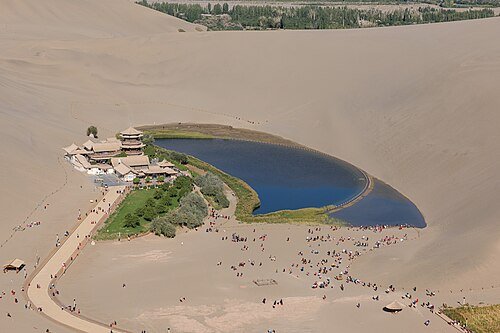
Mingsha Mountain and Crescent Moon Spring (鸣沙山月牙泉) is a desert scenic area 5 km southwest of Dunhuang (敦煌) in Gansu, where a small crescent-shaped spring sits in a ring of sand dunes.
Mingsha Mountain, the 'Singing Sand Mountain', is a range of dunes about 40 km from east to west and 20 km from north to south; its highest point stands 1,715 m above sea level. It is known for the sound its sand makes when it moves, a noise that singing dunes give off when sand slumps down a slope, set off by wind or by someone walking near the crest. In the Eastern Han the range was called Shajiao Mountain (沙角山); the name Mingsha dates from the Jin dynasty. Sand that climbers push downhill is blown back into shape by the wind.
Crescent Moon Spring is named for its new-moon outline and measures about 150 m at its longest and 50 m at its widest. It was once known as Wowa Pool (渥洼池), Shajing (沙井, 'sand well') and Yaoquan (药泉, 'medicine spring'), and took its present name after the Qing dynasty began. Geologists who studied it from 1997 concluded that it forms where groundwater spills out in a hollow between the alluvial fans of the Dang River (党河) and the Xishuigou (西水沟).
The spring's depth has changed within living memory. In 1960 it averaged 4 to 5 m, with 7.5 m at its deepest; by the 1990s the average had dropped to about 0.9 m and the deepest point to 1.3 m. An emergency works programme run by Dunhuang came partly into use in early March 2008 and lifted the average level by about 30 cm. The travellers Mildred Cable and Francesca French reached the lake in 1932 and wrote about it in their book The Gobi Desert.
The area became a national scenic area in 1994 and a national 5A tourist attraction on 13 July 2015. Crescent Moon Spring is part of the Dunhuang Yardang National Geopark, recognised by UNESCO in 2015. On the dunes around the lake, visitors go sand sledding and take camel rides.
What to look for
- Crescent Moon Spring (月牙泉), a crescent-shaped spring about 150 m long enclosed by dunes
- The dune ridges of Mingsha Mountain, rising to 1,715 m above sea level, whose sand sounds when it slides
- 'Singing ridge in clear weather' (沙岭晴鸣) and 'Moon spring clear at dawn' (月泉晓澈), two of the Eight Views of Dunhuang (敦煌八景)
- Sand sledding and camel rides on the dunes around the lake
Location & getting there
Getting to Mingsha Mountain and Crescent Moon Spring
- Search for 鸣沙山月牙泉 with 酒泉市 and 敦煌市.
Find Mingsha Mountain and Crescent Moon Spring
鸣沙山月牙泉 · 敦煌市
The pin marks the area, not the entrance.
Sources & visit information
Written from the linked sources and checked sentence by sentence against quoted extracts by a separate reviewer on 2026-09-23. Opening hours, admission and access arrangements are not covered; confirm current visitor information with the site.
Some facts checked against Wikipedia contributors, "月牙泉" · CC BY-SA 4.0.
Some facts checked against Wikipedia contributors, "Crescent Lake (Dunhuang)" · CC BY-SA 4.0.
Some facts checked against Wikipedia contributors, "鸣沙山 (敦煌)" · CC BY-SA 4.0.
Some facts checked against Wikipedia contributors, "Singing sand" · CC BY-SA 4.0.