


Explore the region
About Northern Grotto Temple
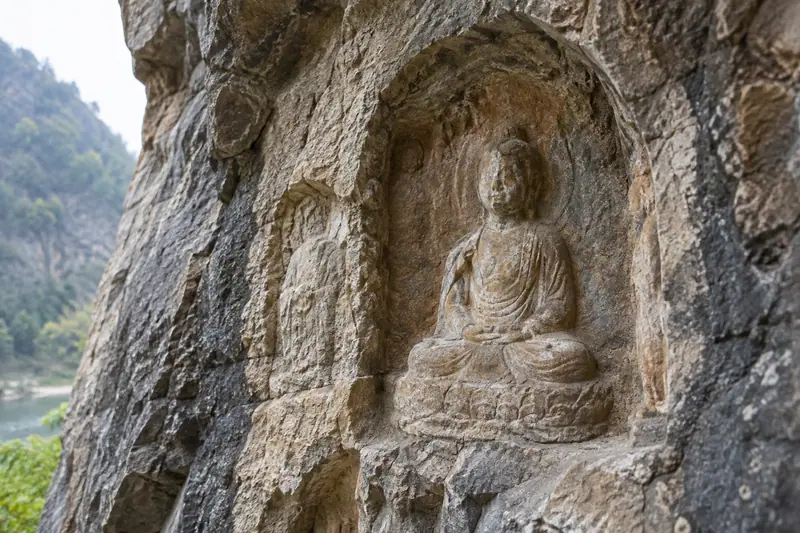
The figures are cut from the rock itself, giving the site a different character from cave complexes dominated by modelled clay. Cave 165 is particularly associated with a group of seven monumental Buddhas, surrounded by further sculpture and relief. Weathering is visible in the exposed stone, so the conservation setting is part of understanding what has survived across the cliff.
Northern Grotto Temple was begun in 509, in the second year of the Yongping era (永平) of Northern Wei Emperor Xuanwu (宣武帝), and was expanded through the later Northern Wei, Western Wei, Northern Zhou, Sui, Tang and Song dynasties, when further caves were cut and enlarged.
The site comprises 308 caves and more than 2,000 carved stone figures, together with stelae, painted murals and incised or ink inscriptions. Its main cave cluster is on the east bank of the Pu River (蒲河) in Sigou (寺沟). The protected area extends 1.5 kilometres north and south along both banks. A cultural-relics management office was established in 1963, and the site entered the third group of Major Historical and Cultural Sites Protected at the National Level (全国重点文物保护单位) on 13 January 1988.
What to look for
- Cave 165’s group of seven monumental Buddhas, subject to the authorised viewing arrangements.
- The carved sandstone figures and reliefs across the cave interiors.
Location & getting there
Getting to Northern Grotto Temple
Approach the grottoes through Sigou in Nanzhuang Village, Dongzhi Town, southwest of Qingyang’s Xifeng urban area. Arrange a road transfer to the official cave entrance and check whether Cave 165 is included in the available visit.
Combine your visit
A suggested order for the documented features and stops.
-
Cliff overview
Read the cave openings and sandstone face in their river setting.
-
Authorised cave visit
Study the carving at close range, including Cave 165 when included.
This is an editorial sequence. Check access and any road or boat transfers; it does not establish a walking route, common ticket or guaranteed same-day connection.
Find Northern Grotto Temple
北石窟寺 · 庆阳
The pin marks the area, not the entrance.
More places nearby
Approximate straight-line distances between map pins, not travel distances.
Sources & visit information
The sources below support the place-specific description and arrival information. Suggested combinations are editorial planning ideas; confirm current opening, entry arrangements and transport services for your date.
- www.dha.ac.cn ↗
- ygx.sxu.edu.cn ↗
- m.thepaper.cn ↗
- 北石窟寺 ↗
- Chinese Wikipedia: 北石窟寺 (revision 92634338, 2026-05-12) ↗
Visitor information adapted and edited from Wikipedia contributors, “北石窟寺” · CC BY-SA 4.0. Source revision 92634338.
Background paragraphs translated and condensed from Wikipedia contributors, "北石窟寺", Chinese Wikipedia · CC BY-SA 4.0. Source revision 92634338.