

Photo adjustments
Full frame retained; proportionally resized and converted to WebP. No retouching or changes to the photographed subject. Card displays may crop the view.
Explore the region
About Western Thousand Buddha Caves
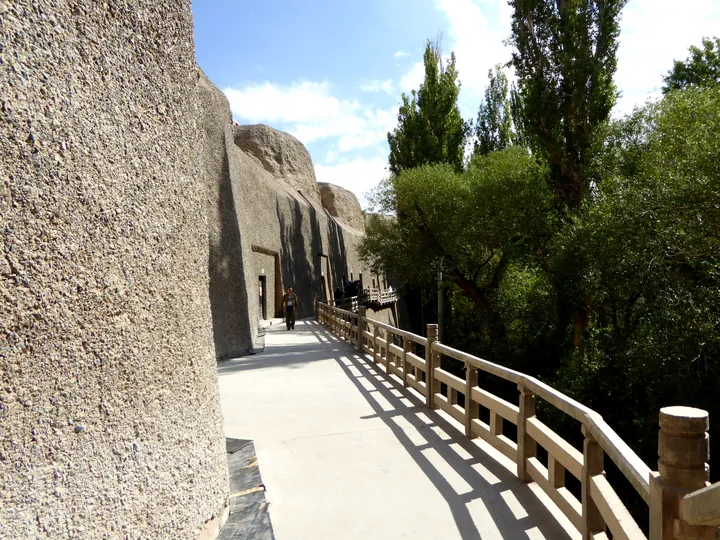
The Western Thousand Buddha Caves (西千佛洞) are Buddhist cave temples cut into a cliff on the north bank of the Dang River (党河), about 35 km southwest of the city of Dunhuang (敦煌) in Gansu.
The name places them west of the Mogao Caves (莫高窟), also called the Thousand Buddha Caves (千佛洞), and of Mingsha Mountain (鸣沙山). The site lies about as far from the Yangguan Pass (阳关) as from Dunhuang, in country that served Silk Road travellers as a staging post. Floods and collapses have claimed some caves; around forty survive.
A Five Dynasties manuscript from the Library Cave at Mogao, now in the Bibliothèque nationale in Paris, records an old inscription 60 li east of Shouchang County (寿昌县) that mentions a small Buddha niche made in the Han. Because Shouchang lay at the Yangguan Pass, the passage is read as a reference to the origins of these caves. The surviving decorated caves span the Northern Wei to the Yuan, including four Northern Zhou caves, three late Tang caves and one from the Uyghur period. The painter Zhang Daqian (张大千) made the first survey and numbering between 1941 and 1943, while copying murals at Dunhuang. In 2003 the Dunhuang Academy (敦煌研究院), led by Fan Jinshi (樊锦诗), settled on the 22-cave sequence devised by Huo Xiliang (霍熙亮).
In March 1961 the State Council placed the caves, as an annex of the Mogao Caves, in the first batch of nationally protected heritage sites. The Dunhuang Academy's forerunner took charge of them in the 1950s, and in the 1990s the Academy thoroughly repaired and strengthened the main western group.
Caves 1 to 19 cluster on the valley's north cliff at the west end; the last three lie 2 to 2.5 km downstream, cave 20 near the second floodgate and caves 21 and 22 at the east end of the cliff. Together the twenty-two decorated caves hold 34 painted statues and 800 square metres of murals, though most statues were reworked in a different style under the Qing and the Republic. In Northern Wei Cave 7 the broken main Buddha exposes its making, earth plaster built up over a core of branches and reeds, and where upper paint has flaked away the grid used to lay out rows of small Buddhas shows through. Aluminium doors and glass partitions now shield the western caves, and some paintings from the far east end were lifted and remounted in a cave at Mogao.
What to look for
- The cliff of caves 1 to 19 above the north bank of the Dang River (党河)
- Northern Wei Cave 7, whose damaged main Buddha shows earth plaster over a branch-and-reed core
- Rows of small Buddhas in Cave 7 with the layout grid visible where paint has flaked
- 34 painted statues and 800 square metres of murals dating from the Northern Wei to the Yuan
- Caves 20 to 22, 2 to 2.5 km downstream of the main group, ending at the east end of the cliff
Location & getting there
Getting to Western Thousand Buddha Caves
- Search for 西千佛洞 with 酒泉市 and 敦煌市.
Find Western Thousand Buddha Caves
西千佛洞 · 敦煌市
No reliable map pin yet: search by the Chinese name.
Sources & visit information
Written from the linked sources and checked sentence by sentence against quoted extracts by a separate reviewer on 2026-09-23. Opening hours, admission and access arrangements are not covered; confirm current visitor information with the site.
Some facts checked against Wikipedia contributors, "西千佛洞" · CC BY-SA 4.0.
Some facts checked against Wikipedia contributors, "Western Thousand Buddha Caves" · CC BY-SA 4.0.