

Photo adjustments
EXIF orientation normalized; resized without changing aspect ratio; converted to WebP. No subject edits.
Explore the region
About Guanyin Mountain Wangshan Temple
The county tourism bureau describes the mountain's outline as the world's largest natural reclining Buddha. Within the Guanyin Shan area, a stream to one side is likened to a green dragon, and the encircling hills to the other to a white tiger pouncing; the best-known viewpoints along the mountain paths are named as the waterfall cluster, Longgong (Dragon Palace), Longchuang (Dragon Bed), the Bogong tree, Lingshui Lake, Huixian Tai (Immortal Gathering Terrace) and the Jade Emperor's Seal rock. Guanyinshan Wangshan Si is wreathed in mist year-round, with a bell rung there in the morning and a drum struck in the evening; the scenic area retains unmodified forest, with winding hills, clear streams and many jagged rock formations.
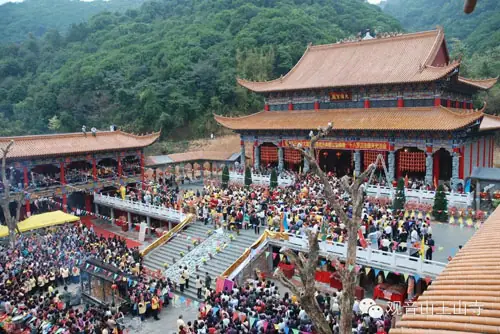
Wangshan Si has been worshipped since the Tang dynasty, and a folk saying holds that a thousand prayers bring a thousand answers at Guanyin Shan. The temple's Mahavira Hall, Heavenly Kings Hall, Sarira Hall and Wuguan Tang have been rebuilt, and its pilgrimage plaza covers more than 10,000 square metres. The bureau's page records visitors coming to worship, to hear the dharma and to release living creatures.
What to look for
- Guanyin Shan itself, whose outline the county tourism bureau describes as the world's largest natural reclining Buddha.
- The waterfall cluster, Longgong and Longchuang among the named viewpoints along the mountain paths.
- Lingshui Lake and Huixian Tai, two further named features of the mountain.
- The temple's pilgrimage plaza, more than 10,000 square metres, and the rebuilt Mahavira Hall, Heavenly Kings Hall, Sarira Hall and Wuguan Tang.
Location & getting there
Getting to Guanyin Mountain Wangshan Temple
Check which interiors and courtyards are accessible. Active places of worship and protected monuments may have different visitor rules.
- Search for 观音山王山寺 with 清远市 and 佛冈县.

Find Guanyin Mountain Wangshan Temple
观音山王山寺 · 佛冈县
No reliable map pin yet: search by the Chinese name.
Sources & visit information
The linked sources support the identity and background described in this introduction. Opening hours, admission, activity availability and exact arrival arrangements have not been comprehensively checked. Confirm current visitor information with the venue; the original catalogue locality and editorial review flag are retained.