

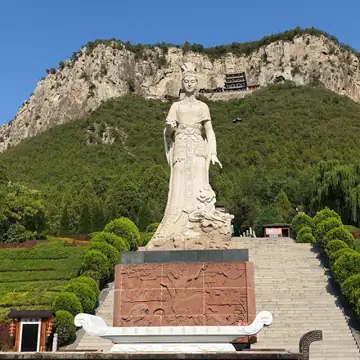
Photo adjustments
Resized and WebP compressed; subject not altered.
Explore the region
About Wahuang Palace
The site brings together the worship of Nüwa with older Buddhist material: Northern Qi scriptures were carved into the rock, while the palace buildings include Qingxu Pavilion, Yingshuang Tower and Shuzhuang Tower. The contrast between the cliff inscriptions and the later built complex gives the visit its substance. Explore the lower buildings before deciding how much of the elevated route to add.
Temples honoring Nüwa (女娲) were first built around Fenghuang Mountain by the end of the Han dynasty, in the second century AD. Buddhist scripture began to be carved into the mountain's cliff face during the Northern Qi period, in the sixth century, and the palace and temple buildings seen today began to be erected under the Wanli Emperor of the Ming.
Besides Qingxu Pavilion, Yingshuang Tower and Shuzhuang Tower, the complex includes a bell and drum tower and a memorial archway, while further halls, including Chaoyuan Palace (朝元宫), Tingcan Palace (停骖宫) and Guangsheng Palace (广生宫), stand at the foot of the mountain. The cliff carvings fill two Northern Qi caves and total more than 131,000 characters, the largest surviving Northern Qi cliff-carved Buddhist scripture site in China.
Wahuang Palace was listed in 1996 as a Major Historical and Cultural Site Protected at the National Level (全国重点文物保护单位). Its scenic area, formerly part of the provincial-level Chongzhou Scenic and Historic Area, has since been elevated as a whole to national level under the name Wahuang Palace Scenic and Historic Area, covering 2,600 mu (1.67 square kilometres), and was designated a AAAAA tourist attraction in 2015.
What to look for
- The cliff-backed palace buildings, including Qingxu Pavilion and Shuzhuang Tower.
- The Northern Qi rock-cut scripture inscriptions within the site.
Location & getting there
Getting to Wahuang Palace
Use 娲皇宫景区 at Fenghuang Mountain in Suobao Town, She County, Handan.
- The documented buildings are arranged both below and against the cliff. Check the current ascent and any access limits before climbing.
Combine your visit
Suggested order within this visit:
-
Lower temple area
Begin with the buildings at the foot of the mountain.
-
Cliff-side palace
See how the later structures fit the rock face.
-
Scripture-carving area
Examine the older Buddhist inscription heritage where accessible.
This sequence is an editorial suggestion based on the features described in the sources. Access to individual buildings or areas should be checked locally; no travel time or shared admission is implied.
Find Wahuang Palace
娲皇宫 · 邯郸市
The pin marks the area, not the entrance.
More places nearby
Approximate straight-line distances between map pins, not travel distances.
Xiangtangshan Caves 响堂山石窟
50 km awayXiangtangshan's Buddhist caves were cut into dense limestone during the sixth-century Northern Qi period. The northern group on Mount Gu contains large central-pillar chambers, while other groups occupy separate sites. Look at…
View guide →Zhaowangcheng Ruins Park 赵王城遗址公园
73 km awayZhaowangcheng preserves the earthwork outline of the Zhao royal city rather than a standing ancient palace. The archaeological complex had eastern, western and northern compounds, with substantial platforms and rammed-earth…
View guide →Sources & visit information
The linked encyclopedia sources support background and place descriptions. Current opening hours, ticket prices, booking rules and transport schedules have not been independently verified for this guide. Confirm them with the venue or operator before travelling.
Visitor information adapted and edited from Wikipedia contributors · CC BY-SA 4.0. Source revision 87227703.
Background paragraphs translated and condensed from Wikipedia contributors, "娲皇宫及石刻", Chinese Wikipedia · CC BY-SA 4.0. Source revision 87227703.
Background paragraphs condensed from Wikipedia contributors, "Nüwa Palace", English Wikipedia · CC BY-SA 4.0. Source revision 1317259421.