

Photo adjustments
Wikimedia thumbnail; fitted to the ranking-card frame.
City & district guides
About Longmen Grottoes
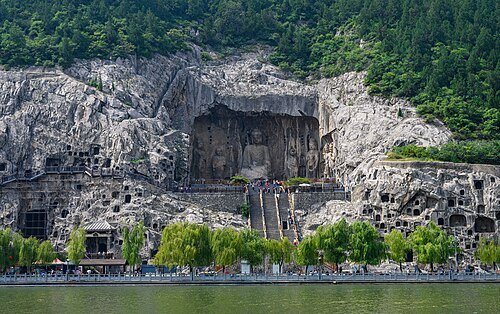
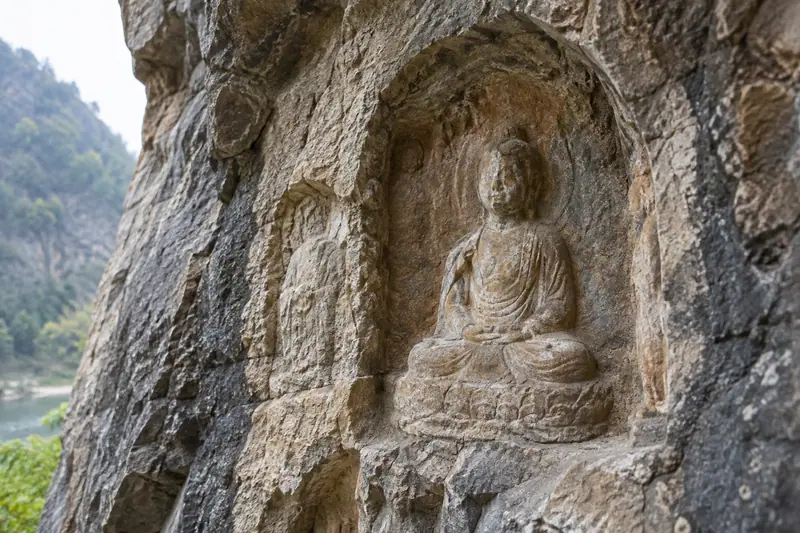
Small niches and inscriptions lead to compositions on a very different scale, especially the great seated Vairocana at Fengxian Temple. The caves also show changes between Northern Wei and Tang carving. Look beyond the largest figures to the surviving halos, attendants and inscriptions, which make the cliffs a layered record of patronage.
According to the Book of Wei, carving at Longmen began after that at the Yungang Grottoes, as Buddhism became a pillar of Northern Wei rule. Emperor Xiaowen moved the Northern Wei capital from Pingcheng to Luoyang in 494, and in 500 Emperor Xuanwu ordered the carving of stone images at Longmen, then called Yique. Further carving continued under later dynasties down to the Ming, with the Northern Wei and Tang periods together accounting for most of the work, over some 150 years.
On the east hill, carving dates mainly from the Tang Wu Zhou period to the Song; the rock strata there are thinner and more fractured than on the west bank, so statues in its larger caves have become loose over time. Binyang Cave (宾阳洞), on the west hill, is the oldest niche at the site and took 24 years to complete, while Fengxian Temple (奉先寺), the largest cave at Longmen, was carved between 672 and 675.
The site holds more than 2,100 niches, over 100,000 carved images and more than 3,600 inscribed stone tablets, the largest total among China's grotto sites. The 'Longmen Twenty' (龙门二十品) inscriptions are considered the finest examples of Wei-dynasty stele calligraphy. Longmen is counted among China's three great stone-carving art treasuries and was added to the UNESCO World Heritage List in 2000.
What to look for
- Fengxian Temple’s monumental Vairocana and its surrounding attendants.
- The Binyang caves and the smaller niches and inscriptions along the west cliff.
The surrounding area
A city base for Longmen, soup breakfasts, old-city food streets and contemporary hanfu visitor districts.
Location & getting there
Getting to Longmen Grottoes
Approach the scenic area at the southern end of Longmen Avenue in Luolong District. From Luoyang Longmen high-speed station, arrange a separate transfer to the attraction’s operating visitor entrance; the station and grottoes are distinct places.
Combine your visit
A suggested sequence linking the specific features of this visit.
-
Binyang cave group
Begin with the earlier sculptural tradition along the west bank.
-
Wanfo Cave area
Compare the scale and repetition of smaller Buddhist figures.
-
Fengxian Temple
Finish with the monumental Tang composition and its relationship to the river valley.
This order is editorial. Confirm access and any transfers between stops; it does not establish a walking route, same-day connection or common admission ticket.
Find Longmen Grottoes
龙门石窟 · 洛阳市
The pin marks the area, not the entrance.
More places nearby
Approximate straight-line distances between map pins, not travel distances.
Guanlin关林
6 km awayGuanlin in Luoyang’s Luolong district is traditionally identified as the burial place of Guan Yu’s head. Its historical complex combines tomb, temple and commemorative grove.
View guide →Luoyang Museum · Nietai Road洛阳博物馆·聂泰路馆址
10 km awayLuoyang Museum presents objects from the successive cultures and capitals of the Luo River valley. Its bronze collection is especially distinctive: a three-wheeled dove cart turns an animal into a small vehicle, while ritual…
View guide →Yingtian Gate应天门遗址
14 km awayYingtian Gate marked the southern entrance to the palace city of Sui and Tang Luoyang. Today, a large protective reconstruction gives the gateway’s scale and projecting towers a visible form above the archaeological remains. The…
View guide →Sources & visit information
The sources below support the place-specific description and arrival information. Suggested combinations are editorial planning ideas; confirm current opening, entry arrangements and transport services for your date.
- en.wikipedia.org ↗
- oss.ly.gov.cn ↗
- 龙门石窟 ↗
- Luoyang ↗
- Chinese Wikipedia: 龙门石窟 (revision 93586439, 2026-07-21) ↗
- English Wikipedia: Longmen Grottoes (revision 1366154989, 2026-07-26) ↗
Visitor information adapted and edited from Wikipedia contributors, “龙门石窟” · CC BY-SA 4.0. Source revision 93586439.
Visitor information adapted and edited from Wikivoyage contributors, listing “Longmen Grottoes” · CC BY-SA 4.0.
Background paragraphs translated and condensed from Wikipedia contributors, "龙门石窟", Chinese Wikipedia · CC BY-SA 4.0. Source revision 93586439.
Background paragraphs condensed from Wikipedia contributors, "Longmen Grottoes", English Wikipedia · CC BY-SA 4.0. Source revision 1366154989.