

Photo adjustments
Wikimedia thumbnail; fitted to the ranking-card frame.
Explore the region
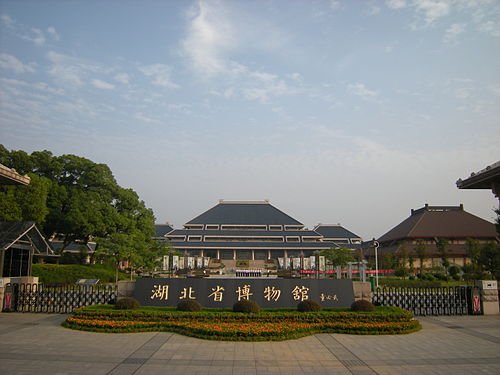
About Hubei Provincial Museum
The bronze bells from the tomb of Marquis Yi and the Sword of Goujian make two very different kinds of metalwork tangible: musical precision and an exceptionally preserved weapon. Other archaeological collections broaden the story beyond these famous objects. Choose the relevant galleries from the current floor plan and allow time to read the tomb context; a bell performance, if scheduled, is a separate experience from viewing the originals.
The museum's preparation began in 1953, growing out of the former Hubei Provincial People's Science Hall; a preparatory office was approved that March under the provincial Culture Bureau. It moved to the Donghu (东湖) area in 1959 and took its present name in 1963. The Xinhai Revolution Memorial Hall (辛亥革命纪念馆) separated from it in 1981, and the Hubei Provincial Institute of Cultural Relics and Archaeology (湖北省文物考古研究所) split off in 1987; the two agencies later operated jointly before separating again in 2023.
The museum holds more than 240,000 objects, including nearly 1,000 first-grade national relics. Representative holdings include prehistoric pottery of the Qujialing (屈家岭) and Shijiahe (石家河) cultures, bronzes from Panlongcheng (盘龙城), lacquerware from Chu and Han tombs, bamboo slips from several Chu and Qin tombs, and objects from the tombs of Prince Liangzhuang (梁庄王) and Prince Ying (郢靖王). Among its collection, the Yunxian Man skull fossil (郧县人头骨化石) and a Yuan-dynasty blue-and-white “Four Loves” meiping vase (元青花四爱图梅瓶) are counted, with the bronze bells and sword, among the museum's four “town treasures” (镇馆之宝).
The museum is designated a national first-grade museum (国家一级博物馆) and is one of eight national key museums jointly built by central and local government. It forms part of the Donghu area, a national 5A tourist attraction (国家5A级旅游景区), and holds 13 long-term exhibitions on the region's history and culture.
What to look for
- The Marquis Yi of Zeng bronze-bell collection and its burial context.
- The Sword of Goujian and other archaeological material from ancient Hubei.
Location & getting there
Getting to Hubei Provincial Museum
Use No 160 Donghu Road in Wuchang. The museum recommends Shengbo Hubei Ribao station on Metro Line 8; individual public-transport visitors use the North Gate, while taxi and group drop-offs use the South Gate. Reserve through the official museum system and bring the matching identification.
Combine your visit
A suggested order for exploring this place and its immediate setting.
-
Marquis Yi of Zeng exhibition曾侯乙展览
Begin with the tomb and the relationship between its objects.
-
Sword of Goujian display越王勾践剑展览
Compare the bronze weapon with the ritual and musical metalwork.
-
East Lake shoreline东湖
Add a short lakeside outing after the galleries if time remains.
Check access to the individual stops. A suggested sequence does not imply a combined ticket or guaranteed transfer.

Find Hubei Provincial Museum
湖北省博物馆 · 武汉市
The pin marks the area, not the entrance.
More places nearby
Approximate straight-line distances between map pins, not travel distances.
East Lake (Wuhan) 武汉东湖
4 km awayEast Lake is a network of water, wooded hills and shoreline parks within Wuhan. Tingtao offers a lower-key lakeside setting and a connection with the poet Qu Yuan; Moshan brings hill views and a different sequence of gardens…
View guide →Yellow Crane Tower 黄鹤楼
6 km awayYellow Crane Tower rises above Snake Hill with layered roofs and wide views towards the Yangtze. Its literary fame is much older than the building: the present tower was completed in 1985 after earlier versions repeatedly burned…
View guide →Wuhan Yangtze River Bridge 武汉长江大桥
7 km awayWuhan’s first Yangtze bridge is a working piece of transport history. Opened in 1957, it put road traffic above a double railway track and replaced the cumbersome ferrying of trains across the river. Its steel spans link Snake…
View guide →Sources & visit information
The sources below support the place-specific description and arrival information. Suggested combinations are editorial planning ideas; confirm current opening, entry arrangements and transport services for your date.
- Hubei Provincial Museum ↗
- Museum visitor guide — reservations and current gate arrangements ↗
- Museum transport and visitor services ↗
- Chinese Wikipedia: 湖北省博物馆 (revision 94108299, 2026-08-30) ↗
- English Wikipedia: Hubei Provincial Museum (revision 1323306622, 2025-11-21) ↗
Visitor information adapted and edited from Wikipedia contributors: Hubei Provincial Museum · CC BY-SA 4.0. Source revision 1323306622.
Background paragraphs translated and condensed from Wikipedia contributors, "湖北省博物馆", Chinese Wikipedia · CC BY-SA 4.0. Source revision 94108299.
Background paragraphs condensed from Wikipedia contributors, "Hubei Provincial Museum", English Wikipedia · CC BY-SA 4.0. Source revision 1323306622.