

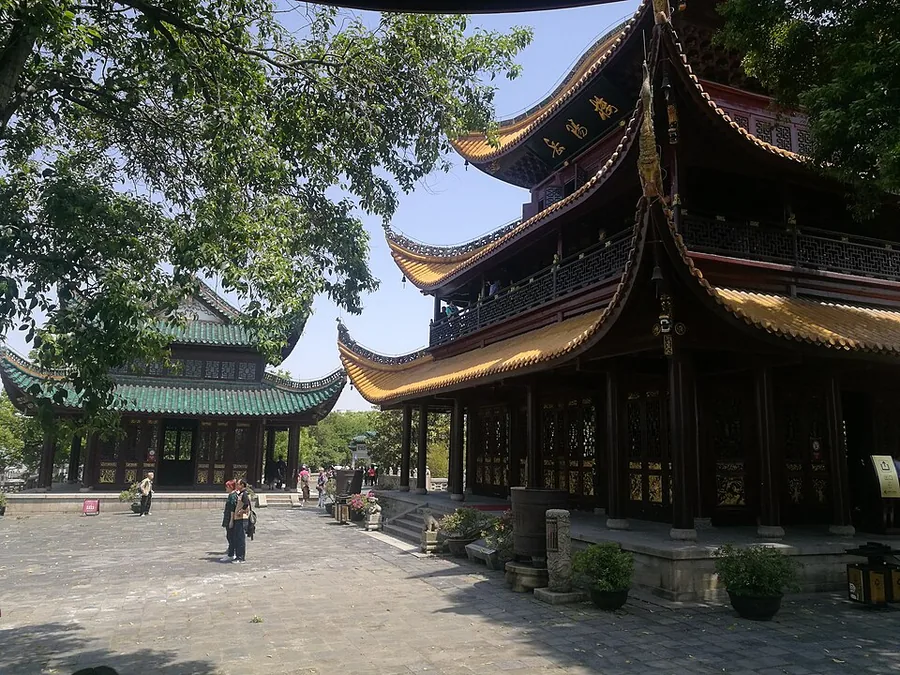
Photo adjustments
Proportionally resized and converted to WebP without cropping, retouching or changing the photographed subject.
Explore the region
About Yueyang Tower
Its timber structure and helmet-shaped roof reward close attention, while Fan Zhongyan’s celebrated essay explains why the building has such a strong place in Chinese literary memory. The present tower preserves Qing-period fabric alongside later conservation. Smaller pavilions and inscriptions extend the visit beyond the main building, and the changing lake level and visibility mean the waterside view will not always match familiar photographs.
The tower originated around AD 220 as the 'Watching Troops Tower' (阅军楼), attributed to Lu Su, a general of the Eastern Wu state during the Three Kingdoms period. It was known as the 'Baling City Tower' (巴陵城楼) during the Western Jin and Northern and Southern dynasties, and took its present name, Yueyang Tower, from the mid-Tang period. It has been rebuilt and altered several times to match the architectural style of each period.
The main tower rises 19.42 meters high, 14.54 meters deep and 17.42 meters wide across a footprint of 251 square meters. Four nanmu pillars run from floor to roof, linked by surrounding corridors, beams and purlins joined entirely by mortise and tenon, with no iron nails used, and the roof rests on ruyi bracket sets. Its smooth, steeply upturned curve resembles an ancient warrior's helmet, and it is the largest existing helmet-roofed building in China. Yueyang Tower Park also displays restored models of the tower's appearance through successive dynasties, called the 'Five Dynasties Towers' (五朝楼观), based on old paintings and records.
It is the only one of the Three Great Towers of Jiangnan (江南三大名楼) to retain its original form. Yueyang Tower was listed as a Major Historical and Cultural Site Protected at the National Level in January 1988 and rated a national 5A tourist attraction in 2001.
What to look for
- The timber tower and its distinctive helmet-shaped roof.
- Literary inscriptions and the surrounding Sanzui and Xianmei pavilions.
Location & getting there
Getting to Yueyang Tower
Use the Yueyang Tower scenic entrance on Dongting North Road at the old city’s lake-facing edge. Confirm access to the tower itself separately from the adjoining public leisure streets and lakeside spaces.
Combine your visit
A suggested order for exploring this place and its immediate setting.
-
Main tower岳阳楼
Study the timber structure and the Dongting Lake outlook.
-
Literary interpretation岳阳楼记与碑刻
Read the relationship between the building and Fan Zhongyan’s essay.
-
Sanzui and Xianmei pavilions三醉亭与仙梅亭
Complete the architectural group before continuing to the public waterfront.
Check access to the individual stops. A suggested sequence does not imply a combined ticket or guaranteed transfer.
Find Yueyang Tower
岳阳楼 · 岳阳市
The pin marks the area, not the entrance.
More places nearby
Approximate straight-line distances between map pins, not travel distances.
Yueyang Museum 岳阳博物馆
5 km awayYueyang Museum gives the Dongting region an archaeological and social history beyond the famous tower. The ancient-civilisation display follows objects from the wider area, while local folk-culture material connects them with…
View guide →Junshan Island 君山岛
9 km awayJunshan Island combines wooded paths, tea associations and legendary sites within the Dongting Lake landscape. The Xiangfei Shrine, Two Consorts’ Tomb and Liu Yi Well belong to a rich body of stories about love, loyalty and the…
View guide →Sources & visit information
The sources below support the place-specific description and arrival information. Suggested combinations are editorial planning ideas; confirm current opening, entry arrangements and transport services for your date.
- Yueyang Tower ↗
- Yueyang government — surviving fabric and scenic-area layout ↗
- Scenic operator — current visitor arrangements ↗
- Chinese Wikipedia: 岳阳楼 (revision 91965474, 2026-03-20) ↗
Visitor information adapted and edited from Wikipedia contributors: Yueyang Tower · CC BY-SA 4.0. Source revision 1364686164.
Background paragraphs translated and condensed from Wikipedia contributors, "岳阳楼", Chinese Wikipedia · CC BY-SA 4.0. Source revision 91965474.