

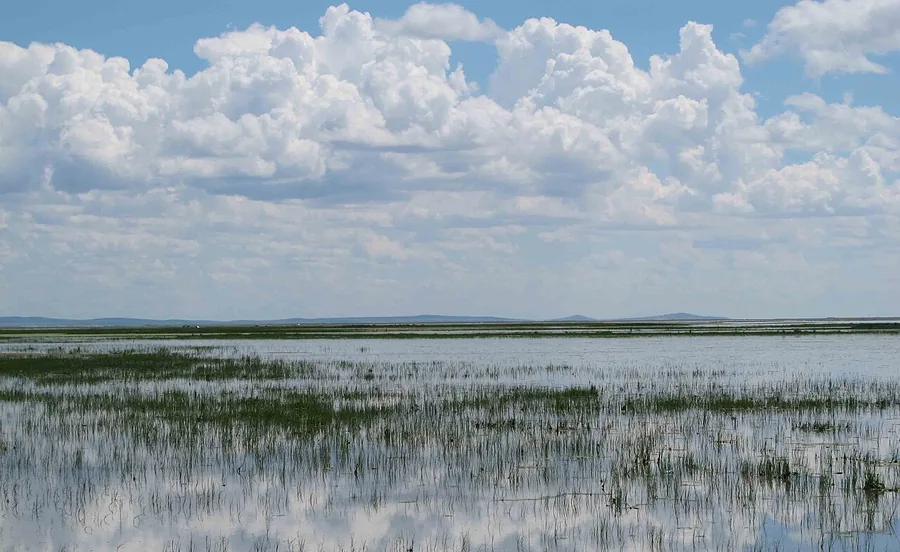
Photo adjustments
Proportionally resized and converted to WebP without cropping, retouching or changing the photographed subject.
Explore the region
About Hulun Lake
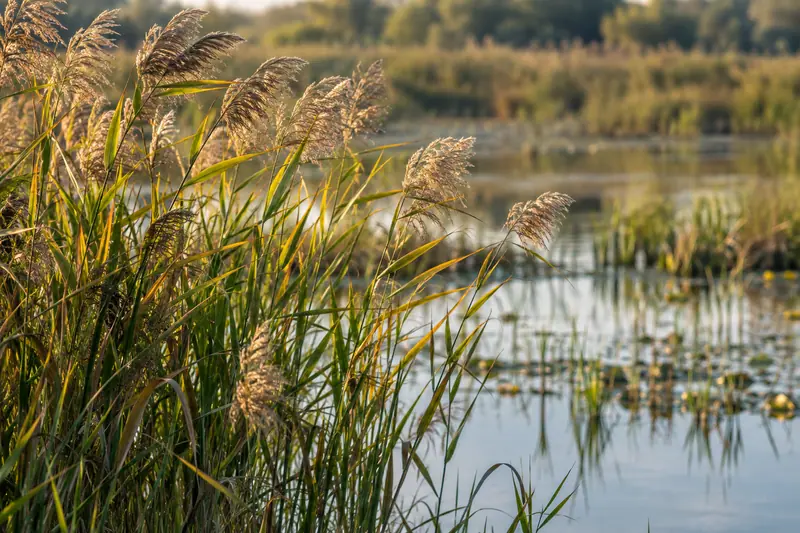
Reeds and wetlands around its margins form important habitat, while the managed Xiaohekou visitor shore provides the familiar open-water view. The lakeside goddess sculpture is a useful landmark within this developed sector. Concentrating on the northern visitor area gives a coherent lake visit without attempting to follow the entire shore or enter the protected wetland beyond the public route.
The lake has carried several names through history: Daze (大泽) in the Shanhaijing, Julunbo (俱伦泊) in the Tang dynasty, and Kulenghu (库楞湖) in the Qing, while local herders call it Dalai Nur (达赉诺尔), meaning 'sea-like lake' in Mongolian. Hulun, the modern name, means 'otter' in Mongolian; paired with the neighbouring Buir Lake ('male otter'), the names recall a time when otters were plentiful in both lakes.
Hulun Lake occupies a strongly subsided structural basin at the western end of the Hulunbuir grassland, mostly within Xin Barag Right Banner. It covers about 2,339 square kilometres and is 93 kilometres long, with an average depth of 5.7 metres; combined water and wetland area totals 3,253 square kilometres. It freezes from early November to early May, with ice over a metre thick. Its main inflows are the Urshun River, draining Buir Lake, and the Kerulen River, which rises in Mongolia.
The Dalai Lake Nature Reserve was established in 1986 and upgraded to a national-level nature reserve in 1992, later renamed Hulun Lake National Nature Reserve. In 1994 China, Mongolia and Russia agreed to jointly form the Dauria International protected area from their respective adjoining reserves. The lake was listed as a Wetland of International Importance in 2002 and accepted as a UNESCO biosphere reserve.
What to look for
- The broad water and grassland horizon from the Xiaohekou visitor shore.
- The Hulun Lake Goddess sculpture holding a red pearl beside the lake.
Location & getting there
Getting to Hulun Lake
Approach from Manzhouli and Zhalainuoer toward the northern visitor reception area in the Yueya Lake sector.
- The new reception centre was completed in 2024 as part of the Xiaohekou restoration project; confirm the current reception and internal transfer arrangement before continuing to the lakeshore.
Combine your visit
Suggested order within this visit:
-
Xiaohekou lakeshore
Begin with the lake's scale and open horizon.
-
Hulun Lake Goddess sculpture
Continue along the authorised visitor shore to its named landmark.
This sequence is an editorial suggestion based on the features described in the sources. Access to individual buildings or areas should be checked locally; no travel time or shared admission is implied.
Find Hulun Lake
呼伦湖 · 呼伦贝尔
The pin marks the area, not the entrance.
More places nearby
Approximate straight-line distances between map pins, not travel distances.
Manzhouli Beihu Park 满洲里北湖公园
69 km awayBeihu Park is a small urban-lake retreat in northwestern Manzhouli. Its appeal comes from the water, planted edges and views back toward the surrounding city, rather than a long sightseeing checklist. A circuit along the…
View guide →Manzhouli Matryoshka Square 满洲里套娃广场
71 km awayManzhouli's Matryoshka complex turns the Russian nesting doll into architecture, scenery and entertainment. The giant doll-shaped hotel anchors a theme park whose buildings borrow Russian decorative forms. Inside, the Matryoshka…
View guide →Manzhouli National Gate Visitor Center 满洲里国门景区游客中心
73 km awayThe National Gate visitor complex presents Manzhouli's border and railway history around the monumental gate above the rail corridor. Boundary Monument No. 41 marks the frontier, while Locomotive Square makes the railway…
View guide →Sources & visit information
The sources below support the place-specific description and arrival information. Suggested combinations are editorial planning ideas; confirm current opening, entry arrangements and transport services for your date.
- Wikipedia: Hulun Lake ↗
- Hulunbuir government: 2024 northern lake visitor-centre project ↗
- Inner Mongolia gazetteer: Xiaohekou and Hulun Lake Goddess ↗
- Chinese Wikipedia: 呼倫湖 (revision 92375033, 2026-04-22) ↗
Visitor information adapted and edited from Wikipedia contributors · CC BY-SA 4.0. Source revision 1366029569.
Background paragraphs translated and condensed from Wikipedia contributors, "呼倫湖", Chinese Wikipedia · CC BY-SA 4.0. Source revision 92375033.