

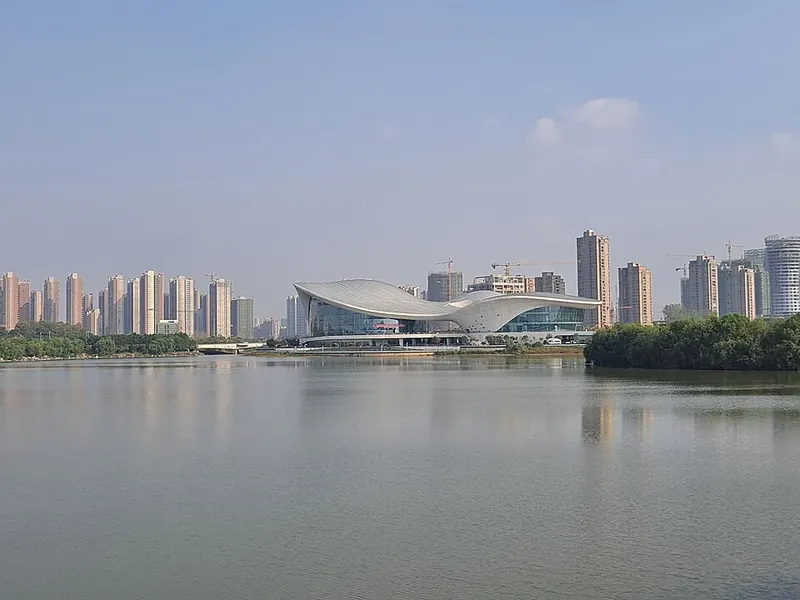
Photo adjustments
Full frame retained; proportionally resized and converted to WebP. No retouching or changes to the photographed subject. Card displays may crop the view.
Explore the region
About Jiujiang
Suojiang Tower and its pagoda mark the river edge, while Yanshui Pavilion occupies a small island reached by a winding bridge. These monuments also connect the city with its literary and trading past. A city visit can focus on this river-and-lake contrast before a separate trip into Lushan.
The name Jiujiang first appeared under the Qin dynasty, when a commandery of that name administered from Shou County (寿春) covered the area, though no county existed here yet; its territory later shrank and was renamed Huainan commandery (淮南郡) by the Three Kingdoms period. A county was established at Chaisang (柴桑) in 201 BC, during the Han dynasty. The name Jiujiang became fixed in the Ming dynasty. The city was taken by Taiping Rebellion forces in 1853 and by Xiang Army troops in 1858.
In 1861, Jiujiang was opened as a treaty port under the Treaty of Tianjin (天津条约) and the Treaty of Peking (北京条约), and a British concession (九江英租界) of 150 mu (亩) was established between the Yangtze and Gantang Lake (甘棠湖) west of the city; the concession was returned to China in 1927. As the only stop in Jiangxi for the Yihe and Taigu (怡和, 太古) shipping lines, Jiujiang quickly overtook other towns to become the province's trade hub, developing into one of China's 'four great rice markets' (四大米市) and 'four great tea markets' (四大茶市). In the late nineteenth century, Guling (牯岭) atop Mount Lu became a noted summer retreat, known during the Republican era as China's 'summer capital' (夏都).
What to look for
- Suojiang Tower’s riverside setting beside the old pagoda.
- Yanshui Pavilion and the winding bridge across Gantang Lake.
Background & history
Jiujiang, formerly transliterated Kiukiang and Kew-Keang, is a prefecture-level city located on the southern shores of the Yangtze River in northwest Jiangxi Province in the People's Republic of China. It is the second-largest prefecture-level city in Jiangxi and its borders include Poyang Lake, the largest freshwater lake in China. Jiujiang is the fourth largest port on the Yangtze River and was one of the first five cities that were opened to foreign trade along the Yangtze River following the implementation of Deng Xiaoping's Opening-Up Policy. It is Jiangxi's only international trade port city. In 2007, the city was named China's top ten livable cities by the Chinese Cities Brand Value Report, which was released at 2007 Beijing Summit of China Cities Forum. In 2022, the State Council of China granted Jiujiang the title of Famed National Historical and Cultural City for its rich history and multicultural background in the Republican era.
Excerpt from Wikipedia: Jiujiang · Wikipedia contributors · CC BY-SA 4.0. Selected introductory sentences; formatting simplified. Background information, not current visitor-service advice.
Location & getting there
Getting to Jiujiang
Use Jiujiang railway station for the urban visit, then transfer to Binjiang Road for Suojiang Tower or to Gantang Lake for Yanshui Pavilion. Lushan railway station serves a different arrival area and is not in the old riverfront district.
Combine your visit
A suggested sequence linking the specific features of this visit.
-
Suojiang Tower
Start beside the Yangtze and compare tower and pagoda forms.
-
Yanshui Pavilion
Continue to the smaller-scale lake landscape and island buildings.
This order is editorial. Confirm access and any transfers between stops; it does not establish a walking route, same-day connection or common admission ticket.
Find Jiujiang overview
九江 · 九江市
The pin marks the area, not the entrance.
More places nearby
Approximate straight-line distances between map pins, not travel distances.
Donglin Temple (Jiangxi) 东林寺
6 km awayDonglin Temple lies at Lushan’s northwestern foot and is closely associated with Huiyuan and the Pure Land Buddhist tradition. The present complex includes a main Buddha hall and smaller commemorative spaces set among wooded…
View guide →Lushan 庐山
12 km awayLushan combines a highland resort town with rocky valleys, lakes and a remarkable concentration of literary and religious sites. Around Guling, historic villas recall its development as a summer retreat, while the Flower Path…
View guide →Sandie Spring Waterfall 庐山三叠泉瀑布
14 km awaySandiequan drops down three rock steps below Lushan’s Wulao Peaks. The water first falls sharply, spreads across the intermediate ledges and gathers again before reaching the lower pool. Different rock layers and erosion created…
View guide →Sources & visit information
The sources below support the place-specific description and arrival information. Suggested combinations are editorial planning ideas; confirm current opening, entry arrangements and transport services for your date.
- Jiujiang ↗
- szfzsb.jiujiang.gov.cn ↗
- xunyangjiang.cn ↗
- www.lushan.gov.cn ↗
- Chinese Wikipedia: 九江市 (revision 94241127, 2026-09-08) ↗
Visitor information adapted and edited from Wikipedia contributors, “Jiujiang” · CC BY-SA 4.0. Source revision 1366843976.
Background paragraphs translated and condensed from Wikipedia contributors, "九江市", Chinese Wikipedia · CC BY-SA 4.0. Source revision 94241127.