

Photo adjustments
Wikimedia thumbnail; fitted to the ranking-card frame.
Explore the region
About Mu Palace
A long central axis links formal halls with side courtyards and upper buildings. The Assembly Hall introduces the governing role, while Wanjuan Tower connects the complex with books and scholarship. Read it as a reconstructed museum site, and follow the main axis before stepping into the smaller side spaces.
Mu Palace was originally built as the office and residence of the Ming-dynasty Mu chieftains (木氏土司) in 1382, during the Hongwu era (洪武), with the Wanli era (万历) later adding buildings such as the Zhongyi Gateway (忠义坊). Xu Xiake (徐霞客), visiting in 1639, during the Chongzhen era (崇祯), described the chieftain's residence as rivalling a king's palace in splendour. Looted in 1647 and largely burned in fighting in 1860, the complex was later rebuilt on a much smaller scale, with only three courtyards, and was further damaged during the Cultural Revolution before its reconstruction after the 1996 Lijiang earthquake.
Its design is said to have followed the symmetrical, formal layout of the imperial central court, giving the complex a resemblance to a miniature Forbidden City. The present buildings date from a 1999 reconstruction, which also established the Lijiang Ancient Town Museum (丽江古城博物院) on the site; the complex covers 46 mu (亩), with a central axis 369 metres long. In 2012 it was listed in the second batch of Lijiang Municipal Protected Cultural Sites (丽江市文物保护单位).
What to look for
- The Assembly Hall and long central axis reveal the formal administrative layout.
- Wanjuan Tower connects the complex with its tradition of collecting books and manuscripts.
Location & getting there
Getting to Mu Palace
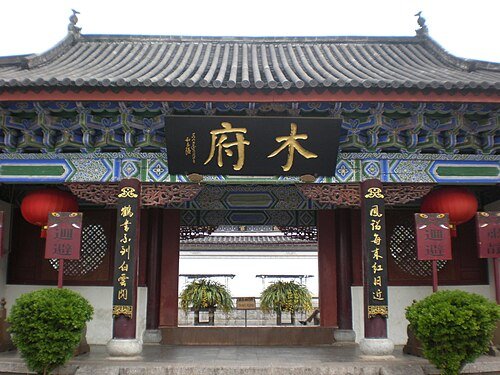
The entrance is at 49 Guanyuan Lane, Guangyi Street, within Lijiang’s old town. Approach on foot through the old-town lanes to the Mu Palace frontage below Lion Hill.
Combine your visit
Suggested order for the visit:
-
Assembly Hall
Begin with the formal governing space.
-
Wanjuan Tower
Continue with the scholarly collection theme.
-
Side courtyards
Compare smaller spaces with the main axis.
This is an editorial sequence of named spaces or places. It does not imply a verified walking connection or promise opening, ticket availability or a journey time.
Find Mu Palace
木府 · 古城区
The pin marks the area, not the entrance.
More places nearby
Approximate straight-line distances between map pins, not travel distances.
Wangu Pavilion 万古楼
Less than 1 km awayWangu Pavilion rises above Lijiang old town on Lion Hill. The reconstructed five-storey timber building uses tall columns, carved dragon decoration and surrounding stone lions to create a monumental lookout. Where upper-level…
View guide →Dayan Sifang Square 大研四方街
Less than 1 km awaySifang Square is the central gathering place of Dayan Old Town, with lanes extending towards the surrounding bridges and courtyard streets. On its western side, Kegongfang rises as a three-storey gateway; east of the square…
View guide →Zhongyi Market 忠义市场
Less than 1 km awayZhongyi Market is a working produce market on the southern edge of Dayan Old Town. The stalls make the seasons visible: spring brings edible blossoms and young shoots, while the rainy season brings displays of mushrooms such as…
View guide →Sources & visit information
The sources below support the place-specific description and arrival information. Suggested combinations are editorial planning ideas; confirm current opening, entry arrangements and transport services for your date.
- 木府 ↗
- Wikivoyage: Lijiang ↗
- Yunnan Ethnic and Religious Affairs Commission: Mu Palace museum ↗
- Lijiang Daily: Mu Palace visitor spaces ↗
- Chinese Wikipedia: 木府 (revision 92860944, 2026-05-31) ↗
Visitor information adapted and edited from Wikipedia contributors, “木府” · CC BY-SA 4.0. Source revision 92860944.
Visitor information adapted and edited from Wikivoyage contributors, Lijiang · CC BY-SA 4.0. Source revision 5236561.
Background paragraphs translated and condensed from Wikipedia contributors, "木府", Chinese Wikipedia · CC BY-SA 4.0. Source revision 92860944.