

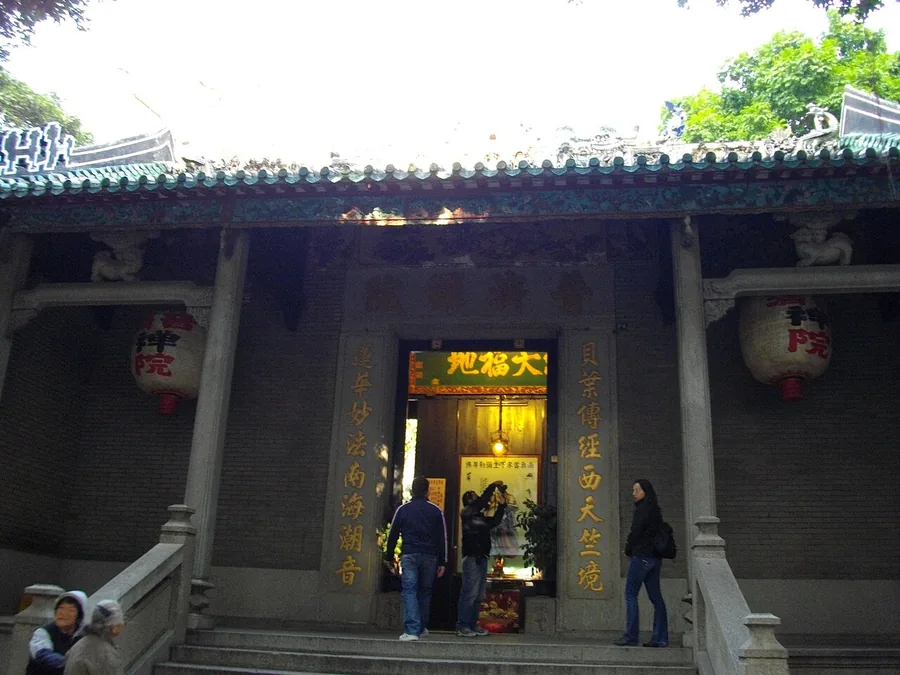
Photo adjustments
Proportionally resized and converted to WebP without cropping, retouching or changing the photographed subject.
About Kun Iam Temple
The first hall contains three Buddha images, while the principal Guanyin Hall is flanked by arhats. Ceramic roof figures add detail above the courtyards. In the garden, a stone table marks the setting associated with the Treaty of Wanghia. Follow the halls before the garden to understand the complex’s religious and historical layers.
The monastery's exact founding date is unknown, but a bell dated to the fifth year of the Chongzhen reign (崇祯五年) and a stele from the seventh year of the Tianqi era (天启七年) indicate it was established no later than the end of the Ming dynasty. Its founding patriarch is recorded as the monk Shi Lian Dashan (石濂大汕). A pavilion commemorating the 1844 treaty signed at the temple was erected in 1944.
A bronze bell over 350 years old hangs beside the main hall, whose roof ridge bears Ming-dynasty glazed tiles and Shiwan ceramic figures. The Guanyin statue in the rear hall, carved from camphor wood, sits on a lotus throne flanked by eighteen arhats; local tradition holds that one arhat represents the Venetian traveller Marco Polo. The rear garden is described as unusually large among Buddhist temple gardens in Hong Kong and Macau.
During the Second Sino-Japanese War the painter Gao Jianfu (高剑父) lived at the temple, which holds his paintings and those of his student Guan Shanyue (关山月), plus the manuscript diary of the late-Ming monk Jin Bao (金堡). With A-Ma Temple (妈阁庙) and Lin Fung Temple (莲峰庙) it is one of Macau's three great ancient temples, named one of the “Eight Sights of Macau” in 1992, and designated a Monument (纪念物).
What to look for
- Buddha and Guanyin halls contain distinct groups of religious images.
- Ceramic figures decorate the rooflines above the courtyards.
- The rear garden includes the stone table associated with the Treaty of Wanghia.
Background & history
The Kun Iam Temple (Chinese: 觀音堂, Portuguese: Templo de Kun Iam Tong) is a Chinese Buddhist temple in Nossa Senhora de Fátima, Macau, China. One of the three largest and richest Buddhist temples in Macau, its more official name is Pou Chai Sim Un (Pou Chai Temple, Chinese: 普濟禪院). It is regarded as one of the oldest temples in Macau, it was founded in the 13th century to venerate Kun Iam, the Chinese representation of Avalokiteśvara, the Bodhisattva of Mercy.
Excerpt from Wikipedia: Kun Iam Temple · Wikipedia contributors · CC BY-SA 4.0. Selected introductory sentences; formatting simplified. Background information, not current visitor-service advice.
Location & getting there
Getting to Kun Iam Temple
The tourism office gives 2 Avenida do Coronel Mesquita for Kun Iam Tong. Use this temple address, since Macau has other separate Guanyin shrines and an offshore Kun Iam statue.
Combine your visit
Suggested order for the visit:
-
First Buddha hall
Observe the principal group of images.
-
Guanyin Hall
Continue to the Guanyin and arhat figures.
-
Rear garden
Look at the treaty-associated stone table.
This is an editorial sequence of named spaces or places. It does not imply a verified walking connection or promise opening, ticket availability or a journey time.

Find Kun Iam Temple
普济禅院 · 澳门半岛
The pin marks the area, not the entrance.
More places nearby
Approximate straight-line distances between map pins, not travel distances.
Communications Museum, Macau澳门通讯博物馆
Less than 1 km awayMacao’s Communications Museum links postal history with the science of transmitting information. The postal section presents stamps, equipment and objects associated with the local postal service. Telecommunications displays…
View guide →Lou Lim Ieoc Garden卢廉若公园
Less than 1 km awayLou Lim Ioc Garden compresses a Suzhou-inspired landscape inside high walls. Narrow paths weave between bamboo, flowering shrubs and artificial rock forms before reaching a pond with carp and seasonal lotus. A zigzag bridge…
View guide →Red Market红街市
Less than 1 km awayThe Red Market is a working food market inside a striking Art Deco building. Red brick, a central tower and smaller corner towers distinguish it from the surrounding apartment blocks. Inside, fresh produce and food stalls…
View guide →Sources & visit information
The sources below support the place-specific description and arrival information. Suggested combinations are editorial planning ideas; confirm current opening, entry arrangements and transport services for your date.
- Kun Iam Temple ↗
- Wikivoyage: Macau/Peninsula ↗
- Macao Government Tourism Office: Kun Iam Tong ↗
- Chinese Wikipedia: 普濟禪院 (revision 92955803, 2026-06-05) ↗
Visitor information adapted and edited from Wikipedia contributors, “Kun Iam Temple” · CC BY-SA 4.0. Source revision 1366847151.
Visitor information adapted and edited from Wikivoyage contributors, Macau/Peninsula · CC BY-SA 4.0. Source revision 5237853.
Background paragraphs translated and condensed from Wikipedia contributors, "普濟禪院", Chinese Wikipedia · CC BY-SA 4.0. Source revision 92955803.