


Photo adjustments
EXIF orientation normalized; resized without changing aspect ratio; converted to WebP. No subject edits.
Explore the region
About Big Buddha Temple Grottoes
Big Buddha Temple Grottoes (大佛寺石窟) are Buddhist cave shrines hewn into cliffs on the south bank of the Jing River (泾河), within the grounds of the Big Buddha Temple (大佛寺), about 10 km west of the city of Binzhou (彬州市) in Xianyang (咸阳), Shaanxi. The caves face north across the river.
Cutting began under the Northern Dynasties (北朝), but most of the work came in the early Tang and was largely complete by 628. The Binzhou city government says Emperor Taizong (唐太宗) founded the temple, first named Yingfu Temple (应福寺), for soldiers killed in the battles of Qianshuiyuan (浅水原) and Wulongban (五龙阪) that he commanded. It became Qingshou Temple (庆寿寺) under the Northern Song, and from the Ming it has been known simply as the Big Buddha Temple after its Amitabha statue. More caves were added under the Song, Yuan and Ming.
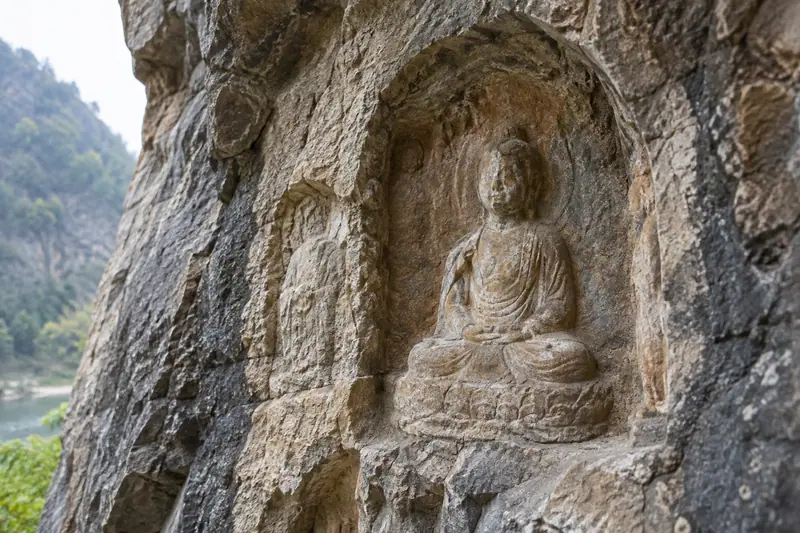
More than 130 caves spread over a cliff face roughly 400 m long, with 446 niches and over 1,980 statues according to the city government. They fall into four groups: the Big Buddha Cave (大佛窟), the Thousand Buddha Cave (千佛洞), the Arhat Cave (罗汉洞) and the Zhangba Buddha Cave (丈八佛窟). The Qing scholar Bi Yuan (毕沅) called the site the "first wonder of Guanzhong" (关中第一奇观).
The Big Buddha Cave, about 34 m across, holds three figures of carved stone finished in clay. The Amitabha sits on a lotus throne, 20 m tall, with seven relief Buddhas and flying apsaras (飞天) in the halo behind its head; the bodhisattvas Guanyin (观世音菩萨) and Mahasthamaprapta (大势至菩萨) stand 15.6 m high on either side. In front rises a five-storey protective tower, 32 m tall, rebuilt in the Ming Jiajing (嘉靖) reign. Its second storey, inscribed Mingjing Terrace (明镜台), has three arches that open into the cave and light the statues; the upper storeys are timber and can be climbed.
The grottoes joined the third batch of national key cultural relics protection units in 1988. In June 2014 UNESCO inscribed them, as Binxian Cave Temple (彬县大佛寺石窟), within the Silk Roads: the Routes Network of Chang'an-Tianshan Corridor, which made them Xianyang's first World Heritage property.
What to look for
- Big Buddha Cave (大佛窟), with a 20 m Amitabha flanked by two 15.6 m bodhisattvas
- The halo behind the Amitabha's head, carved with seven Buddhas and flying apsaras
- The 32 m five-storey protective tower in front of the Big Buddha Cave, with the Mingjing Terrace (明镜台) arches
- Thousand Buddha Cave (千佛洞), east of the Big Buddha, with over 300 figures, mostly in relief
- Arhat Cave (罗汉洞), four small linked caves to the west, with Manjushri (文殊菩萨) seated on a lion
- Zhangba Buddha Cave (丈八佛窟), nine small caves 200 m west, centred on a 7.5 m Buddha
Location & getting there
Getting to Big Buddha Temple Grottoes
- Search for 大佛寺石窟 with 咸阳市 and 彬州市.
Find Big Buddha Temple Grottoes
大佛寺石窟 · 彬州市
No reliable map pin yet: search by the Chinese name.
Sources & visit information
Written from the linked sources and checked sentence by sentence against quoted extracts by a separate reviewer on 2026-09-23. Opening hours, admission and access arrangements are not covered; confirm current visitor information with the site.
Some facts checked against Wikipedia contributors, "大佛寺石窟" · CC BY-SA 4.0.