

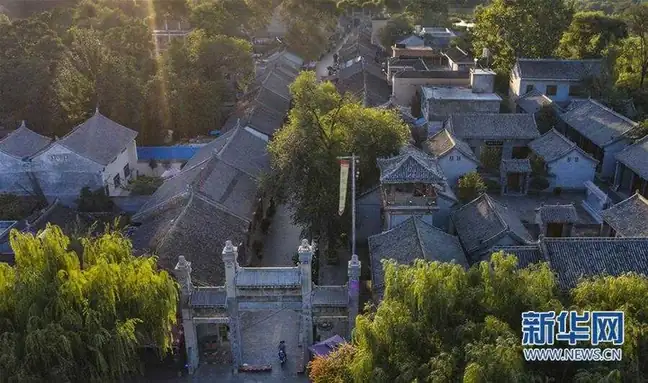
Photo adjustments
EXIF orientation normalized; resized without changing aspect ratio; converted to WebP. No subject edits.
Explore the region
About Dihua Ancient Town
Dihua is where Jia Pingwa lived for 19 years and the setting of Qin Qiang, the novel that won him the Mao Dun Literature Prize. The town stands by the Dan River in Danfeng County; a Xinhua photo report lists its scenery as including the Song-Jin border town, the Qingfeng old street, a lotus pond of a thousand mu, the Shangshan greenway and the Dan River national wetland park.
The street a visitor walks today is a reconstruction rather than the historic fabric. The feature is explicit that the town had no Qingfeng Street before: the scenic area opened on 28 September 2014 and copied the Qingfeng Street of Jia's novel to create the street now standing there, on the site of the older Dihua old street where he spent his childhood. Along with the street came a theatre, the Kuixing Tower, the Erlang Temple and the Niangniang Temple, and the older Dihua post station and Song-Jin Street. The feature gives the scenic area's extent as 170 hectares.
The town's 'border town' name comes from the 12th-century frontier: the feature records that in the Southern Song period this was where the Song and Jin negotiated, with a Song-Jin Street dividing the boundary by a change of paving. The Erlang Temple, Song-Jin Street, Song-Jin Bridge and Song-Jin old well have been restored as sights. Two temples stand side by side — the Erlang Temple, built in 1211, the third year of the Jin Da'an era, and east of it the Guandi Temple, built in 1753, the eighteenth year of the Qianlong reign, which the feature says was built in imitation of the older one. Jia Pingwa's old family house and the Jia Pingwa literature and art museum also stand in the town; the museum was locked when the feature's reporters visited, and no cited source states present opening arrangements for either.
What to look for
- Qingfeng Street, laid out in 2014 after the street in Jia Pingwa's novel Qin Qiang
- The Erlang Temple of 1211 and, east of it, the Guandi Temple of 1753, which the feature says was built in imitation of the older building
- Song-Jin Street, where the feature records that paving divided the 12th-century Song-Jin boundary
- The lotus pond of a thousand mu and the Dan River national wetland park, named in the Xinhua report among the town's scenery
- Jia Pingwa's old family house and the Jia Pingwa literature and art museum
Location & getting there
Getting to Dihua Ancient Town
Identify the main visitor approach and any separately managed houses, museums or performances. Ask before entering residential spaces or photographing residents.
- Search for 棣花古镇 with 商洛市 and 丹凤县.

Find Dihua Ancient Town
棣花古镇 · 丹凤县
No reliable map pin yet: search by the Chinese name.
Sources & visit information
The linked sources support the identity and background described in this introduction. Opening hours, admission, activity availability and exact arrival arrangements have not been comprehensively checked. Confirm current visitor information with the venue; the original catalogue locality and editorial review flag are retained.