


Photo adjustments
Full frame retained; proportionally resized and converted to WebP. No retouching or changes to the photographed subject. Card displays may crop the view.
Explore the region
About Hongshi Gorge
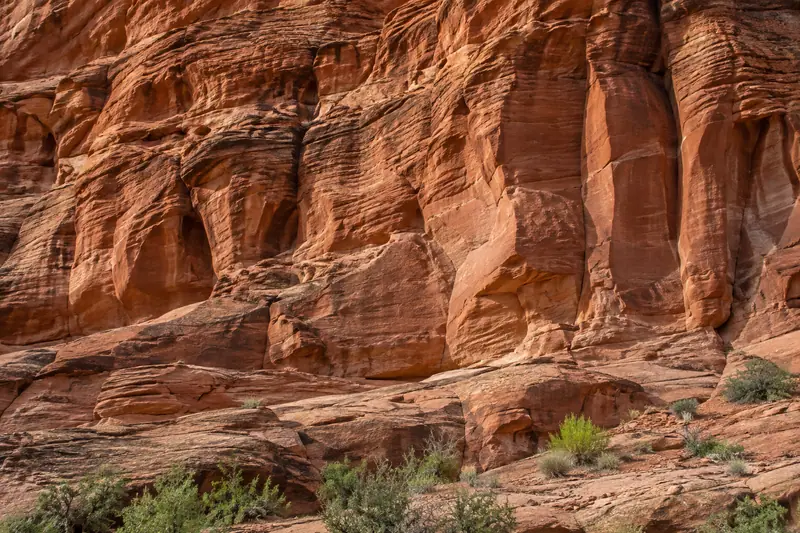
The gorge takes its name from its red rock, which the district heritage page says is high in iron and has oxidised to a rust-red colour; the late-afternoon effect known as 红山夕照 is one of Yulin's Eight Scenes, and the page also names 水帘飞雪 and 石洞栖云 among the Eight Scenes' sights. It records 34 cave shrines along the cliffs, their wall and ceiling carvings worn but still legible, and 35 steles inside the caves, mostly Ming and Qing, in record, merit and name categories – examples the page gives include a 1487 record of founding a stone Buddha hall and an 1857 text on rebuilding the gorge's Buddhist temple.
The district page calls the cliff inscriptions the site's most celebrated feature. It records more than 160 originally on the east and west cliffs, of which 120 survive, in seal, clerical, regular, running and cursive scripts and with rare Mongolian examples. Named carvings include 龙蟠虎踞 (1581), 万里长城 (1586) and 雄石封关 (1599) on the west cliff, and among later work 左宗棠's 榆溪胜地 and the 1924 carvings 力挽狂澜 and 还我河山. A 2023 report on Shaanxi's provincial news portal Xiyang Wang adds that the rock here is comparatively soft and suited to carving, and that the inscriptions use both cutting techniques, with 大漠金汤 and 山河巩固 carved in relief and 蓬莱仙岛 and 力挽狂澜 cut in. In 1992 the Shaanxi Provincial People's Government listed the cliff inscriptions in the third batch of provincial-level protected cultural relics.
What to look for
- The carved inscriptions on the east and west cliffs, recorded at more than 160 originally with 120 surviving, in seal, clerical, regular, running and cursive scripts, alongside rare Mongolian examples.
- The dated Ming carvings on the west cliff, including 龙蟠虎踞 (1581), 万里长城 (1586) and 雄石封关 (1599).
- The 1924 carvings 力挽狂澜 and 还我河山, and 左宗棠's 榆溪胜地.
- The two cutting techniques the report distinguishes: 大漠金汤 and 山河巩固 carved in relief, 蓬莱仙岛 and 力挽狂澜 cut in.
- The 34 cave shrines along the cliffs, and the 35 steles inside them – mostly Ming and Qing, in record, merit and name categories.
Location & getting there
Getting to Hongshi Gorge
Check which interiors and courtyards are accessible. Active places of worship and protected monuments may have different visitor rules.
- Search for 红石峡 with 榆林市 and 榆阳区.
Find Hongshi Gorge
红石峡 · 榆阳区
No reliable map pin yet: search by the Chinese name.
Sources & visit information
The linked sources support the identity and background described in this introduction. Opening hours, admission, activity availability and exact arrival arrangements have not been comprehensively checked. Confirm current visitor information with the venue; the original catalogue locality and editorial review flag are retained.