

Photo adjustments
EXIF orientation normalized; resized without changing aspect ratio; converted to WebP. No subject edits.
Explore the region
About Tongguan Ancient City and Yellow River Viewing Area
Tongguan took over from Hangu Pass as the eastern gate of the region. The Yellow River Conservancy Commission's account records that silting raised the riverbank north of Hangu Pass and weakened its position, and that in the first year of Jian'an under the Eastern Han, which the page dates to 196, the defensive gate was moved west onto the loess tableland nearer the meeting of the Yellow, Wei and Luo rivers: Hangu was abandoned and Tongguan was established. It quotes the Commentary on the Waterways Classic – the river, flowing south inside the pass, dashes against the pass mountain, and that is why the pass is called Tong. It describes the pass as commanding the junction of Shaanxi, Shanxi and Henan, with the Qinling to the south and the Yellow River to the north, and its defences as an I-shaped system formed by the Qinling, the river, the Jing gully and the Twelve Linked Cities. Between the Eastern Han and the Tang, the same account says, the pass was built three times and moved twice.
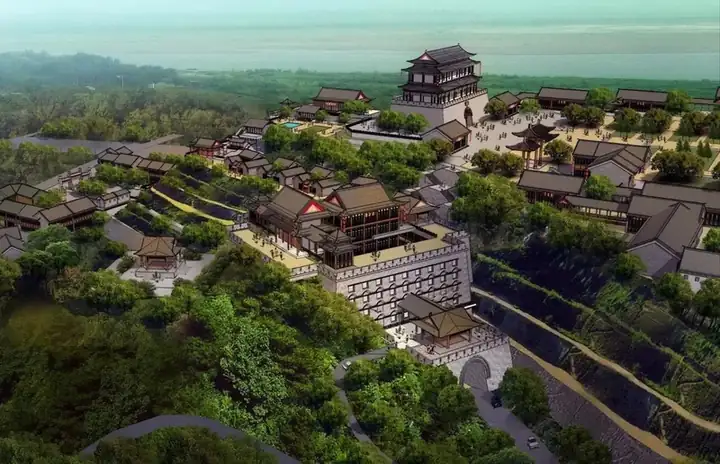
The present scenic area is a reconstruction centred on the Dongshan scenic area. A Western Network report describes it as taking old Tongguan culture as its core, linking Yellow River myths with the town's history, and recreating scenes from the eight views of Tongguan, among them the evening light on the drum tower and the crouching tiger of the pass. It gives the project an area of more than 9,600 mu with more than 3,000 mu of planned construction land, in three broad zones plus the city defence system and related visitor facilities, and records that in December 2020 the ancient city was created a national AAAA-grade scenic area. The Tongguan county museum stands inside it; the county people's congress page describes the museum building as reproducing the Ming and Qing panorama tower of old Tongguan and says its third- and fourth-floor viewing platforms take in the whole scenic area and the meeting of the three rivers. The conservancy commission's account names the surviving Ming and Qing buildings of Shuipo alley as a representative northern Chinese water street, the Yuedu scenic area, and the old ferry area.
The catalogue's second element is not a name any cited page uses. No cited page calls the confluence viewpoints by the phrase 'Yellow River viewing area'; the named places are the Yuedu and old-ferry areas and the museum's upper platforms. The pages also differ on the museum's floor area, at 3,400 square metres on the county people's congress page and 3,374.38 square metres in the Western Network report.
What to look for
- The third- and fourth-floor viewing platforms of the Tongguan museum building, which the county people's congress page says take in the whole scenic area, the meeting of the three rivers and the Yellow River golden triangle.
- Shuipo alley, whose surviving Ming and Qing buildings the Yellow River Conservancy Commission's account calls a representative northern Chinese water street.
- The Yuedu scenic area, which the same account sums up in the couplet 'one pavilion takes in the scenery of three provinces'.
- The old ferry area, which the account says displays Tongguan's ferry culture.
- The recreated scenes from the eight views of Tongguan that the Western Network report lists, among them the evening light on the drum tower and the crouching tiger of the pass.
Location & getting there
Getting to Tongguan Ancient City and Yellow River Viewing Area
Check which interiors and courtyards are accessible. Active places of worship and protected monuments may have different visitor rules.
- Search for 潼关古城与黄河观景区 with 渭南市 and 潼关县.
Find Tongguan Ancient City and Yellow River Viewing Area
潼关古城与黄河观景区 · 潼关县
No reliable map pin yet: search by the Chinese name.
Sources & visit information
The linked sources support the identity and background described in this introduction. Opening hours, admission, activity availability and exact arrival arrangements have not been comprehensively checked. Confirm current visitor information with the venue; the original catalogue locality and editorial review flag are retained.