

Photo adjustments
Full frame retained; EXIF orientation normalized, proportionally resized to at most 800 pixels and converted to WebP. No generated pixels or subject changes. Cards may crop the display.
Explore the region
About Yangjialing and Zaoyuan Revolutionary Sites
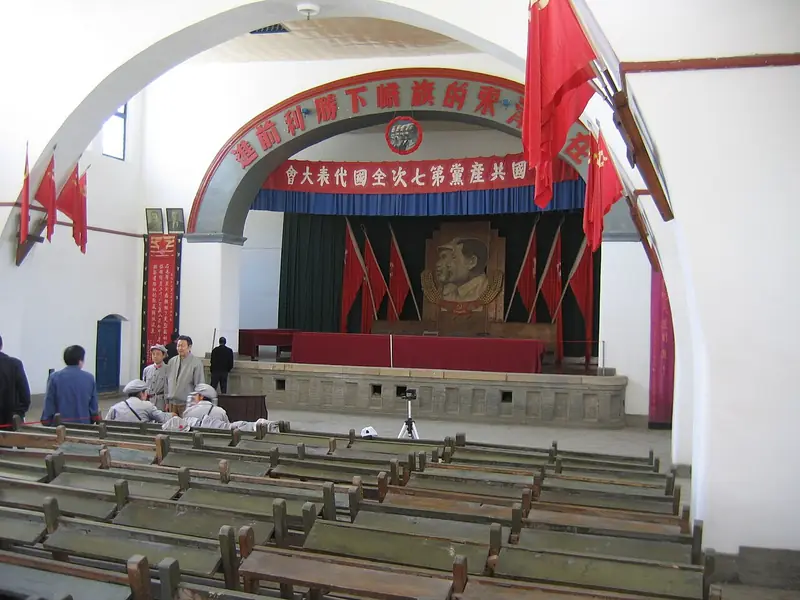
A China Daily report on the site records that Yangjialing was a base of the Communist Party's central organs, with Mao Zedong and others of his generation living there from November 1938 to March 1947. The same report says the Central Auditorium was completed there in 1942 and that the Party's Seventh Congress was held in it from 23 April to 11 June 1945.
The buildings the report names on the site are the Central Auditorium, the office of the Party's central general office, and Mao Zedong's former residence, which it describes as holding his desk and photographs. It also records a small stone table outside a cave dwelling where, in August 1946, Mao met the American journalist Anna Louise Strong, and says a guide explains that spot to visitors, and it identifies a vegetable plot on the site as one he worked.
The Shaanxi Party History Network's own page on Zaoyuan places the site eight kilometres north-west of Yan'an city, gives it an area of 80 mu, and records that it was the seat of the Party's Secretariat from October 1943 to March 1947, the Secretariat members having moved there from Yangjialing. The page describes the site as one with trees and grass, with the 'Happiness Canal' crossing the garden, the Secretariat's auditorium standing at the centre and five separate courtyards set against the hillside, given as the former residences of central leaders including Mao Zedong, Zhu De, Zhou Enlai, Liu Shaoqi, Ren Bishi, Zhang Wentian and Peng Dehuai.
That page also sets out the site's conservation history and designations: repair began in 1953 and it opened to the public in 1959; the State Council listed it in the first batch of national key cultural relic protection units in 1961; it was named one of the hundred national patriotism education demonstration bases in 1997; it was rated an AAAAA-grade tourist area in 2020; and in 2024 the Shaanxi Party History Research Office named it a sixth-batch provincial Party history education base.
What to look for
- The Central Auditorium at Yangjialing, completed in 1942 and given as the hall where the Party's Seventh Congress met from 23 April to 11 June 1945.
- The office of the Party's central general office at Yangjialing, named among the buildings on the site.
- Mao Zedong's former residence at Yangjialing, described in the report as holding his desk and photographs.
- The small stone table outside a Yangjialing cave dwelling where the report places the August 1946 meeting with the journalist Anna Louise Strong, and which it says a guide explains to visitors.
- The vegetable plot at Yangjialing identified in the report as one Mao worked.
- At Zaoyuan, the Secretariat auditorium at the centre of the garden and the five courtyards set against the hillside, given as the residences of central leaders including Mao Zedong, Zhu De, Zhou Enlai, Liu Shaoqi, Ren Bishi, Zhang Wentian and Peng Dehuai.
- The 'Happiness Canal' the Zaoyuan page says crosses the site.
Location & getting there
Getting to Yangjialing and Zaoyuan Revolutionary Sites
Check which interiors and courtyards are accessible. Active places of worship and protected monuments may have different visitor rules.
- Search for 杨家岭与枣园革命旧址 with 延安市 and 宝塔区.
Find Yangjialing and Zaoyuan Revolutionary Sites
杨家岭与枣园革命旧址 · 宝塔区
No reliable map pin yet: search by the Chinese name.
Sources & visit information
The linked sources support the identity and background described in this introduction. Opening hours, admission, activity availability and exact arrival arrangements have not been comprehensively checked. Confirm current visitor information with the venue; the original catalogue locality and editorial review flag are retained.