

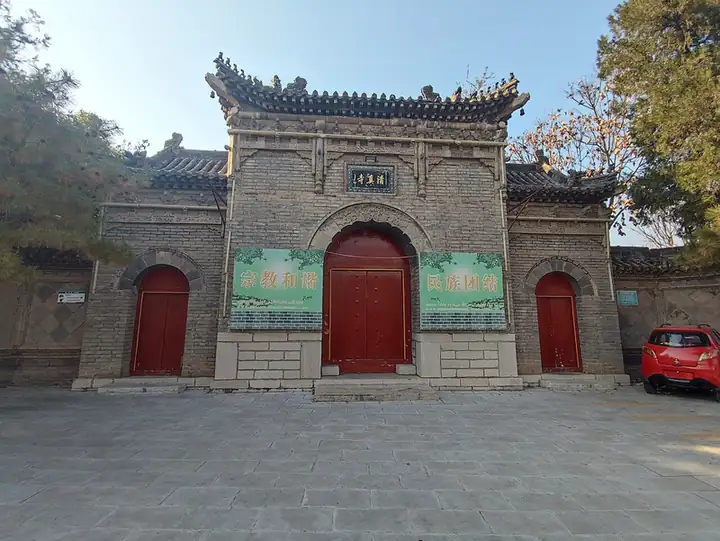
Photo adjustments
EXIF orientation normalized; resized without changing aspect ratio; converted to WebP. No subject edits.
Explore the region
About Yunmen Mountain
Qingzhou's municipal government lists the mountain as a national scenic area, a national geopark and a national key cultural heritage unit, and as part of a 5A-rated tourism area centred on the old city. It covers 150 hectares with green cover above 90 percent, mostly cypress planted in two campaigns in the 1930s and 1940s and again in the 1970s and 1980s, now numbering well over a hundred thousand trees. The name comes from a natural opening through the main summit, Dayunding: a cave about three metres high, four metres wide and more than six metres deep that runs from north to south and looks from a distance like a hanging mirror. In summer and autumn cloud drives through the gap and past the summit temples. Local tradition attributes the cutting of the opening to the First Emperor, the mountain was once known locally as Gauze-Cap Mountain, and it has long been frequented by Buddhists and Daoists alike.
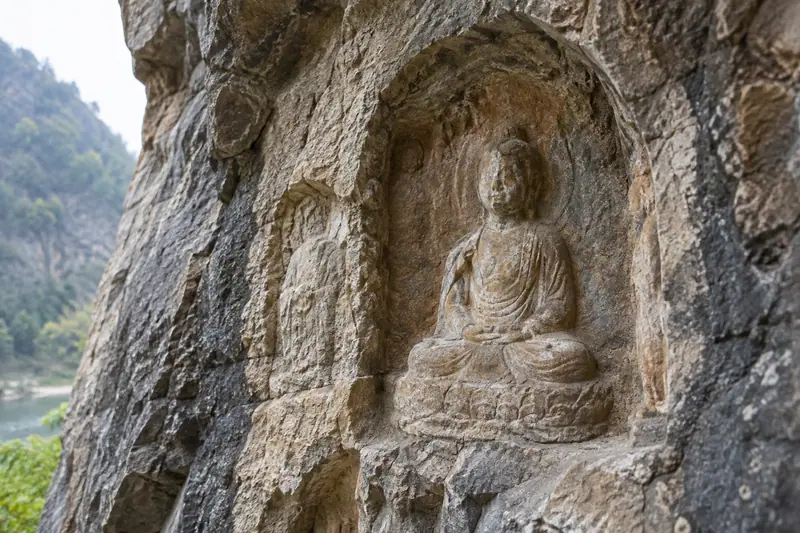
The giant character for longevity on the north face is 7.5 metres high and 3.7 metres wide, with the 'cun' element at its foot alone standing 2.30 metres. It was presented on the ninth day of the ninth month of 1560 by Zhou Quan, a steward of the Heng Prince's household, and Qingzhou claims it as the origin of the saying about longevity matching the southern mountain. On the sunny south face are five cave shrines of the Sui and Tang holding 272 carved figures, the earliest dated inscription reaching back to 589; the Yunmen caves are protected together with the Tuoshan grottoes as a national key cultural heritage unit. Dayunding was also a site for the Daoist rite of casting the dragon, and in 752 the Beihai prefect Zhao Juzhen cut a poem there while praying for the longevity of Emperor Xuanzong, a text preserved in the Complete Tang Poems.
What to look for
- The Ming giant character for longevity on the north face, 7.5 metres by 3.7 metres, presented in 1560
- The natural Yunmen opening through the summit, about three metres high and four metres wide
- The five Sui and Tang cave shrines on the south face with their 272 carved figures
- Sanfeng Cave, linked by the Jiajing-era Qingzhou prefectural gazetteer to the Daoist Zhang Sanfeng, and Wanchun Cave with its high-relief figure of Chen Tuan asleep on his books
- Yingxu Gate and the Tianxian Yunü Shrine to Bixia Yuanjun, both Yuan-period beamless all-stone vaulted buildings
Location & getting there
Getting to Yunmen Mountain
Check which interiors and courtyards are accessible. Active places of worship and protected monuments may have different visitor rules.
- Search for 云门山 with 潍坊市 and 青州市.
Find Yunmen Mountain
云门山 · 青州市
No reliable map pin yet: search by the Chinese name.
Sources & visit information
The linked sources support the identity and background described in this introduction. Opening hours, admission, activity availability and exact arrival arrangements have not been comprehensively checked. Confirm current visitor information with the venue; the original catalogue locality and editorial review flag are retained.