

Photo adjustments
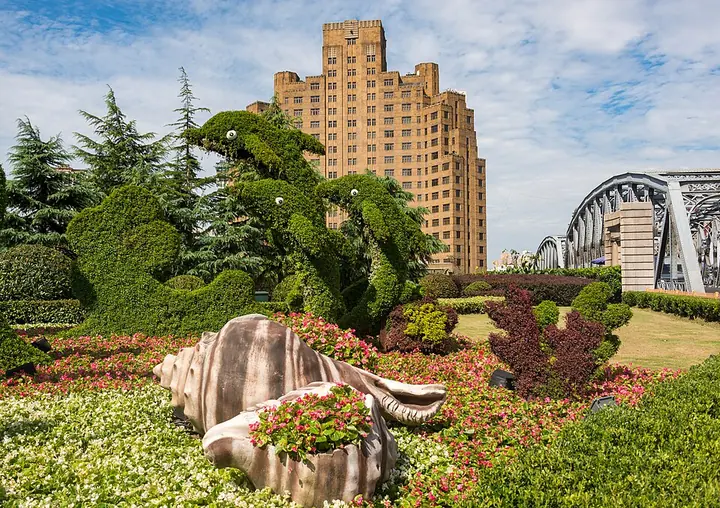
Full frame retained; proportionally resized and converted to WebP. No retouching or changes to the photographed subject. Card displays may crop the view.
City & district guides
About Huangpu Park
Its origins lie in the treaty-port Public Garden, later reshaped as a commemorative riverfront park.
The Monument to the People’s Heroes and Bund Historical Museum add two distinct historical elements to the landscaped setting. The park also provides a natural point to finish a Bund walk before Waibaidu Bridge. Its history of exclusion is documented, while the often-repeated “No dogs or Chinese” sign is a later myth rather than an authenticated sign.
The park is described as China's earliest modern park. Its predecessor was the Bund Garden (外滩花园), begun on 8 August 1869 with permission from the Shanghai Circuit Intendant (上海道) and built with funds from the Shanghai Municipal Council (工部局) as a recreation ground for the foreign community, under the name Public Garden. In 1886 the garden was rebuilt as a park designed by a Scottish gardener, adding a resting pavilion and a tennis court, and it was also known at the time as the Public Garden, Bund Park (外滩公园) and Bridge Park (大桥公园).
From 1890 the park was closed to Chinese people, apart from Chinese amahs accompanying children, until they were again admitted on 1 July 1928. It was renamed Huangpu Park in 1946 and was renovated in the 1990s. The Monument to the People's Heroes (上海市人民英雄纪念塔) within the park was completed on 27 May 1994, and the Bund Historical Museum (外滩历史纪念馆), housed in the monument's hall, opened to the public on 30 September that year. The historical name survives in nearby place names such as Garden Bridge and the New Bund Garden apartment building in Hongkou District.
What to look for
- The river junction shapes the triangular park.
- The Monument to the People’s Heroes and Bund-history displays add commemorative context.
Background & history
Huangpu Park (simplified Chinese: 黄浦公园; traditional Chinese: 黃浦公園; pinyin: Huángpǔ Gōngyuán; Shanghainese: Waonphu Gonyu) is the name of the triangular stretch of green at the northern end of the Bund in Shanghai, the oldest and smallest park of the city. It is the site of the large Monument to the People's Heroes, commemorating those who helped to free China from foreign occupation, and of the Bund Historical Museum, which documents the history of the Bund in old photographs.
Excerpt from Wikipedia: Huangpu Park · Wikipedia contributors · CC BY-SA 4.0. Selected introductory sentences; formatting simplified. Background information, not current visitor-service advice.
Location & getting there
Getting to Huangpu Park
Approach the northern end of the Bund beside Waibaidu Bridge, where Suzhou Creek enters the Huangpu.
Combine your visit
A suggested sequence linking the specific features of this visit.
-
Riverside park
Begin with the meeting of the two waterways.
-
Monument to the People’s Heroes
Continue to the park’s major commemorative structure.
-
Bund Historical Museum, when open
Add photographs and interpretation of the historic waterfront.
This order is editorial. Confirm access and any transfers between stops; it does not establish a walking route, same-day connection or common admission ticket.
Find Huangpu Park
黄浦公园 · 黄浦区
The pin marks the area, not the entrance.
More places nearby
Approximate straight-line distances between map pins, not travel distances.
Peace Hotel和平饭店
Less than 1 km awayThe Peace Hotel name links two historic buildings at the Bund end of Nanjing Road. The northern building was completed in 1929 as Sassoon House and originally contained the Cathay Hotel. The southern building opened as the…
View guide →The Bund外滩
Less than 1 km awayThe Bund follows the western bank of the Huangpu along East Zhongshan No. 1 Road. Historic banks, trading houses and hotels face the modern towers of Lujiazui across the water.
View guide →Holy Trinity Church (Anglican)上海圣三一堂
Less than 1 km awayHoly Trinity Church is the red-brick former Anglican cathedral in the Bund neighbourhood. The present nineteenth-century church replaced an earlier building and became an important place of worship for Shanghai’s…
View guide →Sources & visit information
The sources below support the place-specific description and arrival information. Suggested combinations are editorial planning ideas; confirm current opening, entry arrangements and transport services for your date.
- en.wikivoyage.org ↗
- Huangpu Park ↗
- Shanghai/Huangpu ↗
- Chinese Wikipedia: 黃浦公園 (revision 92093673, 2026-03-30) ↗
- English Wikipedia: Huangpu Park (revision 1362604536, 2026-07-05) ↗
Visitor information adapted and edited from Wikipedia contributors, “Huangpu Park” · CC BY-SA 4.0. Source revision 1362604536.
Visitor information adapted and edited from Wikivoyage contributors, listing “Huangpu Park” · CC BY-SA 4.0.
Background paragraphs translated and condensed from Wikipedia contributors, "黃浦公園", Chinese Wikipedia · CC BY-SA 4.0. Source revision 92093673.
Background paragraphs condensed from Wikipedia contributors, "Huangpu Park", English Wikipedia · CC BY-SA 4.0. Source revision 1362604536.