

Photo adjustments
Full frame retained; proportionally resized and converted to WebP. No retouching or changes to the photographed subject. Card displays may crop the view.
Explore the region
About Lu Xun Park (Shanghai)
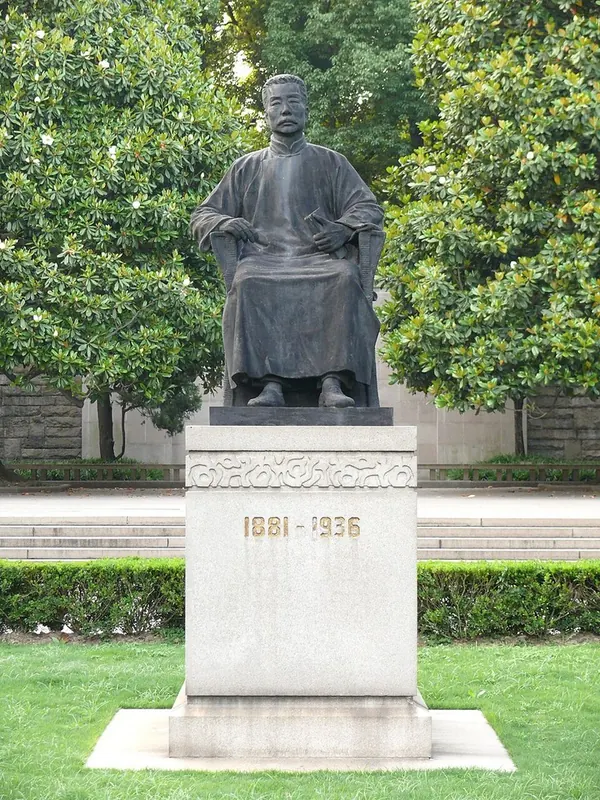
His tomb and bronze statue form one commemorative focus; the memorial hall presents belongings, papers and publications.
The central artificial lake gives the visit a quieter landscape element between historical stops. Follow the literary theme from the memorial hall to the tomb, then continue around the water. The museum’s opening arrangements are separate from general access to the park.
In 1932 the Korean nationalist Yun Bong-gil detonated a bomb in the park during a celebration of Emperor Hirohito's birthday, killing or injuring several senior Imperial Japanese military figures; a memorial hall dedicated to Yun Bong-gil now stands in the park. Lu Xun's tomb carries an inscription by Mao Zedong, and the trees on either side of it were planted by Zhou Enlai and Lu Xun's widow, Xu Guangping. The park lies just north of Duolun Road, a historic street that is now car-free, and near Lu Xun's former residence, a three-story Japanese-style house where he lived from 1933 until his death in 1936.
Today the park is used by local residents for exercise, including practicing tai chi and ballroom dancing. A bust of the Hungarian poet Sándor Petőfi, some of whose works Lu Xun translated into Chinese, was unveiled in the park in 2007 by the Hungarian prime minister as part of preparations for the Shanghai Expo.
What to look for
- Lu Xun’s tomb and bronze statue form a distinct memorial setting.
- The memorial hall interprets the writer through personal belongings and publications.
- A central artificial lake provides the park’s landscape focus.
Location & getting there
Getting to Lu Xun Park (Shanghai)
Approach 146 East Jiangwan Road behind Hongkou Football Stadium.
Combine your visit
A suggested sequence linking the specific features of this visit.
-
Lu Xun Memorial Hall
Begin with the writer’s life and publications when the hall is open.
-
Lu Xun’s tomb
Continue to the commemorative burial place and statue.
-
Central lake
Finish with the public garden and water landscape.
This order is editorial. Confirm access and any transfers between stops; it does not establish a walking route, same-day connection or common admission ticket.
Find Lu Xun Park (Shanghai)
鲁迅公园 · 虹口区
The pin marks the area, not the entrance.
More places nearby
Approximate straight-line distances between map pins, not travel distances.
Huangpu Park 黄浦公园
3 km awayHuangpu Park occupies the triangular green space at the northern end of the Bund, between the Huangpu River and Suzhou Creek. Its origins lie in the treaty-port Public Garden, later reshaped as a commemorative riverfront park.
View guide →Shanghai Jewish Refugees Museum 上海犹太难民纪念馆
4 km awayShanghai Jewish Refugees Museum centres on the former Ohel Moshe Synagogue in Hongkou’s Tilanqiao area. Documents, photographs and personal objects explain the lives of European Jews who found refuge in Shanghai during Nazi…
View guide →Peace Hotel 和平饭店
4 km awayThe Peace Hotel name links two historic buildings at the Bund end of Nanjing Road. The northern building was completed in 1929 as Sassoon House and originally contained the Cathay Hotel. The southern building opened as the…
View guide →Sources & visit information
The linked encyclopedia sources support background and place descriptions. Current opening hours, ticket prices, booking rules and transport schedules have not been independently verified for this guide. Confirm them with the venue or operator before travelling.
Visitor information adapted and edited from Wikipedia contributors, “Lu Xun Park” · CC BY-SA 4.0. Source revision 1355296024.
Background paragraphs condensed from Wikipedia contributors, "Lu Xun Park", English Wikipedia · CC BY-SA 4.0. Source revision 1355296024.