


Photo adjustments
Resized and WebP compressed; subject not altered.
City & district guides
About Jinci
Its Hall of the Holy Mother is especially rewarding for the coiled wooden dragons outside and the individually modelled Song-period attendants within. The Flying Bridge across the Fish Pond changes the way you approach the hall, while the Hall of Offerings forms another distinct architectural stop. Follow these connected structures slowly instead of treating the garden as a passage to one famous photograph.
Jinci was built to honor Tang Shuyu (唐叔虞), founding lord of the state of Jin under the Zhou dynasty, and his mother Yijiang (邑姜), and is considered the oldest surviving royal sacrificial garden in China. It is first recorded in the Northern Wei dynasty. In the Northern Song dynasty, Emperor Renzong posthumously honored Tang Shuyu as Prince of Fendong (汾东王) and built a large Hall of the Holy Mother for Yijiang, around which the temple's central axis later took shape.
The Zhou-dynasty cypress (周柏), the Never-Aging Spring (难老泉) and its Song-dynasty clay attendant figures are known together as the 'Three Wonders of Jinci', while the Hall of the Holy Mother, the Flying Bridge over the Fish Pond and the Hall of Offerings (献殿) form its 'Three Treasures'. The Hall of Offerings, built in 1168, in the Dading era (大定) of the Jin dynasty, stands 9.75 metres high on a plan three bays wide, praised by the architectural historian Liang Sicheng in 1934 for its simple, enduring frame.
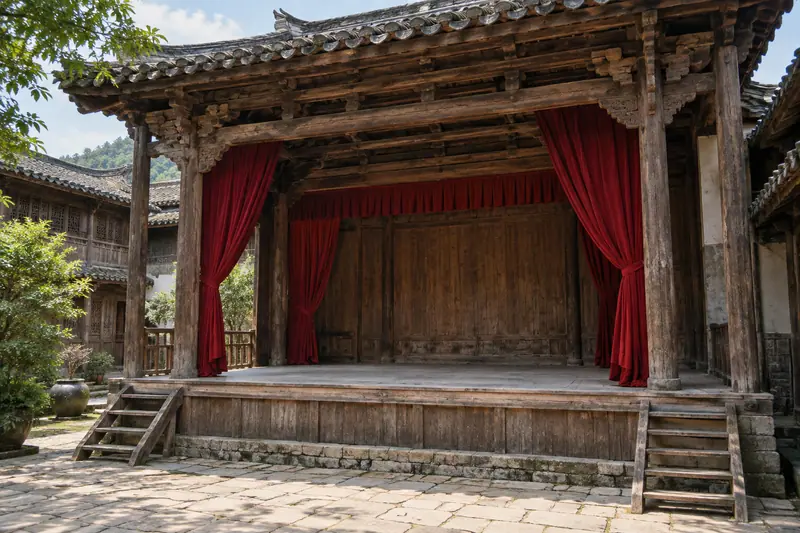
Jinci is a Major Historical and Cultural Site Protected at the National Level, a first-class national museum, and a national 5A-level tourist area, having previously been among the first national AAAA-level tourist areas. Its Water Mirror Terrace (水镜台), an old opera stage, still hosts activities during the Jinci temple fair.
What to look for
- The Hall of the Holy Mother's dragon-wrapped columns and expressive clay attendants.
- The Flying Bridge across the Fish Pond and the separate Hall of Offerings.
The surrounding area
Provincial city base for Jinci, museums and the Zhonglou Street food-and-walking district.
Location & getting there
Getting to Jinci
Go to Jinci at the Jin Springs below Xuanweng Mountain, southwest of Taiyuan, and identify the historic museum entrance within the wider park destination.
- The adjoining public park and the historic building complex are different parts of the visit; confirm access to the halls.
Combine your visit
Suggested order within this visit:
-
Hall of Offerings
Begin with its open, carefully proportioned structure.
-
Flying Bridge across the Fish Pond
Read how water and the approach shape the temple layout.
-
Hall of the Holy Mother
Finish with the columns and sculpture ensemble.
This sequence is an editorial suggestion based on the features described in the sources. Access to individual buildings or areas should be checked locally; no travel time or shared admission is implied.
Find Jinci
晋祠 · 太原市
The pin marks the area, not the entrance.
More places nearby
Approximate straight-line distances between map pins, not travel distances.
Tianlongshan Grottoes天龙山石窟
7 km awayTianlongshan's caves extend across two wooded mountain faces, tracing changes in Buddhist sculpture from the Eastern Wei and Northern Qi into the Tang period. Caves 2 and 3 preserve the earlier architectural language, while Cave…
View guide →Mengshan Giant Buddha蒙山大佛
8 km awayThe Mengshan Buddha is a huge rock-cut figure whose weathered body and modern replacement head tell two distinct chapters of the site's history. The original carving belongs to the Northern Qi period and stood behind Kaihua…
View guide →Shanxi Museum山西博物院
19 km awayShanxi Museum is a useful starting point for understanding why the province's tombs, temples and merchant houses contain such different kinds of art. The Jin Soul displays connect archaeology with later religious and commercial…
View guide →Sources & visit information
The sources below support the place-specific description and arrival information. Suggested combinations are editorial planning ideas; confirm current opening, entry arrangements and transport services for your date.
Visitor information adapted and edited from Wikipedia contributors · CC BY-SA 4.0. Source revision 93741459.
Visitor information adapted and edited from Wikivoyage contributors · CC BY-SA 4.0. Source revision 5263442.
Background paragraphs translated and condensed from Wikipedia contributors, "晋祠", Chinese Wikipedia · CC BY-SA 4.0. Source revision 93741459.
Background paragraphs condensed from Wikipedia contributors, "Jinci", English Wikipedia · CC BY-SA 4.0. Source revision 1359678423.