

Photo adjustments
Proportionally resized and converted to WebP without cropping, retouching or changing the photographed subject.
Explore the region
About Qiao Family Compound
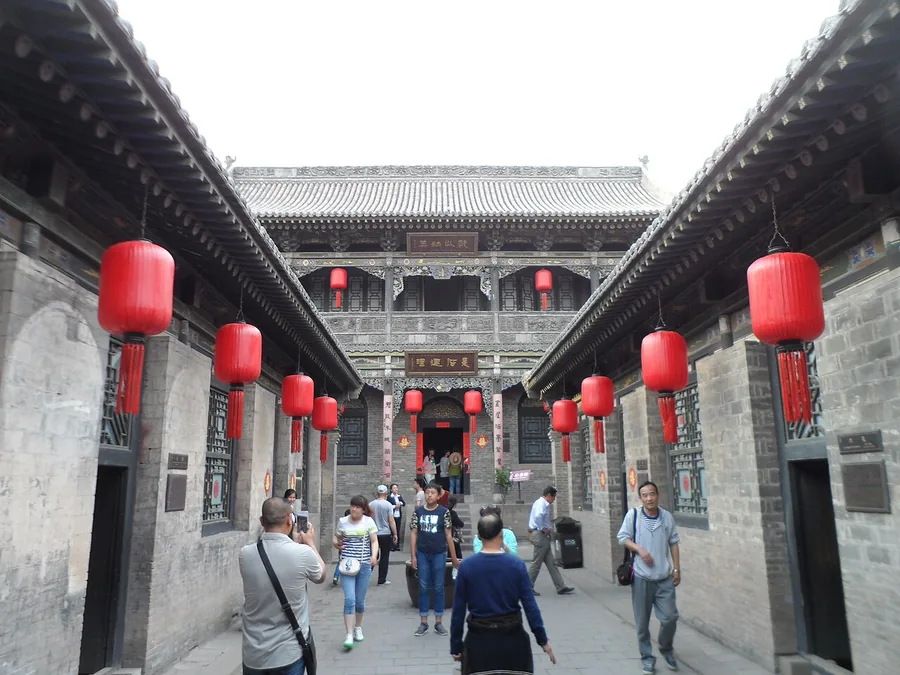
Its identity comes from a dense arrangement of enclosed residential courtyards, tiled roofs and carefully decorated entrances. The house also became familiar through the film Raise the Red Lantern, but the surviving architecture deserves attention on its own terms. Look at how doorways control views and movement between the family spaces rather than expecting the film to provide a historical explanation.
Construction began in 1756, during the Qianlong era of the Qing dynasty, on what was then known as Zaizhong Hall. The complex then underwent two rounds of renovation and expansion and a further enlargement, reaching its present form as a large building complex in the early years of the Republic, in a style typical of northern Chinese housing of the Qing dynasty. In 1985, the local government established the Qi County Folk Custom Museum on the site, which opened to the public on 1 November 1986.
The compound covers 9,000 square metres and contains 313 rooms within 4,000 square metres of floor space, arranged in six large courtyards and nineteen smaller courtyards. It was listed as a Major Historical and Cultural Site Protected at the National Level (全国重点文物保护单位) in 2001 and rated a 5A-level tourist attraction (5A级旅游景区) by the National Tourism Administration (国家旅游局).
What to look for
- Zaizhong Hall's linked residential courtyards and layered gateways.
- Carved brickwork and the contrast between narrow passages and larger family courts.
Location & getting there
Getting to Qiao Family Compound
Travel to Qiaojiabao Village in Qi County and use the Qiao Family Compound entrance; this is outside the historic centre of Qi County.
Combine your visit
Suggested order within this visit:
-
Zaizhong Hall courtyard group
Understand the main residential arrangement.
-
Decorated gateways and inner courts
Examine the carving and controlled views between family spaces.
This sequence is an editorial suggestion based on the features described in the sources. Access to individual buildings or areas should be checked locally; no travel time or shared admission is implied.
Find Qiao Family Compound
乔家大院 · 晋中市
The pin marks the area, not the entrance.
More places nearby
Approximate straight-line distances between map pins, not travel distances.
Cao Family Compound 曹家大院三多堂
7 km awayThe Cao Family Compound, also called Sanduotang, stands at Beiguang Village rather than in central Taigu. Its surviving estate is arranged as three principal courtyard groups, with smaller courts nested inside them. The eastern…
View guide →Qu Family Compound 渠家大院
11 km awayThe Qu Family Compound stands within Qi County's old town, where successive courtyards preserve the residence of a prosperous merchant family. The complex has a fortress-like exterior but a varied interior, with different roof…
View guide →Zhenguo Temple 镇国寺
19 km awayZhenguo Temple at Hadong Village is unusually valuable for the relationship between its early timber architecture and sculpture. Wanfo Hall survives from the Northern Han period, with a deep bracket system that carries the broad…
View guide →Sources & visit information
The linked encyclopedia sources support background and place descriptions. Current opening hours, ticket prices, booking rules and transport schedules have not been independently verified for this guide. Confirm them with the venue or operator before travelling.
Visitor information adapted and edited from Wikipedia contributors · CC BY-SA 4.0. Source revision 93303286.
Background paragraphs translated and condensed from Wikipedia contributors, "乔家大院", Chinese Wikipedia · CC BY-SA 4.0. Source revision 93303286.
Background paragraphs condensed from Wikipedia contributors, "Qiao Family Compound", English Wikipedia · CC BY-SA 4.0. Source revision 1364620653.