

Explore the region
About Qu Family Compound
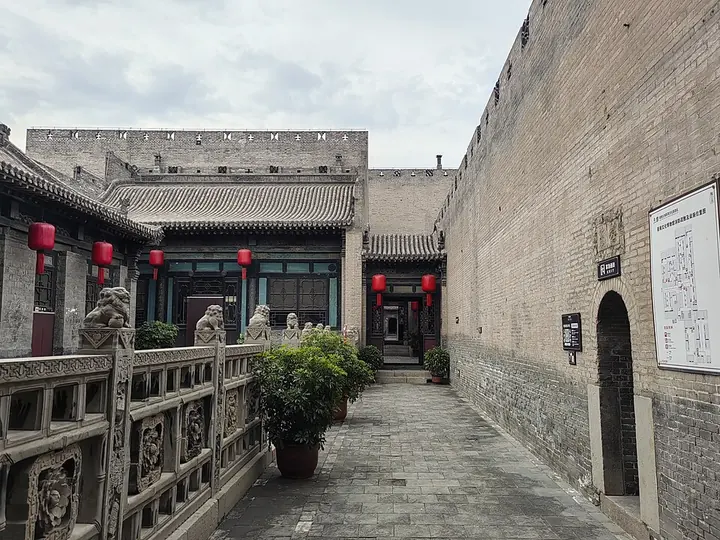
The complex has a fortress-like exterior but a varied interior, with different roof forms and courtyard groups including a theatre court. It also houses interpretation of Shanxi merchant culture. The associated Changyuchuan tea business helps explain how domestic wealth connected with long-distance trade, though its former premises are a separate nearby site.
The compound was the residence of the wealthy Qing merchant Qu Yuanzhen (渠源浈, 1842-1921) and his son Qu Benqiao (渠本翘, 1862-1919), and later generations of their family. Construction began during the Qianlong era of the Qing dynasty and continued in stages until 1925, the fourteenth year of the Republic, when the compound reached its present scale.
The compound faces south and covers 5,317 square metres, with 3,200 square metres of building floor space arranged within eight large courtyards and nineteen smaller courtyards, including a linked-tower courtyard (统楼院) and a balustrade courtyard (栏杆院), totalling 240 rooms. Its exterior has a fortress-like form, while its roofs inside use a mix of hip-and-gable, overhanging-gable, rolled-shed and flush-gable styles.
The former premises of the Changyuchuan Tea Shop (长裕川茶庄), one of the longest-established and largest tea businesses opened by Shanxi merchants, covers 2,039 square metres, with 1,198 square metres of floor space. In 1996, the Qu Family Compound was converted into the Shanxi Merchant Culture Museum (山西省晋商文化博物馆). On 25 May 2006, it was listed as a Major Historical and Cultural Site Protected at the National Level (全国重点文物保护单位), together with the tea shop's former premises.
What to look for
- The linked residential courts, with contrasting roof forms and a dedicated theatre courtyard.
- The merchant-culture interpretation within the house, connecting the Qu family residence to commercial life.
Location & getting there
Getting to Qu Family Compound
Go to 33 Dongda Street in Zhaoyu Town, Qi County. The Changyuchuan tea-house premises are at the northern end of Duanjia Lane and should be treated as a separate optional stop.
Combine your visit
Suggested order within this visit:
-
Main residential courtyards
Read the progression from the street into the family estate.
-
Theatre courtyard
Look at the role of performance within a merchant residence.
-
Merchant-culture displays
Connect the architecture with the family's business background.
This sequence is an editorial suggestion based on the features described in the sources. Access to individual buildings or areas should be checked locally; no travel time or shared admission is implied.
Find Qu Family Compound
渠家大院 · 晋中市
The pin marks the area, not the entrance.
More places nearby
Approximate straight-line distances between map pins, not travel distances.
Zhenguo Temple 镇国寺
9 km awayZhenguo Temple at Hadong Village is unusually valuable for the relationship between its early timber architecture and sculpture. Wanfo Hall survives from the Northern Han period, with a deep bracket system that carries the broad…
View guide →Qiao Family Compound 乔家大院
11 km awayThe Qiao Family Compound occupies Qiaojiabao Village in Qi County and is associated with the merchant Qiao Zhiyong. Its identity comes from a dense arrangement of enclosed residential courtyards, tiled roofs and carefully…
View guide →Cao Family Compound 曹家大院三多堂
17 km awayThe Cao Family Compound, also called Sanduotang, stands at Beiguang Village rather than in central Taigu. Its surviving estate is arranged as three principal courtyard groups, with smaller courts nested inside them. The eastern…
View guide →Sources & visit information
The linked encyclopedia sources support background and place descriptions. Current opening hours, ticket prices, booking rules and transport schedules have not been independently verified for this guide. Confirm them with the venue or operator before travelling.
Visitor information adapted and edited from Wikipedia contributors · CC BY-SA 4.0. Source revision 92132137.
Background paragraphs translated and condensed from Wikipedia contributors, "渠家大院", Chinese Wikipedia · CC BY-SA 4.0. Source revision 92132137.
Image credits & notes (1)
- A courtyard of the Qu Family Compound · 渠家大院 Photograph date recorded by the source: 5 June 2025, 17:44:55.Photo: Yumeto · CC BY-SA 4.0Resized for the web; the photo itself has not been edited. Thumbnails may show a cropped view.
