

Photo adjustments
Proportionally resized and converted to WebP without cropping, retouching or changing the photographed subject.
City & district guides
About Shuanglin Temple
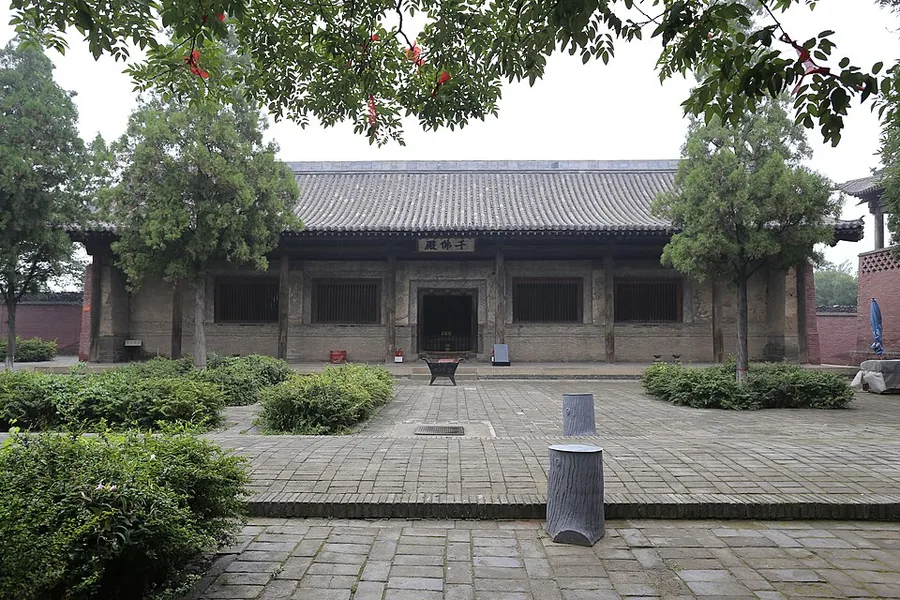
Its halls contain painted clay figures whose postures, clothing and expressions reward slow looking. The forceful guardian Weituo in the Thousand Buddha Hall offers a striking contrast to the many-armed Guanyin in the Bodhisattva Hall. Other rooms, including the Arhat Hall, make clear that the ensemble is spread across several buildings rather than concentrated in a single shrine.
Shuanglin Temple was founded in 571 AD, during the second year of the Wuping period of the Northern Qi dynasty. The buildings standing today date from the Ming and Qing dynasties. Many of its clay statues were stolen or damaged during the Cultural Revolution, and the temple complex has undergone several renovations as part of the city's protected cultural-relics area.
The sculptures are displayed across ten halls arranged within three courtyards, in a fortress-like compound enclosed by a high wall with a gate. The complex holds more than two thousand painted clay statues dating from the twelfth to nineteenth centuries.
The temple stands in the countryside of Qiaotou village, six to seven kilometres southwest of the ancient city of Pingyao. Together with Zhenguo Temple and the walled old city, it forms one of the three components of the 'Ancient City of Pingyao' UNESCO World Heritage Site, inscribed in 1997; in Pingyao's tortoise-shaped city plan, known for its coloured sculptural art, the temple is rated as the city's third treasure.
What to look for
- Weituo in the Thousand Buddha Hall, with a notably dynamic stance and elaborate armour.
- The many-armed Guanyin and the individual faces and poses of the Arhat Hall figures.
Location & getting there
Getting to Shuanglin Temple
Travel to Qiaotou Village southwest of Pingyao's walled centre; Shuanglin is a separate village visit, so arrange the return connection rather than treating it as an old-city street stop.
Combine your visit
Suggested order within this visit:
-
Arhat Hall
Begin with the varied expressions of the individual figures.
-
Thousand Buddha Hall
Look closely at Weituo and the surrounding sculpture.
-
Bodhisattva Hall
Finish with the many-armed Guanyin.
This sequence is an editorial suggestion based on the features described in the sources. Access to individual buildings or areas should be checked locally; no travel time or shared admission is implied.
Find Shuanglin Temple
双林寺 · 晋中市
The pin marks the area, not the entrance.
More places nearby
Approximate straight-line distances between map pins, not travel distances.
Pingyao Ancient City平遥古城
4 km awayPingyao's walled centre preserves a merchant city whose courtyard houses, shops and financial institutions grew around long-distance trade. The city walls establish its compact outline, while South Street and the Rishengchang…
View guide →Mount Mian绵山
15 km awayMount Mian combines precipitous scenery with temples fitted into cliffs and enormous rock recesses. Daluo Palace supplies a dramatic, vertically stacked Daoist ensemble, while Yunfeng Temple sits beneath the great Baofu Rock…
View guide →Zhenguo Temple镇国寺
18 km awayZhenguo Temple at Hadong Village is unusually valuable for the relationship between its early timber architecture and sculpture. Wanfo Hall survives from the Northern Han period, with a deep bracket system that carries the broad…
View guide →Sources & visit information
The linked encyclopedia sources support background and place descriptions. Current opening hours, ticket prices, booking rules and transport schedules have not been independently verified for this guide. Confirm them with the venue or operator before travelling.
Visitor information adapted and edited from Wikipedia contributors · CC BY-SA 4.0. Source revision 1367598550.
Background paragraphs condensed from Wikipedia contributors, "Shuanglin Temple", English Wikipedia · CC BY-SA 4.0. Source revision 1367598550.