

Photo adjustments
EXIF orientation normalized; resized without changing aspect ratio; converted to WebP. No subject edits.
Explore the region
About Bao'en Temple
The temple was built up the slope of Longan town in three rising courtyards, facing east across the Fu river, under the direction of Wang Xi and his son Wang Jian. The Sichuan Provincial Institute of Cultural Relics and Archaeology describes it as one of China's currently complete examples of early-Ming official-style temple architecture, and records that the State Administration of Cultural Heritage and the provincial heritage bureau have repeatedly funded its conservation; it was made a provincial protection unit in 1956 and a national one in 1996. A 2014 feature in the CPPCC Daily, reprinted on the People's Daily portal, adds that the temple is now a teaching and research base for Tsinghua University.
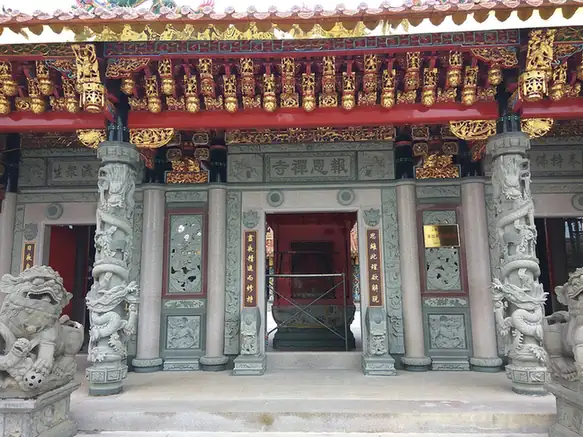
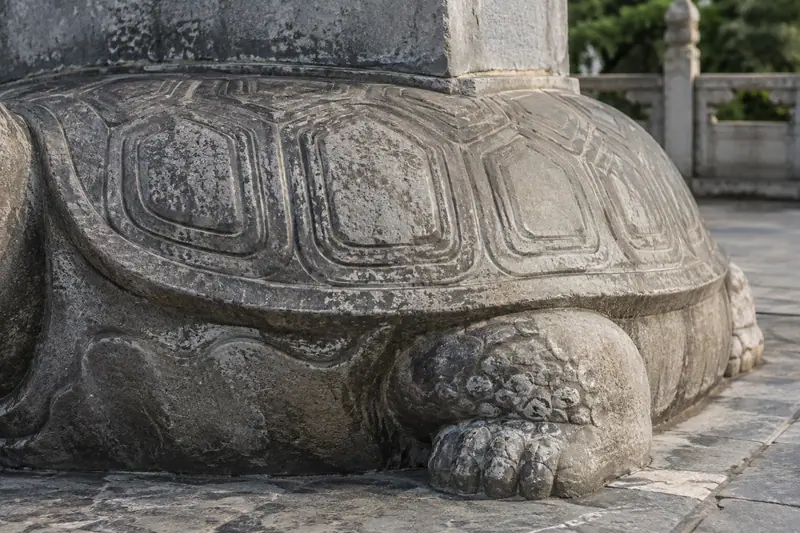
Past the forecourt and its sutra pillars, the gate carries a plaque reading 'Imperially Commissioned Baoensi' and is flanked inside by four Vajra guardian figures; a bell tower stands to its right with no matching drum tower opposite, which the CPPCC Daily account calls unusual for a Ming temple, and holds a large bell of ten thousand catties and a small bell of five thousand. Three stone bridges, likened in the account to the Forbidden City's Golden Water bridges, lead to the Tianwang hall and its four Heavenly King statues, and behind it stands the Daxiong hall with three large Buddha statues on a Sumeru altar. Flanking the Daxiong hall stand the Dabei hall and the Huayan Zang, and behind it the Wanfo pavilion with paired stele pavilions in front, each stele set on a stone tortoise.
In the courtyard's third tier the Wanfo pavilion is five bays wide, three deep and 24 metres tall, its interior holding a preaching Buddha flanked by disciple figures, with court-dressed statues of the temple's builders, Wang Xi and Wang Jian, standing before it, under murals covering the walls.
What to look for
- The Huayan Zang's revolving sutra cabinet, a seven-tier pagoda-shaped structure eleven metres tall and seven metres across, popularly called the 'star-wheel cart', which the CPPCC Daily account describes as the best-preserved example of its kind in China.
- The thousand-hand Guanyin in the Dabei hall, carved from a single nanmu log with 1,004 hands, standing barefoot on a lotus pedestal.
- The slanted corridors outside the Daxiong hall that touch none of the surrounding buildings, popularly called 'four not touching', which the account says survives as a physical example only here though the type is mostly recorded from the Song dynasty.
- The paired imperial stele pavilions before the Wanfo pavilion, each a sixteen-column double-eave pavilion under a pyramidal roof, octagonal above and square below, their steles mounted on stone tortoises and inscribed 'Mandate of Nine Heavens' and 'Ten-thousand-chariot Imperial Grace'.
- The bell tower's two inscribed bells, of ten thousand and five thousand catties, under a plaque reading 'Heavenly Sound Awakens the World'.
Location & getting there
Getting to Bao'en Temple
Check which interiors and courtyards are accessible. Active places of worship and protected monuments may have different visitor rules.
- Search for 报恩寺 with 绵阳市 and 平武县.
Find Bao'en Temple
报恩寺 · 平武县
No reliable map pin yet: search by the Chinese name.
Sources & visit information
The linked sources support the identity and background described in this introduction. Opening hours, admission, activity availability and exact arrival arrangements have not been comprehensively checked. Confirm current visitor information with the venue; the original catalogue locality and editorial review flag are retained.