

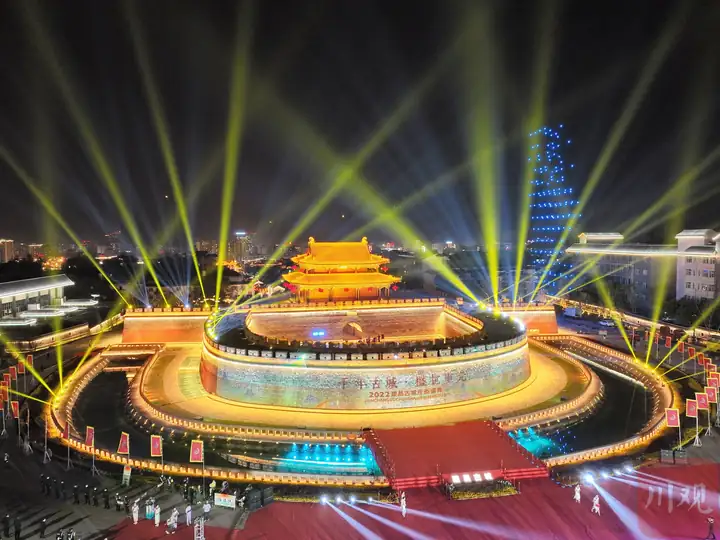
Photo adjustments
EXIF orientation normalized; resized without changing aspect ratio; converted to WebP. No subject edits.
Explore the region
About Jianchang Ancient City
The city was sited at the north-west corner of the Tang city of Xizhou, backing on the northern hills, set between the East and West rivers and looking out towards Qionghai. It was square to begin with and became fan-shaped after flooding, and the Liangshan Daily describes the resulting plan as a fan-shaped walled city with a cross for its axis, straight streets and winding lanes. Four main streets radiate from the Sipailou at the centre: North Street, South Street, Cang Street to the west and Fu Street to the east, and the nine streets and eighteen lanes still keep their Ming arrangement. Jianchang was a trading town on the tea-horse road linking Yunnan and Tibet, and its buildings mix Sichuan, Yunnan and other styles. By an incomplete count more than 2,400 items of cultural heritage are distributed across the old city, among them ancient sites, tomb groups, stone carvings, rock paintings and old buildings; the Ming writer Yang Shen'an, the Qing calligrapher He Shaoji, the Qing vice-minister Zha Jiantang and the modern educator Huang Yanpei all left inscriptions here.
Three of the gates survive – Jianping, Anding and Datong – and the Liangshan Daily calls Jianping the largest of the three, with the tallest barbican and gate tower. The Datong gate on the south side was one of the four great gates of the Ming Jianchang garrison and was listed as a Sichuan provincial protected cultural relic in 1992. The Sipailou was rebuilt in 2021 in the course of the restoration, phase one of the protection project opened its street in November 2022, and in March 2023 the old city was designated a national 4A-grade tourist scenic area. The work has not made the whole city uniform. Cang Street, which takes its name from a granary that stood there, was left half restored to the appearance of a Ming and Qing street and half as it had become in modern times.
What to look for
- The Sipailou at the centre, a square three-storey pagoda-form pavilion 22.15 m high covering 162.28 square metres, rebuilt in 2021.
- The Datong gate, the south gate and a Sichuan provincial protected cultural relic since 1992.
- The Anding gate at the east end of Fu Street, whose tablet carries an inscription dating it to the fourth month of the twentieth year of Hongwu.
- Number 58 Yongquan Street, the Zhang family courtyard house, a late-Qing earth-and-timber siheyuan that keeps its carved windows, camel-hump brackets and door-dragon members, among others.
- Jiyang Lane, one of the quiet lanes the reporters describe in the old city, with a clear stream running through it from north to south.
Location & getting there
Getting to Jianchang Ancient City
Identify the main visitor approach and any separately managed houses, museums or performances. Ask before entering residential spaces or photographing residents.
- Search for 建昌古城 with 凉山彝族自治州 and 西昌市.
Find Jianchang Ancient City
建昌古城 · 西昌市
No reliable map pin yet: search by the Chinese name.
Sources & visit information
The linked sources support the identity and background described in this introduction. Opening hours, admission, activity availability and exact arrival arrangements have not been comprehensively checked. Confirm current visitor information with the venue; the original catalogue locality and editorial review flag are retained.