

Photo adjustments
Full frame retained; proportionally resized and converted to WebP. No retouching or changes to the photographed subject. Card displays may crop the view.
Explore the region
About Guangyuan Thousand-Buddha Cliff
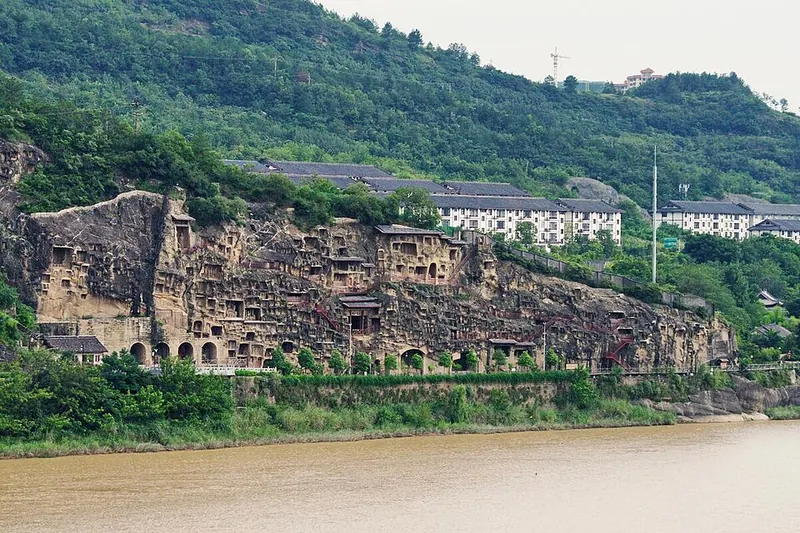
A Palace Museum research team's 2017 field survey calls Qianfoya the largest grotto complex within Sichuan: carving began in the Northern Wei period and continued for nearly 1,500 years across a cliff 45 metres high and more than 200 metres long, in as many as 13 overlapping tiers of niches, though more than half the carvings were destroyed in 1935 when the Sichuan-Shaanxi highway was built through the site. The survey recorded more than 400 surviving niches with over 7,000 statues; a later People's Daily account, in 2025, instead gives 950 niches and over 7,000 statues, along with 118 inscriptions from the Tang to the Qing and more than 30 poems by historical notables.
The Palace Museum survey describes the whole cliff as centred on the Dayun cave, its largest niche, with 234 statues including 148 lotus-Guanyin images on its side walls and a central standing Maitreya figure that, the survey notes, local tradition holds to be an image of the Tang empress Wu Zetian, born in the area then called Lizhou; the survey recounts the tradition that when Wu Zetian took the throne in 690, monks presented her a sutra naming her an incarnation of Maitreya, and that local people accordingly carved this cave with images of both her and Emperor Gaozong. The People's Daily account adds that the site is unusual in combining two nationally protected relics, the rock carvings and the old Jinniu Shu road itself, the latter excavated archaeologically in 2010 and dated to the Ming-Qing period, and that conservation of the site is now overseen by the Guangyuan Grotto Research Institute, formed in March 2023 from the former Huangze Temple Museum and the Qianfoya Stone Carving Art Museum.
What to look for
- The Dayun cave, the site's largest niche, with 234 statues including 148 lotus-Guanyin figures and a central Maitreya statue locally identified with Wu Zetian.
- The rear niche behind the Dayun cave's main image, carrying figures of Emperor Gaozong and Wu Zetian arranged, the survey notes, with the empress on the left and the emperor on the right.
- The old Jinniu Shu road beside the cliff, excavated archaeologically in 2010 and dated to the Ming-Qing period, itself a separately listed national key cultural relic.
- The Sleeping Buddha niche and the Lotus cave among the named niches in the cliff's southern section.
Location & getting there
Getting to Guangyuan Thousand-Buddha Cliff
Check which interiors and courtyards are accessible. Active places of worship and protected monuments may have different visitor rules.
- Search for 千佛崖 with 广元市 and 利州区.
Find Guangyuan Thousand-Buddha Cliff
千佛崖 · 利州区
No reliable map pin yet: search by the Chinese name.
Sources & visit information
The linked sources support the identity and background described in this introduction. Opening hours, admission, activity availability and exact arrival arrangements have not been comprehensively checked. Confirm current visitor information with the venue; the original catalogue locality and editorial review flag are retained.