

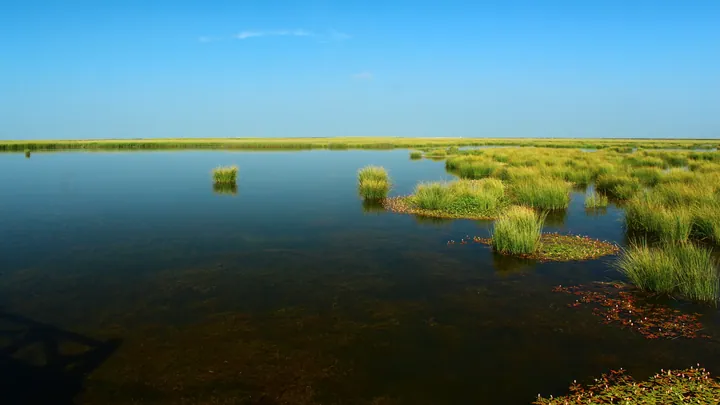
Photo adjustments
Full frame retained; proportionally resized and converted to WebP. No retouching or changes to the photographed subject. Card displays may crop the view.
Explore the region
About Ruo'ergai Flower Lake
On the Re'er Dam three neighbouring lakes sit together: the smallest, Cuo'ergan; the largest, Cuoreha; and Huahu, the one in the middle. The county government describes the Huahu wetland as a key part of the Ruo'ergai Wetland National Nature Reserve and as the Re'er Dam's main catchment area. Global warming and falling groundwater had shrunk Huahu's water area, given as 386 hectares in the late 1970s by the county government and as 286 hectares by a later Ministry of Ecology and Environment case study, down to 215 hectares by 2009; Aba prefecture designated Huahu a wetland restoration pilot, with 10 million yuan in provincial special funds. Construction ran from December 2010 to May 2011, when water impoundment began; by November 2011 the water level had risen 42cm in the dry season and 52cm in the wet season, the catchment area had expanded from 215 to 650 hectares, and 13,382 mu of surrounding semi-marsh and dry marsh had been restored to perennial catchment. Bird numbers resident at the lake doubled after impoundment, and previously scarce species such as the black stork increased.
A 2024 Ministry of Ecology and Environment case study records restoration measures at the lake: 2.86 km of boardwalk and 14,000 square metres of tourist facilities were removed from the wetland buffer zone, a 1,740-metre ecological dam was built, and money was invested in treating ecologically fragile and desertified land and rural sewage across the watershed. For the change in the lake itself the study gives the same figures as the county account — a water-level rise of 0.52 metres and an expansion from 215 to 650 hectares — and it adds that water quality downstream of Huahu exceeded the Grade III surface-water standard and that the lake now supplies about 4.4 billion cubic metres of water to the Yellow River each year. The reserve's principal protected species, the black-necked crane, increased in number from 407 to about 1,000. Both the reserve and the lake are described as a water-conservation and recharge area for the upper Yellow River, a relatively well-preserved plateau peat swamp that the Ministry's case study calls 'the kidney of the earth'.
What to look for
- Huahu itself, the middle one of the Re'er Dam's three neighbouring lakes, the smallest of which is Cuo'ergan and the largest Cuoreha.
- The black-necked cranes, the reserve's principal protected species, whose numbers the Ministry's case study reports rising from an original 407 to about 1,000.
- The restored surrounding marshland, 13,382 mu of semi-marsh and dry marsh returned to perennial catchment during the 2010-11 pilot.
- The 1,740-metre ecological dam recorded in the Ministry of Ecology and Environment's 2024 case study.
Location & getting there
Getting to Ruo'ergai Flower Lake
Check the open visitor route and follow the site’s rules on distance, food and photography. Conservation areas may limit access beyond designated paths.
- Search for 若尔盖花湖 with 阿坝藏族羌族自治州 and 若尔盖县.

Find Ruo'ergai Flower Lake
若尔盖花湖 · 若尔盖县
No reliable map pin yet: search by the Chinese name.
Sources & visit information
The linked sources support the identity and background described in this introduction. Opening hours, admission, activity availability and exact arrival arrangements have not been comprehensively checked. Confirm current visitor information with the venue; the original catalogue locality and editorial review flag are retained.